
Sorry, but your login has failed. Please recheck your login information and resubmit. If your subscription has expired, renew here.
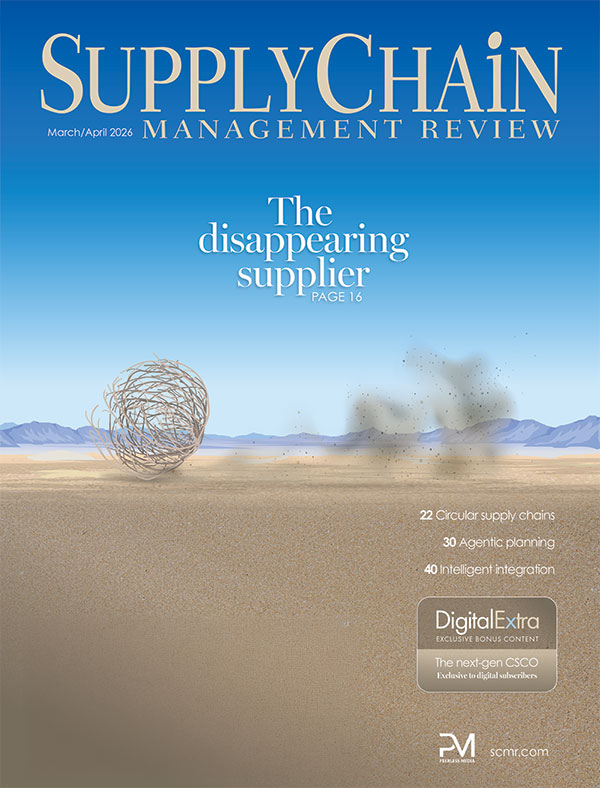
March-April 2026
The March/April 2026 issue of Supply Chain Management Review examines how supply chain leaders are managing supplier risk, circular supply chain design, AI-driven retail planning, CPG network optimization, and shifting LTL market dynamics to improve resilience and performance. Features include frameworks to prevent supplier failure, operationalize circular economy strategies, prevent retail stockouts using AI, and eliminate costly DC transfer patterns, plus insights from the 34th Annual Study of Logistics and Transportation Trends and a digital-exclusive on the evolving CSCO role. Browse this issue archive.Need Help? Contact customer service 1-508-503-1313 More options
When we talk about risk management, we often focus on the physical—weather, tariffs, even cyber. What we don’t usually mention is the risk your suppliers bring if they are not financially sound.
It is one of the hardest truths supply chain leaders continue to confront. Stability is often an illusion. Suppliers that appear financially sound and our strategically aligned can disappear with little warning. That reality is at the heart of this month’s cover story, “Suppliers can evaporate: Five ways to improve SCM risk management,” which offers a practical and at times uncomfortable reminder: risk in supply chains cannot be eliminated, only understood and managed more intelligently.
SC
MR
Sorry, but your login has failed. Please recheck your login information and resubmit. If your subscription has expired, renew here.
March-April 2026
The March/April 2026 issue of Supply Chain Management Review examines how supply chain leaders are managing supplier risk, circular supply chain design, AI-driven retail planning, CPG network optimization, and… Browse this issue archive. Access your online digital edition. Download a PDF file of the March-April 2026 issue.When we talk about risk management, we often focus on the physical—weather, tariffs, even cyber. What we don’t usually mention is the risk your suppliers bring if they are not financially sound.
It is one of the hardest truths supply chain leaders continue to confront. Stability is often an illusion. Suppliers that appear financially sound and our strategically aligned can disappear with little warning. That reality is at the heart of this month’s cover story, “Suppliers can evaporate: Five ways to improve SCM risk management,” which offers a practical and at times uncomfortable reminder: risk in supply chains cannot be eliminated, only understood and managed more intelligently.
In an era of supplier bankruptcies, transportation failures, geopolitical disruption, and financial volatility, the most dangerous posture for supply chain organizations is complacency. As the article outlines, effective risk management today depends on better visibility into supplier health, smarter contracting practices, disciplined insurance and liability controls, and balanced supplier portfolios that emphasize redundancy without sacrificing performance. In short, risk management is no longer a periodic audit exercise, but a continuous leadership discipline.
Moving on from risk, I want to announce that we are introducing a new feature this month. But, it is only available to our digital subscribers. Our first Digital Extra article, “From operations to orchestration: The CSCO’s nexus role in a synergistic C-suite,” explores how the chief supply chain officer has moved from functional executor to enterprise integrator.
As supply chains become the connective tissue linking finance, technology, operations, and customer experience, the CSCO increasingly serves as the orchestrator of enterprise performance—not just a cost or logistics leader.
This Digital Extra is available exclusively to Digital Edition subscribers, and to all subscribers with an active account on scmr.com. We plan to publish several Digital Extra articles throughout the year, allowing us to go deeper into emerging leadership, technology, and organizational issues without the physical constraints found in our print format. So please check that out.
Finally, I’d be remiss not to look ahead. Planning is well underway for the 2026 NextGen Supply Chain Conference, and we are actively seeking practitioner speakers from organizations operating in our four focus areas: logistics and fulfillment, retail, chemicals and pharmaceuticals, and food and beverage. If you are leading real-world supply chain initiatives in these areas and are interested in sharing your experience, I encourage you to reach out directly.
We have also revamped our NextGen awards program for 2026, introducing clearer categories that reflect how supply chains are actually evolving—including Intelligent Transformation, Autonomous Operations, Visionary, Startup, and Partnership in Execution awards for both end users and solution providers. Full details and submission information is available on the NextGen website at nextgensupplychainconference.com, and I encourage you to consider nominating your organization or partners.
SC
MR


More Supply Chain Leadership
- The AI-empowered supply chain leader
- From operations to orchestration: The CSCO’s nexus role in a synergistic C-Suite
- Suppliers may evaporate, but leadership does not
- Leadership turmoil threatens supply chain resilience, Gartner survey finds
- Fixing the misalignment between supply chain leaders and the C-suite
- More Supply Chain Leadership
 Explore
Topics
Business Management News
- What options do you really have? Shaping the supply chain resilience funnel
- Nexus suppliers: Hidden anchors of resilience in decentralized supply chains
- Finding the ROI in supply chain education
- Managing human and AI teams across the supply chain
- Risk sharing is the new advantage in capital project delivery
- The AI-empowered supply chain leader
- More Business Management
Latest Business Management Resources
About the Author
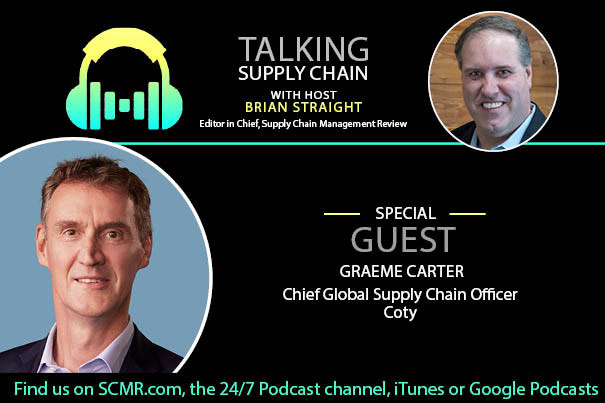
Brian Straight, SCMR Editor in Chief

Brian Straight is the Editor in Chief of Supply Chain Management Review. He has covered trucking, logistics and the broader supply chain for more than 15 years. He lives in Connecticut with his wife and two children. He can be reached at [email protected], @TruckingTalk, on LinkedIn, or by phone at 774-440-3870.
Follow SCMR on social media.
@SupplyChainManagementReview on Facebook
@SCMR on Twitter
SCMR on Linkedin
Subscribe

Supply Chain Management Review delivers the best industry content.

Editors’ Picks



