
The reopening of the Strait of Hormuz is welcome news for global supply chains, but according to Eric Fullerton, vice president of data insights at project44, the industry’s focus should not be on returning to normal. Instead, supply chain leaders should be asking what they learned from the disruption and how they can build more resilient operations before the next crisis arrives.
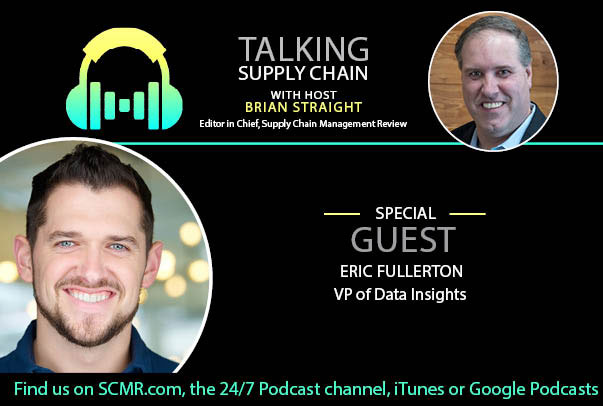
In a recent episode of Talking Supply Chain, Fullerton joined Supply Chain Management Review Editor-in-Chief Brian Straight to discuss project44’s data on shipment diversions, port congestion, supply chain recovery, and what separates organizations that successfully navigate disruptions from those that struggle.
Theme 1: The Strait of Hormuz matters far beyond oil
While much of the public discussion focused on oil prices, Fullerton emphasized that the Strait of Hormuz is a critical artery for global manufacturing and agriculture. The region supports the movement of petrochemical feedstocks, fertilizers, and other raw materials that power supply chains worldwide. Disruptions can ripple far beyond energy markets and affect everything from consumer goods to food production.
Key takeaway: The Strait of Hormuz is not just an energy story. It is a manufacturing, agriculture, and supply chain resilience story.
Key quote: “Yes, it’s about oil. Yes, it’s about gas, but it’s actually about a lot of these downstream raw material components from petrochemicals and into how the world gets fed.”
Theme 2: Recovery is not the same as returning to normal
One of the most surprising findings from project44’s data was that shipment diversions continued increasing weeks after the disruption began. Unlike many supply chain events where impacts peak immediately and then decline, uncertainty surrounding the conflict caused carriers to continually adjust routing decisions. More than 81,000 shipments were ultimately diverted.
Even as the Strait reopens, Fullerton believes many of the routing changes, supplier relationships, and logistics strategies developed during the disruption may remain in place.
Key takeaway: Supply chains are unlikely to simply revert to pre-disruption operating models. Some of the workarounds developed during the crisis may become permanent.
Key quote: “The back to normal is probably the wrong framing.”
Theme 3: The biggest impacts often occur far from the disruption
The discussion highlighted how disruptions rarely remain isolated. While the conflict centered on the Middle East, some of the most significant impacts occurred elsewhere, including severe congestion at ports in India and increased vessel traffic around the Cape of Good Hope. Supply chains felt the effects thousands of miles from the source of the disruption.
Key takeaway: The greatest risks from supply chain disruptions are often the secondary and tertiary effects that emerge across interconnected global networks.
Key quote: “The disruption did not stay in the Middle East and propagated outwards into those Asian port networks.”
Theme 4: Visibility alone is no longer enough
Fullerton argued that the companies that managed the disruption best were not necessarily those with the largest teams or resources. They were the organizations that could immediately identify which shipments, inventory, suppliers, and transportation lanes were at risk and then take action.
That distinction reflects an evolution occurring across supply chain management. Visibility remains essential, but organizations increasingly need decision-support capabilities that help translate data into action.
Key takeaway: The future of supply chain resilience is not simply seeing disruptions—it is understanding their impact and acting quickly.
Key quote: “They weren’t short on people or effort. They were short on signal.”
Theme 5: Resilience starts with knowing your exposure
As the conversation concluded, Straight asked what advice Fullerton would give chief supply chain officers preparing for the next disruption. His answer was straightforward: organizations must be able to instantly understand their exposure when a disruption occurs.
Whether the next event is a geopolitical conflict, a weather disaster, a labor disruption, or a trade dispute, leaders need immediate visibility into at-risk inventory and supply chain flows.
Key takeaway:The most resilient organizations are not those that avoid disruption—they are the ones that can quickly assess risk and respond with confidence.
Key quote: “I want to know what our risk exposure is to in-transit inventory instantly, not days.”
Final thought
Perhaps the most important lesson from the Strait of Hormuz disruption is that supply chains are entering an era of what Fullerton described as the “never normal.” Geopolitical uncertainty, trade policy shifts, climate events, and transportation disruptions are becoming persistent features of the operating environment rather than isolated incidents. Organizations that invest in visibility, decision-making, and response capabilities today will be better positioned to navigate whatever disruption comes next.
This wasn’t ultimately a story about the Strait of Hormuz. It was a reminder that resilience is no longer measured by how quickly a company returns to normal, but by how effectively it adapts when normal changes.
Subscribe to the Supply Chain Management Review podcast
Sign up today and get the next podcast episode sent to you. Subscribe via Apple and Google Podcasts or choose another podcast platform. Subscribe via RSS or download an MP3 or media file.Latest Supply Chain Management Review podcast episodes
Here are a few of our latest podcast episodes.- Talking Supply Chain: Building the Supply Biome.
- Talking Supply Chain: Moving from AI pilot to execution with AWS’ Petra Schindler-Carter.
- Talking Supply Chain: How logistics leaders are winning in volatile times.
- Talking Supply Chain: AI and the new trade barrier.
- Talking Supply Chain: Rethinking supplier relationships.
- Talking Supply Chain: Cargo theft’s new era.
SC
MR

Subscribe

Supply Chain Management Review delivers the best industry content.

Editors’ Picks



