
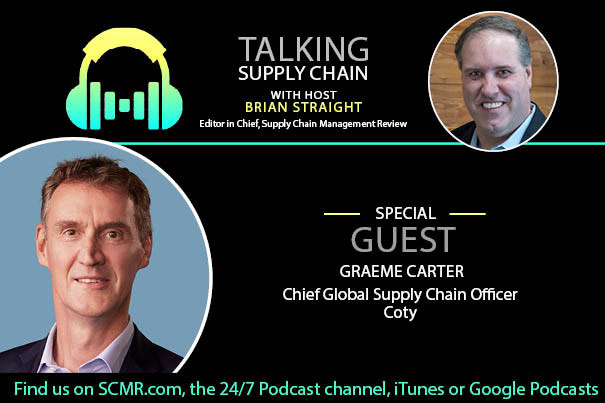
For decades, supply chains were managed as a series of interconnected but largely independent functions. Planning, sourcing, manufacturing, logistics, and fulfillment each operated with their own objectives, metrics, and decision-making processes. But according to Graeme Carter, chief global supply chain officer at Coty, that model is no longer sufficient in a world defined by volatility, geopolitical uncertainty, rapidly changing consumer preferences, and accelerating digital transformation.
On this episode of Talking Supply Chain, Carter introduces the concept of the “Supply Biome”—an adaptive, interconnected ecosystem that continuously senses signals from across the business environment and responds in near real time. Drawing on leadership experience at Coty, Amazon, Unilever, Avon, and Procter & Gamble, Carter explains why supply chains must evolve beyond linear processes and siloed functions toward operating models enabled by AI, collective sensing, and integrated decision-making.
Founded in Paris in 1904, Coty is one of the largest global beauty companies with a portfolio that includes more than 60 brands or brand licenses and $5.9 billion in revenues across 120 countries.
The discussion explores how Coty is using AI-driven demand planning, social listening, and digital transformation initiatives to improve forecasting accuracy, reduce complexity, and create a more agile organization. Carter also offers practical guidance for supply chain leaders seeking to prepare their organizations for an increasingly digital future.
Key themes and takeaways
The supply chain is becoming a ‘Supply Biome’
Traditional supply chains were designed as linear systems focused on moving products from suppliers to customers. Carter argues that today’s environment is far more interconnected. Geopolitical events, labor availability, consumer behavior, competitive activity, economic conditions, and supplier disruptions all interact simultaneously.
Rather than viewing supply chains as chains or even networks, Carter believes leaders should think of them as living ecosystems that continuously adapt to changing conditions.
Key takeaway: The future supply chain is not a linear process but an adaptive ecosystem that continuously senses changes in its environment and adjusts accordingly.
Key quote: “I’m now phrasing that as a Supply Biome, an adaptive system that changes with all the signals coming in and we need to be more adaptive.”
Collective sensing creates competitive advantage
A core component of the Supply Biome is what Carter calls “collective sensing”—the ability to gather and interpret signals from a wide range of internal and external sources before disruptions occur.
These signals can come from consumer searches, social media activity, influencer trends, geopolitical developments, economic indicators, customer behavior, or supplier activity. Organizations that can identify these signals early gain valuable time to respond.
Carter points to recent tariff activity as an example. By monitoring political developments before official announcements, Coty was able to shift production and inventory strategies proactively rather than reacting after changes took effect.
Key takeaway: The companies that respond fastest are often the ones that recognized the signal first—not necessarily the ones with the most resources.
Key quote: “The supply chain needs to be reaching what I call collective sensing, trying to understand the signals.”
Breaking down functional silos is essential
Many organizations still operate with separate planning, procurement, manufacturing, and logistics teams that optimize their own objectives. Carter believes this fragmented approach prevents companies from achieving true agility.
Using the human body as an analogy, he explains that every function must respond simultaneously to changing conditions. If one function reacts while others lag behind, organizational performance suffers.
The ability to connect functions through data, shared information, and coordinated decision-making becomes critical to creating a responsive operating model.
Key takeaway: Supply chain performance improves when functions act together rather than optimizing independently.
Key quote: “In our organic biome, we want all of those parts of the body to react simultaneously.”
Metrics must shift from internal performance to customer outcomes
Carter believes many traditional supply chain KPIs measure internal activities rather than actual business outcomes. Instead of focusing on metrics such as production adherence, internal fill rates, or material delivery performance, organizations should increasingly align around customer-centric measures.
At Coty, the emphasis is moving toward service as measured by customers and ultimately product availability, where consumers make purchasing decisions.
Key takeaway: The most important supply chain metric may not be internal efficiency—it may be whether the product is available when the consumer wants to buy it.
Key quote: “Arguably, the only metric that matters is on-shelf availability where we and the retailers actually make the money.”
AI enables the Supply Biome—but doesn't create it
While AI is often positioned as the answer to supply chain transformation, Carter sees it as an enabler rather than the foundation. Coty’s approach started with simplification, standardization, and centralization. Only after processes and systems were streamlined did the company deploy AI-enabled planning capabilities.
According to Carter, organizations that attempt to deploy AI before simplifying operations often struggle to generate value.
Key takeaway: AI delivers the greatest value when built on standardized processes, unified systems, and strong operational foundations.
Key quote: “We didn’t start with the planning tool and say, ‘Look at our shiny new tool.’ We started with simple, standard, central, and then the digital capability enabled the new operating model.”
Human judgment remains critical
Despite significant advances in AI forecasting and planning, Carter does not envision a fully autonomous supply chain anytime soon. At Coty, AI models help generate forecasts and identify patterns, but supply chain professionals remain responsible for validating outputs, applying contextual knowledge, and making final decisions.
The company’s planners have evolved from “spreadsheet administrators” into “orchestrators of AI-generated insights.”
Key takeaway: The most effective AI deployments augment human decision-making rather than replace it.
Key quote: “People are absolutely essential to the process.”
AI is transforming demand planning
One of Coty’s most significant AI initiatives involves demand forecasting. The company consolidated six planning systems into a single platform and implemented AI-enabled forecasting capabilities through o9 Solutions. The system combines traditional statistical forecasting with AI models that incorporate signals from social listening, influencers, retailers, and market activity. The result is improved forecast accuracy, reduced bias, and more efficient planning processes.
Key takeaway: AI delivers the greatest forecasting value in volatile, rapidly changing demand environments where traditional historical models struggle.
Key quote: “The volatile is where the AI brings new and better insights for the humans to then make the choice.”
Three priorities for supply chain leaders
As organizations prepare for the next phase of digital transformation, Carter recommends focusing on three foundational priorities:
- Fix your data: AI is only as effective as the information feeding it.
- Simplify before you digitize: Standardized processes and systems create the foundation necessary for scaling digital capabilities.
- Invest in people: Digital transformation ultimately depends on workforce readiness.
Final Thought
While much of the current AI conversation focuses on automation and productivity, Carter’s vision points toward something broader. The real opportunity may not be creating autonomous supply chains but building adaptive organizations capable of sensing, learning, and responding faster than ever before.
In that future, success will depend less on individual technologies and more on the ability to connect data, processes, people, and decision-making into what Carter describes as a living, evolving “Supply Biome.”
Subscribe to the Supply Chain Management Review podcast
Sign up today and get the next podcast episode sent to you. Subscribe via Apple and Google Podcasts or choose another podcast platform. Subscribe via RSS or download an MP3 or media file.Latest Supply Chain Management Review podcast episodes
Here are a few of our latest podcast episodes.- Talking Supply Chain: The Strait of Hormuz is open, but normal is not near.
- Talking Supply Chain: Building the Supply Biome.
- Talking Supply Chain: Moving from AI pilot to execution with AWS’ Petra Schindler-Carter.
- Talking Supply Chain: How logistics leaders are winning in volatile times.
- Talking Supply Chain: AI and the new trade barrier.
- Talking Supply Chain: Rethinking supplier relationships.
SC
MR

Subscribe

Supply Chain Management Review delivers the best industry content.

Editors’ Picks



