
Sorry, but your login has failed. Please recheck your login information and resubmit. If your subscription has expired, renew here.
July-August 2026
The July issue of Supply Chain Management Review explores how organizations are preparing for the future through workforce development, AI adoption, leadership education, and supply chain resilience. Features examine closing the skills gap, building AI-enabled teams, strengthening supplier networks, and developing practical strategies for navigating disruption in an increasingly complex global marketplace. Browse this issue archive.Need Help? Contact customer service 1-508-503-1313 More options
Supply chain teams operate in environments where conditions can change by the hour (or faster). Forecasts shift. Suppliers miss deadlines. Inventory levels fluctuate. Operational priorities evolve constantly across planning, procurement, manufacturing, and logistics functions.
To keep pace, many organizations are embedding AI directly into their workflows. AI-driven systems increasingly help teams monitor operations, identify risks, surface recommendations, and respond to changing conditions in near real time.
SC
MR
Sorry, but your login has failed. Please recheck your login information and resubmit. If your subscription has expired, renew here.
Supply chain teams operate in environments where conditions can change by the hour (or faster). Forecasts shift. Suppliers miss deadlines. Inventory levels fluctuate. Operational priorities evolve constantly across planning, procurement, manufacturing, and logistics functions.
To keep pace, many organizations are embedding AI directly into their workflows. AI-driven systems increasingly help teams monitor operations, identify risks, surface recommendations, and respond to changing conditions in near real time.
While many organizations are moving quickly to integrate AI in these ways, they are not always building the readiness needed to support it effectively. Gaps in operational and workforce readiness make it harder for organizations to scale AI effectively, coordinate responses across functions, and maintain trust in AI-supported decisions.
The sections that follow examine where gaps are emerging and outline practical steps supply chain leaders can take to strengthen foundational processes, improve cross-functional collaboration, and prepare employees to work effectively alongside AI-supported systems.
AI is changing how supply chain teams operate
Many supply chain organizations have moved beyond treating AI as a standalone productivity tool. Instead, they are increasingly embedding AI into operational workflows that span planning, procurement, manufacturing, logistics, and inventory management.
Related Infographic: Coordinating AI-enabled supply chain operations
That shift is especially apparent in planning and forecasting activities. Organizations are increasingly using AI to support demand forecasting, inventory optimization, spend analysis, and scenario planning. APQC research shows that these efforts are already driving measurable gains: Organizations report a 30% improvement in forecast accuracy and a 20% reduction in excess inventory from AI-driven optimization and automation initiatives (Figure 1).
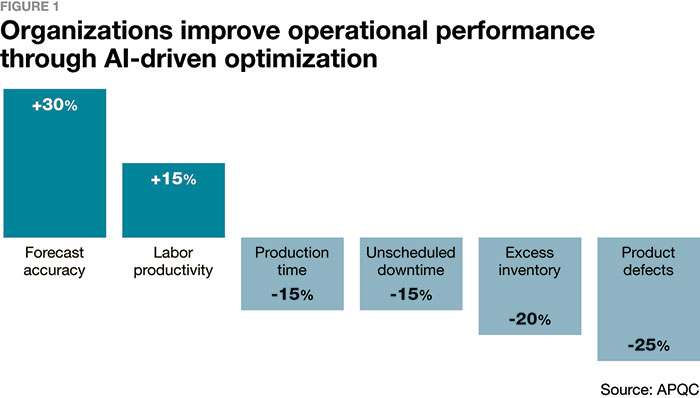
APQC research finds that organizations are also embedding AI into operational processes like predictive maintenance, warehouse automation, manufacturing operations, and production scheduling. Organizations using AI-driven optimization and automation report a 25% reduction in product defects, a 15% reduction in unscheduled downtime, and a 15% increase in labor productivity (Figure 1).
These use cases reflect a broader shift in how supply chain work gets coordinated across functions. As organizations integrate AI more deeply across interconnected processes and teams, operational effectiveness increasingly depends on the strength of underlying data, governance structures, and cross-functional collaboration.
Many organizations still lack foundations necessary to support AI
While the benefits of AI for supply chain are clear, many organizations are implementing AI tools and systems faster than they are building the operational foundations needed to support them effectively.
APQC research suggests significant readiness gaps remain:
- more than one-third of organizations still lack access to real-time manufacturing data;
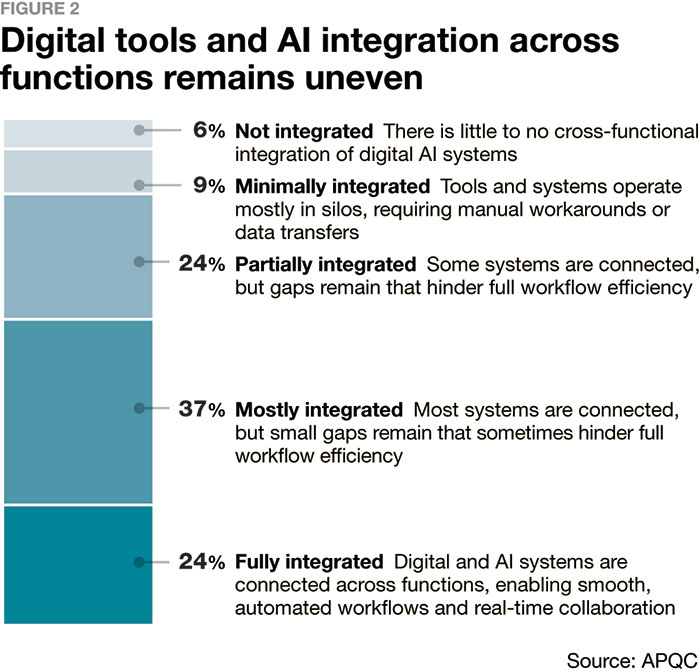
- only 24% report fully integrated digital tools and AI capabilities (Figure 2); and
- only 21% consider themselves very prepared to adopt new technologies with strong business process support.
Organizations also continue to struggle with broader operational and governance challenges:
- 53% cite lack of collaboration across functions and external partners as a major obstacle
- 49% identified the implementation of new technologies as a significant challenge
- 35% struggle with governance gaps and poor data management
These gaps matter because AI-supported workflows depend on consistent processes, reliable data, cross-functional collaboration, and clear decision ownership. Without those foundations, organizations may struggle to coordinate decisions across functions or maintain trust in AI-supported operational decisions.
Operational readiness checklist
To strengthen operational readiness for AI, supply chain leaders should begin by evaluating the workflows, governance structures, and operational processes that support AI-enabled decision-making.
Over the next 30 days:
- identify at least one workflow where AI already influences operational decisions;
- assess whether that workflow has standardized processes and clear decision ownership;
- identify gaps in data visibility, system integration, or real-time operational reporting;
- review where employees still rely on spreadsheets, manual workarounds, or disconnected systems to coordinate work; and
- establish clear governance for how teams validate, escalate, and intervene on AI-generated recommendations.
Teams need different skills for AI-enabled operations
Supply chain employees increasingly need to understand how to work effectively within AI-enabled systems and processes. Beyond simply learning how to use new tools, they need to understand how AI-supported decisions affect other teams, suppliers, and broader supply chain activities and when human collaboration and judgment are still required.
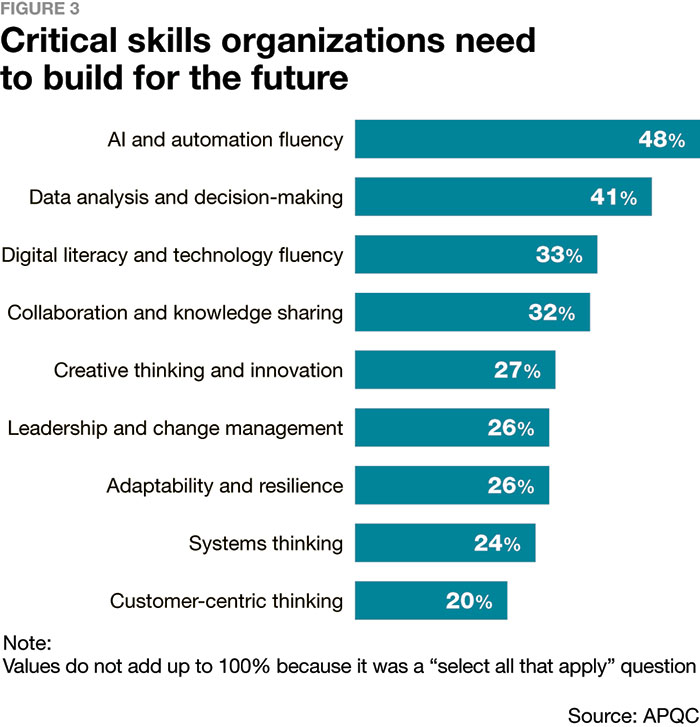
That shift changes the skills organizations need across supply chain teams. APQC research finds that organizations should not only prioritize technical capabilities such as AI fluency, data analysis, and data-driven decision-making, but also interpersonal skills like collaboration and knowledge sharing, leadership and change management, and adaptability (Figure 3).
These skills matter because supply chain operations rarely involve purely technical decisions. Employees must continuously balance cost, service, resilience, supplier relationships, customer expectations, and operational risk while working alongside AI-supported systems. That means everyone—from procurement leaders and managers to frontline employees—need clear guidance on when to trust AI-generated recommendations, when to validate outputs, and when human intervention is necessary.
Workforce readiness priorities
Once organizations begin strengthening operational foundations, leaders also need to prepare employees to work effectively within AI-enabled workflows. Over the next 60 days to 90 days:
- map one AI-supported workflow and identify where employees are expected to review, approve, escalate, or override AI-generated recommendations;
- define which operational decisions remain human-led and which can be handled primarily through AI-supported processes;
- identify where cross-functional collaboration becomes critical when AI surfaces disruptions, exceptions, or conflicting recommendations;
- build escalation procedures for situations where AI recommendations conflict with operational realities, supplier constraints, or customer requirements;
- hold cross-functional reviews of AI-supported workflows so employees understand how operational decisions affect upstream teams, downstream operations, suppliers, and customers; and
- update training and onboarding programs to reflect how operational responsibilities change inside AI-enabled workflows.
AI changes the management challenge
As AI becomes more deeply embedded into planning, execution, and operational decision-making, supply chain leaders are increasingly managing teams that include both people and AI-supported systems.
In light of that shift, supply chain leaders will need to think differently about how operational decisions are made, how teams collaborate across functions, and how to oversee accountability, escalation, and exception handling across interconnected workflows.
AI may accelerate analysis, monitoring, and responsiveness, but supply chain operations still depend on human judgment, collaboration, and relationships. The challenge for leaders now is learning how to manage environments where people and AI systems work together across interconnected processes that span the supply chain.
Data in this content was accurate at the time of publication. For the most current data, visit apqc.org.
About APQC
APQC (American Productivity & Quality Center) is the world’s foremost authority in benchmarking, best practices, process and performance improvement, and knowledge management (KM). With more than 1,000 member organizations worldwide, APQC provides the information, data, and insights organizations need to support decision-making and develop internal skills.
APQC’s Resource Library content leverages data from multiple sources. The Open Standards Benchmark repository is updated on a nightly cadence, whereas other data sources have differing schedules. To provide as much transparency as possible, APQC will always attempt to provide context for the data included in our content and leverage the most up-to-date data available at the time of publication.
SC
MR


More Human-Robot Collaboration
 Explore
Topics
Business Management News
- Innovators Netstock, Pickle Robot win NextGen Solution Provider awards
- Bigger trucks versus broken bridges and roads
- From salon to dock door: Repurposing scheduling software for inbound flow
- The biggest barrier to AI in supply chains isn’t technology
- Rebuilding a planning function around the physical world
- Why companies blame the wrong supplier … and miss the real failure
- More Business Management
Latest Business Management Resources
About the Author
Marisa Brown, Senior Principal Research Lead

Marisa Brown is senior principal research lead, supply chain management, APQC.
Follow SCMR on social media.
@SupplyChainManagementReview on Facebook
@SCMR on Twitter
SCMR on Linkedin
Subscribe

Supply Chain Management Review delivers the best industry content.

Editors’ Picks



