
Editor’s note: This is the final installment of a three-part series on manufacturing risk appearing on scmr.com. You can read part one here, and part two here.
A failure occurs. Components begin failing at a higher-than-expected rate. Production is affected. Customers escalate. A formal investigation is launched—and the first question sounds deceptively simple: Which supplier is responsible?
That question is a trap. You are searching only where your ERP can see.
In practice, the supplier identified at the end of an investigation is often not the source of the failure. It is the last node the system can trace.
In the MLCC case described in Part 1 of this series, the initial conclusion pointed to a supplier. Documentation linked the failed components to a specific vendor. The vendor was flagged. The relationship was reviewed. On paper, the conclusion looked complete. In reality, it explained very little.
The failure did not originate at the supplier level. It entered earlier—in a fragmented transaction layer (brokers, re-packagers, and secondary aggregators operating between authorized distribution and the buyer) where component lots were aggregated, repackaged, and reintroduced. By the time the components reached the supplier recorded in the ERP system, the issue was already embedded in the lot.
The investigation identified where the components were booked. Not where they changed.
Most investigations follow a predictable path: tracing the component through procurement records, identifying the supplier tied to the transaction, confirming documentation, and assigning responsibility. Each step follows the evidence. The conclusion follows the system—which is exactly the problem. Because the system being interrogated is the same system that failed to detect the issue.
Your ERP knows who you paid. It does not know where the lot actually came from.
The difference between the actual path of a component lot and what the procurement system records is illustrated in Figure 1. Each layer of the supply chain that the lot passes through without documentation becomes invisible to any subsequent investigation.
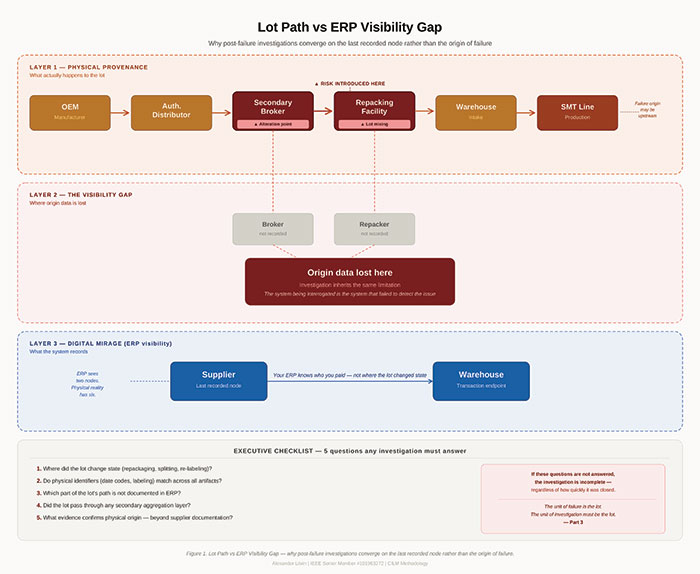
As a result, investigations converge on the most visible point in the chain—not the most relevant one. This creates a false sense of resolution. The supplier is replaced. Controls are tightened. Procurement marks the issue as closed, while the risk continues to circulate in the system. And the same pattern returns under a different supplier name.
The underlying issue is not a weak investigation; it is a mismatch between how failures occur and how they are analyzed.
Component-level failures do not follow supplier boundaries. A single lot can move through multiple layers, from manufacturer to distribution, through secondary aggregation and repackaging, and back into circulation. At each step, visibility degrades. By the time the lot appears in your ERP, part of its history is already gone. When that lot fails, the investigation inherits the same limitation: it can only analyze what was recorded.
This is why supplier-level blame is so persistent. It is supported by the data that is easiest to access. And that is exactly why it is often wrong.
What a real investigation requires
It does not stop at the supplier. It reconstructs the path of the lot—not just where it was purchased, but where it was handled, split, repackaged, or mixed. That data does not sit in one system. It has to be assembled across multiple sources: inbound warehouse logs, packaging and inspection archives, customs and logistics documentation, supplier-side traceability where available, and independent industry databases such as ERAI or GIDEP.
Part 1: The hidden supply chain risk no dashboard shows
Part 2: When component verification becomes operational
It is slower, and it is the only method that reaches past the last visible node.
Why the wrong conclusion is dangerous
Blaming the wrong supplier does not just close the case incorrectly. It resets the system in the wrong direction. As soon as the market tightens again—availability drops, pressure increases—the same secondary channels return with the same blind spot. But now with more confidence. This is how failures become cyclical.
The lesson is not that suppliers are irrelevant. They remain critical. But they are not at the level at which all risk can be understood. The unit of failure is the lot. The unit of investigation must be the lot.
Without that shift, organizations will continue to detect failures late, assign responsibility incorrectly, implement controls that do not address the cause and repeat the same failure under different names.
Executive checklist: breaking the cycle
If your organization wants to stop repeating the same failures, the investigation process must answer five questions—every time:
- Where did the lot change state (repackaging, splitting, re-labeling)?
- Do physical identifiers (date codes, labeling formats) match across all artifacts?
- Which part of the lot’s path is not documented in ERP?
- Did the lot pass through any secondary aggregation layer?
- What evidence confirms physical origin—lot traceability records, manufacturer authentication, or independent database verification?
If these questions are not answered, the investigation is incomplete, regardless of how quickly it was closed.
That requires effort, slows decisions, and produces answers that are harder to act on. The distinction matters because it changes what you do next.
Your job is to prevent the next one.
About the author
Alexander Litvin is a supply chain executive with 27 years of experience in electronic component distribution. He is an IEEE Senior Member and the originator of the CILM (Component Integrity & Lifecycle Management) methodology. He may be reached at [email protected].
SC
MR


More Risk Mitigation
- Why companies blame the wrong supplier … and miss the real failure
- Supply chain resilience isn’t a data problem; it’s a judgment problem
- Why your supply chain risk management plan will fail
- What options do you really have? Shaping the supply chain resilience funnel
- Nexus suppliers: Hidden anchors of resilience in decentralized supply chains
- More Risk Mitigation
What's Related in Risk Mitigation
 Explore
Topics
Procurement & Sourcing News
- When component verification becomes operational
- Caught between a rock and a hard place: Mapping your supply chain
- What options do you really have? Shaping the supply chain resilience funnel
- Nexus suppliers: Hidden anchors of resilience in decentralized supply chains
- Lead time economics: What semiconductor supply chains reveal about strategic planning
- Risk sharing is the new advantage in capital project delivery
- More Procurement & Sourcing
Latest Procurement & Sourcing Resources
Subscribe

Supply Chain Management Review delivers the best industry content.

Editors’ Picks



