
Sorry, but your login has failed. Please recheck your login information and resubmit. If your subscription has expired, renew here.
July-August 2026
The July issue of Supply Chain Management Review explores how organizations are preparing for the future through workforce development, AI adoption, leadership education, and supply chain resilience. Features examine closing the skills gap, building AI-enabled teams, strengthening supplier networks, and developing practical strategies for navigating disruption in an increasingly complex global marketplace. Browse this issue archive.Need Help? Contact customer service 1-508-503-1313 More options
The fate of a capital project is often sealed long before the biggest problem appears on site. The outcome is driven in large part by the delivery model, where incentives, decision rights, and commercial pressure determine how the team responds when conditions shift. Traditional contracts often load risk onto one party, which can be effective where scope is stable and execution risk is low.
In less predictable environments, that structure can strain coordination and slow recovery. With capital spending at record highs, companies need contracts that share risk, reward, and accountability between both parties.
SC
MR
Sorry, but your login has failed. Please recheck your login information and resubmit. If your subscription has expired, renew here.
The fate of a capital project is often sealed long before the biggest problem appears on site. The outcome is driven in large part by the delivery model, where incentives, decision rights, and commercial pressure determine how the team responds when conditions shift. Traditional contracts often load risk onto one party, which can be effective where scope is stable and execution risk is low.
In less predictable environments, that structure can strain coordination and slow recovery. With capital spending at record highs, companies need contracts that share risk, reward, and accountability between both parties.
Capital project delivery faces unprecedented capacity constraints
A wave of capital investment is straining engineering, construction, and equipment markets across industries. In North America alone, data center spending is projected to approach $3 trillion by 2029, with power, grid, manufacturing, and logistics investments rising as well (see Figure 1).
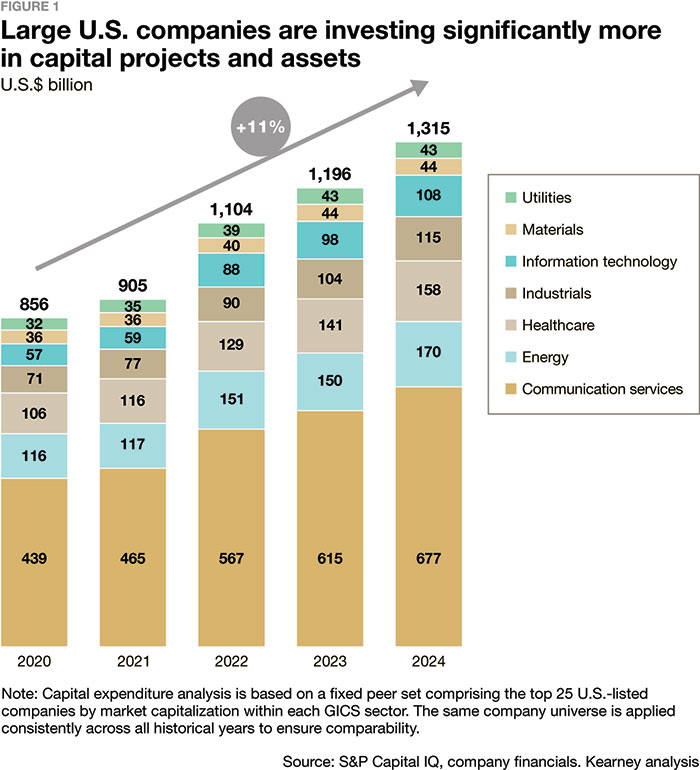
Delivery capacity has not kept pace. Companies that once counted on top-tier engineering and construction teams now compete for the same limited resources. Even when staffing targets are met, expertise is often uneven, and turnover is high. Companies can no longer assume they will get the same depth of talent from engineering, procurement, and construction management (EPCM partners) that they relied on for decades.
How risk allocation shapes owner-contractor collaboration
More than 80% of large capital projects run materially over budget. Most do not fail because of bad luck. They fail because planning is weak, governance falters, and execution breaks down.
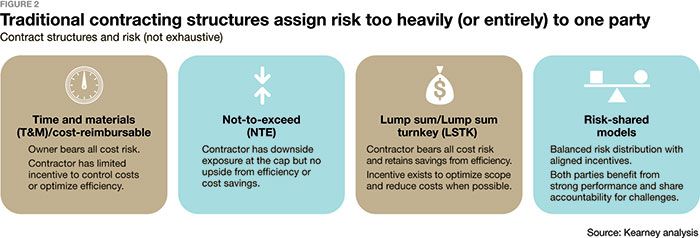
Traditional contracts often make that worse by placing too much risk, sometimes all of it, on one side of the deal (see Figure 2). Under fixed-price and not-to-exceed (NTE) contracts, contractors absorb that risk, and, under time-and-materials (T&M) contracts, owners do. That split can erode the shared incentives that complex projects require, causing manageable issues to sit unresolved until they become formal escalations. At that point, attention often shifts from solving the problem to assigning blame. This cycle is corrosive, especially when alignment matters most.
How much this hurts depends on the project. In repeatable settings, with mature designs, proven technology, experienced contractors, and stable supply markets, traditional contracts can still deliver predictable results.
But uncertainty changes everything. New technology, unfamiliar locations, first-time contractor relationships, tight supply markets, and compressed schedules all make coordination harder and leave less time to respond. In those conditions, project performance depends not just on the contract but on how risk is shared and how information moves during execution.
From risk transfer to shared outcomes
Risk-sharing contracts bind owners and contractors to the same outcome from early planning to final delivery. Instead of pushing risk across a contractual line, they spread both risk and reward across the table. That changes not just who is accountable, but how the work gets done.
The point is not only to limit downside. It is to improve execution. In a tight market, the projects that move first, secure capacity, attract talent, and work through supply bottlenecks gain an edge. Better execution lifts contractor profits and improves owner returns. It rewards speed, judgment, and capability, not just caution.
But the model works only if both sides commit early. Risk-sharing is most effective when contractors come in during feasibility and concept development, while important technical choices are still in play. That is when incentives can still shape outcomes. Early involvement also helps build the habits of collaboration that strong execution requires.
These contracts ask more of both sides upfront. Teams spend more time aligning on design readiness, sequencing, and market exposure before commitments are locked in. They identify risks earlier because the incentives favor candor over concealment.
They can also help solve a growing talent problem. When incentives and accountability are aligned, contractors have more reason to preserve continuity, rethink retention, and reduce the need for long relocations. Some roles can move to the owner after completion, creating career paths that help attract scarce specialists. In a market where expertise is limited and unevenly spread, that continuity matters.
The results are tangible. Across more than 300 risk-shared infrastructure and industrial projects, representing about $60 billion in capital spending, failure rates stayed low and project outcomes improved by several percentage points. Much of that lift came from resolving issues earlier and speeding up shared decisions before they disrupted delivery.
Contracting strategy is now a value lever
Traditional contracts still work when the basics are in place: mature designs, proven technology, ample supply, and manageable schedules. Even then, the best model depends on the job. Fixed-price contracts suit capable contractors, while cost-based models fit owners who need close control or bring critical expertise. In more mixed conditions, risk-sharing works best because it keeps both sides accountable for the outcome (see Figure 3).
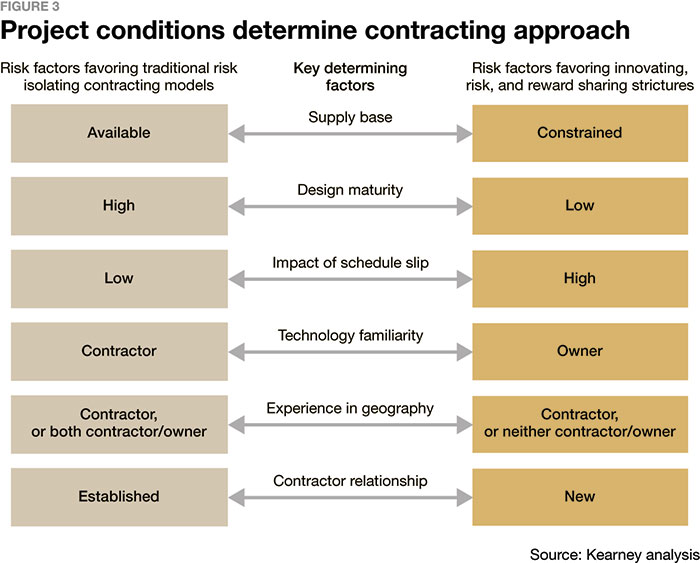
That logic becomes more important as risks begin to stack up. When projects involve new technology, unfamiliar locations, tight schedules, or constrained supply, there is less room to recover when problems arise. At the same time, surging demand in infrastructure, power, and technology has intensified the strain, especially in markets where labor and delivery capacity are already tight. In those conditions, traditional contracts are more likely to miss on cost, timing, or quality, driving up owner costs or forcing contractors to build in more contingency.
The strategic case for risk-sharing contracts
Execution is becoming the decisive variable in capital project delivery. Record investment in data centers and infrastructure is straining delivery capacity and exposing the limits of traditional contracts.
Risk-sharing works because it aligns incentives around performance and gives both parties a direct stake in the same outcome. That shared exposure tends to bring stronger teams to the work, speed up decisions, and reduce the procedural friction that builds when each side is protecting its contractual position. Over time, the effect is cumulative and shows up where it matters most, in stronger execution.
About the authors
Neal Walters is a Kearney partner focused on large-scale manufacturing transformations and can be reached at [email protected].
Bill Duffy is a Kearney partner focused on performance transformation and value creation in the oil and gas industry and can be reached at [email protected].
SC
MR


More Capital Investments
 Explore
Topics
Procurement & Sourcing News
- Innovators Netstock, Pickle Robot win NextGen Solution Provider awards
- From salon to dock door: Repurposing scheduling software for inbound flow
- The biggest barrier to AI in supply chains isn’t technology
- Rebuilding a planning function around the physical world
- Why companies blame the wrong supplier … and miss the real failure
- NextGen Supply Chain Conference unveils agenda focused on AI, execution and the future of leadership
- More Procurement & Sourcing
Latest Procurement & Sourcing Resources
Subscribe

Supply Chain Management Review delivers the best industry content.

Editors’ Picks



