
When inbound flow goes wrong, you see it in the yard before you see it on a dashboard. Trucks queue at the gate, security logs them on paper, and the morning goes to sorting which load belongs where while the next shift’s plan slips. The yard becomes a buffer for everything the schedule didn’t anticipate.
That was the situation at an industrial manufacturer running high-volume inbound receiving. The facility needed yard scheduling, and it needed it in weeks. A purpose-built yard management system wasn’t viable in that window. Procurement for enterprise yard systems runs 6 to 12 months from proposal to go-live, plus integration with the existing transportation management system (TMS), warehouse, and enterprise resource planning layers. The clock didn’t allow it.
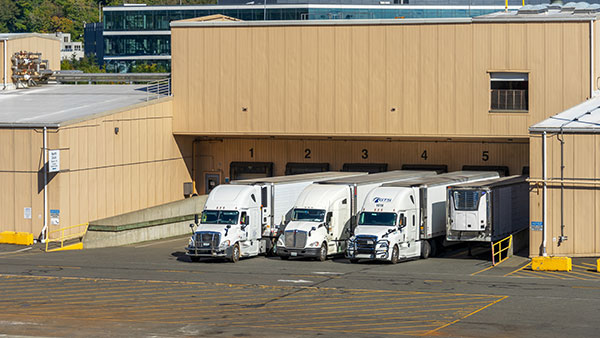
The pre-state was hard to live with. More than 40 trucks queued on the apron on busy mornings. There was no slot discipline, no schedule shared between operations and supply chain. No one saw what was inbound until trucks pulled up. Detention exposure ran into five figures weekly. Arrivals spiked to four or five times the steady-state baseline, a feast-or-famine pattern of dock congestion one hour and dock starvation the next.
Three teams ran the orchestration in silos: security at the gate, operations at the dock, supply chain doing the planning. When the upstream bottleneck went down, operations told security to stop letting trucks through, and supply chain heard about it from drivers calling about overnight stays. Gate congestion turned into disruption inside the plant.
The structural mapping
The path forward came from an unexpected direction. We stopped looking at yard management systems and started looking for any tool that could hold a schedule and let several parties see it. Microsoft Bookings, the consumer scheduling tool packaged with Microsoft 365 Business Standard, kept surfacing.
Bookings is built for service businesses: hair salons booking stylist time, dental practices booking chair time, consultants booking 30-minute slots. The data model is simple. Resources are configured as staff, bookable services as services. A customer selects a service, sees available slots across the staff who deliver it, and books one.
The mapping to an industrial load was direct. A dock door is a resource the way a stylist’s chair is a resource, so each dock door becomes a staff member. A trailer type is a service category the way a haircut is, so each trailer type becomes a service. For us, the customer in that model is the carrier or operations user requesting a slot. The booking discipline that runs a salon’s calendar is the same one a yard needs.
That was the structural translation. Once the mapping was clear, the rest was configuration. We built a small prototype to confirm Bookings’ calendar logic could carry industrial scheduling without breaking, and it answered in days. From there, we drove the scale-out into production. The mapping and prototype came together over those days; the rollout and cross-functional adoption took the next three weeks.
The deployment
Three weeks separated prototype validation from production go-live, in late winter heading into spring. The configuration choices made in that window decided whether the system held under load.
Visibility came first. We wanted operations, supply chain, security, and headquarters on the same schedule. Tying resources to shared service-account calendars in Outlook broke Bookings’ sync, and tighter read-only permissions didn’t fix it. The resolution was to tie staff resources to dummy email accounts that matched no real person, then give users visibility another way. They added Bookings to Outlook as an app, and with at least a viewer role, the day’s calendar appeared inside Outlook.
We had four physical doors but defined two resources at launch, one for the 53-foot door and one for the 48-foot doors, compensating with more bookings per hour on each. Two services, one per resource, held carriers to the trailer type they had booked, which mattered in winter when doors stayed closed most of the time. As the weather warmed, we collapsed the two into a single “any” service on one combined resource, carrying both booking-rate allowances since the physical constraints were unchanged.
Permissions carried more weight than expected. Bookings has four roles; we used three. Most users got viewer, read-only. Administrator stayed tight, local supply chain leaders only, since administrators can make sweeping changes. Scheduler went to headquarters staff who adjusted appointments or booked on a carrier’s behalf. External carriers booked through the public link Bookings generates, which has no approval gate, so operations checked the calendar daily against the inbound manifest for wrong trailer types or duplicates.
The toughest transition was at the gate. We were asking security to enforce a queue from an unfamiliar system, while dispatchers new to the form often filled it out wrong, leaving security to validate against incomplete data while drivers waited. We sat with them for the first few days. To ease the gate longer-term, we added an online safety quiz drivers complete on their phones on arrival, replacing a manual routine of explaining expectations and tracking acknowledgments. A first-day access problem traced to Microsoft licensing on the security accounts; once upgraded, visibility was instant.
What happened
The system produced outcomes 18 days after go-live.
The single-day inbound record fell. The facility took nearly 160 loads in a day against a prior record near 145, and total volume that day, inbound and outbound, topped 270 loads with more than 180 trucks through the gate. All of it ran through four doors, more than 45 trucks per door on the record day.
Operations first thought the scheduler was slowing things down. It wasn’t. The pace looked slow because the team was used to feast-or-famine conditions, so a couple of trucks at check-in felt like underutilization. Across 24 hours, that deliberate pace produced the record. The 40-plus trucks that used to sit on the apron dropped to two or three at steady state, roughly a 90% cut in the congestion operations sees from the floor.
The deployment broke down long-standing silos. Security used to halt inbound whenever upstream operations went down; now they rarely do, as long as the driver is scheduled. Operations learned it needs surge capacity at the dock to absorb upstream downtime without choking inbound flow. Supply chain blocks calendar time directly to recover after unplanned events or to stage maintenance windows on bottleneck operations. The calendar became where anticipated disruption stages before it reaches the floor.
Usage stuck because each group had its own reason for using the tool. Operations got slot discipline. Supply chain got inbound visibility, and security got a verifiable arrival list. No group reverted, and no shadow spreadsheets appeared. We instrumented from go-live, building the analytical layer externally on the booking data, gate timestamps, and detention billing, since Bookings provides none of it. Volume moved immediately; carrier-behavior and detention views fill in as data accumulates.
What we built was not sophisticated software. It was a consumer-grade product configured carefully against the real shape of the operation.
What this approach doesn’t do
The deployment is honest only if its limits are. Microsoft Bookings is not a yard management system, and what we built has to be read alongside what we didn’t.
There’s no real-time integration at the gate. Drivers check in physically, and security verifies the appointment against the calendar by hand. At this scale that held: existing staffing handled more than 180 trucks on the record day without added headcount. Higher volumes would force a different model.
Reporting is minimal. We built the carrier scorecard and detention tracking ourselves on the booking data, gate timestamps, and billing feed. The dock-side handoff to the TMS is still missing and would take additional infrastructure.
There’s a scale ceiling. The configuration works at four doors and a small service count. As resources grow, the calendar interface gets harder to use, and Bookings imposes its own staff and service limits. We wouldn’t recommend it for a high-bay distribution center with 25 doors dispatching across three shifts.
The non-software work doesn’t transfer the way the configuration does. Training, security buy-in, operations’ adoption of buffer strategy, and change-management attention carried the load. The tool didn’t do those things; the team did. The same configuration dropped in without that adoption work would not produce the same result.
What to take from this
Three takeaways for practitioners weighing similar moves.
First, when the deployment window is short and purpose-built tools aren’t viable, look at consumer tools that share a data model with the operational problem. The mapping is the translation; once it’s clear, the configuration follows.
Second, production lives in configuration. The structural insight gets you a viable prototype. The deployment rests on the configuration choices after it, and on the willingness to revisit them when conditions change.
Third, cross-functional adoption is the deployment. Software installs in minutes. Operational discipline takes weeks of standing up the practice with the people who use it.
One closing observation, drawn from this case and others we’ve seen revert: improvised tools tend to stick when the people who carry the compliance cost also receive the value. Each group here had its own reason to use the tool, and the tool delivered on each. We didn’t design around that principle, but in retrospect it’s the structural reason the system held.
About the authors
Bruce Rishel is Principal at Poisson Consulting, LLC, where he focuses on supply chain operations under disruption. He led the structural design and prototype validation for this deployment.
Blake Brownlee is an Industrial Engineer at B2 LLC. He led the production scale-out and cross-functional adoption at the client site.
SC
MR

More Logistics
- From salon to dock door: Repurposing scheduling software for inbound flow
- Penske Logistics jumps into the end-to-end visibility pool as industry options grow
- Amazon opens its supply chain network to everyone
- NextGen Supply Chain Conference 2026 opens speaker submission process
- Quantum logistics unleashed
- More Logistics
What's Related in Logistics
 Explore
Topics
Procurement & Sourcing News
- Why companies blame the wrong supplier … and miss the real failure
- NextGen Supply Chain Conference unveils agenda focused on AI, execution and the future of leadership
- From fragmented negotiations to coordinated negotiation performance: an AI-enabled approach
- Supply chain resilience isn’t a data problem; it’s a judgment problem
- Why your supply chain risk management plan will fail
- When component verification becomes operational
- More Procurement & Sourcing
Latest Procurement & Sourcing Resources

Subscribe

Supply Chain Management Review delivers the best industry content.

Editors’ Picks



