
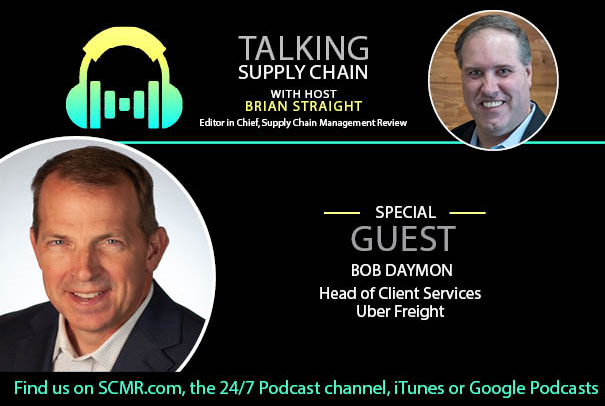
Supply chain disruption is no longer episodic. In this episode of Talking Supply Chain, Bob Daymon, head of client services for Uber Freight, joins host Brian Straight to break down how logistics organizations are adapting to an environment defined by tariff uncertainty, tightening capacity, and compressed planning cycles. The conversation centers on a fundamental shift: companies that win today aren’t the ones with perfect forecasts, they’re the ones that move fastest with imperfect data.
Drawing from Uber Freight’s 2026 Logistics Playbook, Daymon outlines how leading organizations are restructuring planning, embracing real-time decision-making, and building agility into their operating models to stay ahead of volatility.
Key themes & takeaways
The market isn’t just disrupted, it’s structurally unstable
The traditional concept of a “normal” supply chain environment no longer applies. Instead, logistics teams are operating in a state of persistent volatility driven by:
- Ongoing tariff uncertainty and regulatory shifts
- Elevated fuel costs
- Tightening capacity and widening supply-demand gaps
Daymon notes that spot rates are up 25% year-over-year, with no near-term relief expected. Even typically slower periods like April are showing “counter-seasonal tightness.”
Key takeaway: This is not a temporary cycle, it’s a new operating reality.
Key quote: “Tariffs are shifting… capacity is tightening… planning cycles… are now happening in days.”
Speed has overtaken strategy as the differentiator
Planning cycles that once stretched months are now compressed into weeks or even days. Leading organizations are prioritizing incremental improvements over long-term overhauls; making decisions within 30–45 day impact windows; and shifting from governance-heavy processes to faster execution. But speed isn’t just about data, it’s about removing internal friction.
Key takeaway: The constraint isn’t data anymore—it’s decision-making.
Key quote: “They can’t come back with a three to four to five month strategy… there’s a hyper focus on what can we do now.”
The gap is growing between agile and reactive organizations
Daymon describes a widening divide as agile companies that built capabilities during COVID act quickly and use forward-looking signals while reactive companies wait for clarity and let external conditions dictate outcomes. The difference shows up in performance, especially in volatile markets.
Key takeaway: Inaction is now a strategic liability.
Key quote: “Those that don’t have that plan … are kind of waiting … and letting some of those decisions determine their fate.”
“Layered Networks” are replacing static planning models
A key concept from the Uber Freight playbook is the shift to three-layered decision-making that features a strategic layer (annual planning and network design), a tactical layer (Monthly/quarterly adjustments) and an operational layer (Real-time execution decisions).
This model connects planning with execution through continuous feedback loops.
Key takeaway: Supply chains are moving from static plans to dynamic systems.
Key quote: “We’re empowering … operators to make decisions versus taking it back through a governance council.”
Cost reduction isn’t about cutting
Daymon reframes cost reduction as continuous improvement, not short-term cuts, that focuses on flow efficiency, applying lean principles, and eliminates structural waste.
Key takeaway: Sustainable cost control comes from better design, not austerity.
Key quote: “If you just cut cost, that cost always comes back.”
What separates leaders from laggards in 2026
Daymon highlights four key differentiators for organizations in 2026. These include speed + agility in decision-making, continuous and incremental improvement mindset, operational flexibility and redundancy, and strong, strategic carrier relationships. “The differentiator isn’t the one that had the market pegged perfectly, it’s the one that’s got the ability to create agility,” he said.
Listen to the full episode to today to hear these conversations and more.
Subscribe to the Supply Chain Management Review podcast
Sign up today and get the next podcast episode sent to you. Subscribe via Apple and Google Podcasts or choose another podcast platform. Subscribe via RSS or download an MP3 or media file.Latest Supply Chain Management Review podcast episodes
Here are a few of our latest podcast episodes.- Talking Supply Chain: The Strait of Hormuz is open, but normal is not near.
- Talking Supply Chain: Building the Supply Biome.
- Talking Supply Chain: Moving from AI pilot to execution with AWS’ Petra Schindler-Carter.
- Talking Supply Chain: How logistics leaders are winning in volatile times.
- Talking Supply Chain: AI and the new trade barrier.
- Talking Supply Chain: Rethinking supplier relationships.
SC
MR

Subscribe

Supply Chain Management Review delivers the best industry content.

Editors’ Picks



