
Sorry, but your login has failed. Please recheck your login information and resubmit. If your subscription has expired, renew here.
July-August 2026
The July issue of Supply Chain Management Review explores how organizations are preparing for the future through workforce development, AI adoption, leadership education, and supply chain resilience. Features examine closing the skills gap, building AI-enabled teams, strengthening supplier networks, and developing practical strategies for navigating disruption in an increasingly complex global marketplace. Browse this issue archive.Need Help? Contact customer service 1-508-503-1313 More options
Black swans are not rare anymore—they have become a recurring operating condition. Ever since COVID-19 highlighted to the world the dependence of our daily lives on supply chains, resilience is at the forefront of managers’ minds. As a clear illustration, today, 45.4% of companies have a dedicated person responsible for overseeing the running of a resilience program who reports directly to the board, according to the Business Continuity Institute’s 2025 Supply Chain Resilience Report. This board-level attention reflects a simple reality: supply chain disruptions are widely considered inevitable. According to the same institute’s 2024 report, every year, almost 80% of companies experience at least one significant disruption stemming from tier 1 suppliers (50%), tier 2 (23.4%) or even beyond that (9.6%), with many of those having significant financial impact.
SC
MR
Sorry, but your login has failed. Please recheck your login information and resubmit. If your subscription has expired, renew here.
Black swans are not rare anymore—they have become a recurring operating condition. Ever since COVID-19 highlighted to the world the dependence of our daily lives on supply chains, resilience is at the forefront of managers’ minds. As a clear illustration, today, 45.4% of companies have a dedicated person responsible for overseeing the running of a resilience program who reports directly to the board, according to the Business Continuity Institute’s 2025 Supply Chain Resilience Report. This board-level attention reflects a simple reality: supply chain disruptions are widely considered inevitable. According to the same institute’s 2024 report, every year, almost 80% of companies experience at least one significant disruption stemming from tier 1 suppliers (50%), tier 2 (23.4%) or even beyond that (9.6%), with many of those having significant financial impact.
One important reason is that organizations and their supply chains are dispersed, complex and global. A local disruption can cascade across regions, affecting supply, production and customer service far from where the original event occurred. At the same time, global chains typically rely on longer and more complex transportation and distribution networks which add vulnerability through longer and less predictable lead times. In short, both suppliers and logistics networks are exposed to a wider range of risks and, increasingly, several of these risks hit at once, causing simultaneous disruptions due to macro phenomena such as global warming, tariffs, and geopolitical tensions.
Over the past two decades, both academic and practitioner literature have increasingly advised organizations to invest heavily in supply chain resilience. Much of that advice implicitly reads like a checklist: pursue every possible activity that might increase resilience. Many resilience frameworks implicitly suggest that firms should “do everything,” preferably to a high degree. Findings from our study, What Options Do We Have? The Supply Chain Resilience Funnel (Scholten, K., van Donk, D.P. & Boscari, S. (2025) What Options Do We Have? The Supply Chain Resilience Funnel. Journal of Supply Chain Management, 61, 74-105. https://doi.org/10.1111/jscm.12342) and summarized in the following paragraphs, shows that aiming for resilience is not a generic “more is better” goal. Our research shows you cannot and even should not aim for everything, because the resilience options you can realistically build and activate are constrained by your product–process–supply chain (PPS) configuration and by your operating context. When we say that resilience options are constrained by PPS configuration, we simply mean this: the options a firm has in a disruption depend on how its products are designed (e.g., technical specifications and packaging choices), how production is set up (e.g., decisions related to make-to-stock versus make-to-order, equipment, or production footprint), and how the supply chain is configured (e.g., sourcing choices, contractual relationships with suppliers and customers, and network design). In fact, pushing options that are not feasible in the specific organizational context can waste money, and in the worst-case scenario, striving for resilience can become a risk in itself when, for example, the wrong investment options are chosen. In other words, asking the natural question “how do we become resilient?” is not so key, as the question “what options do we really have?”
Surprisingly, although seemingly every manager is talking about and striving for supply chain resilience, it is still ill understood what supply chain resilience actually means. This is illustrated by the words of a service continuity & resilience lead (utilities, UK) in the Supply Chain Resilience Report in 2025, p.13: “Resilience means 100 different things to 100 different people.” These differences relate conceptually to differences in an organization’s reality in terms of its product, process, supply chain and context. As a result, managers often struggle to translate resilience into what it should mean for their own organizational situation.
Taken the above together, managers experience ambiguity and confusion around three interrelated themes:
- What is resilience and how can it be measured?
- How do you know when a supply chain is resilient?
- When is resilience beneficial for a company or situation?
In the following, we address these three questions in turn.
What is supply chain resilience and how can we measure it?
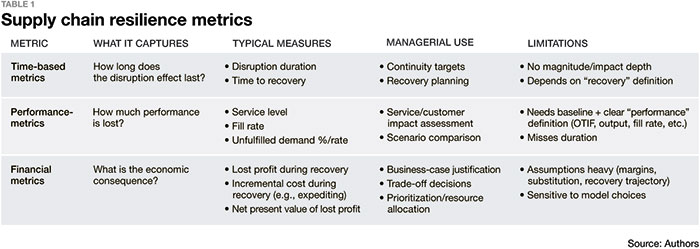
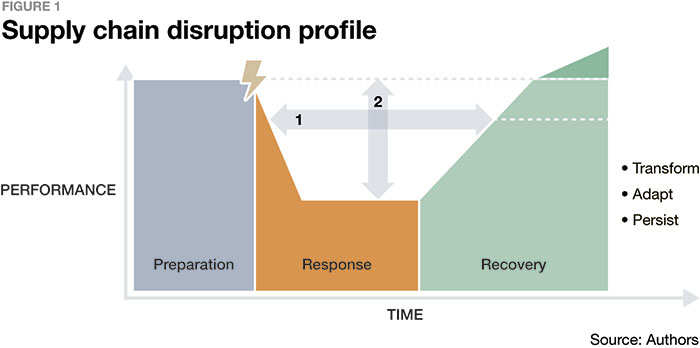
At the core of resilience is the idea that organizations need to accept that disruptions will happen and that they might be affected in terms of a performance decline. Figure 1 provides a simplified disruption profile showing how a disruption can affect an organization’s performance, and it illustrates what we mean by resilience during a disruption. The figure plots performance over time: a disruption creates a drop below the pre-disruption baseline performance, followed by a recovery trajectory back toward the original or to a new level of performance. In addition, this visualization helps to distinguish three ways managers typically think about resilience and its measures. First, managers consider the duration. Here, time-based metrics capture how long the system is affected (e.g., disruption duration, time to recovery, and—if used—time to survive). Second, managers consider the size of the impact. Here, performance-based metrics capture how severe the impact is in operational or customer terms (e.g., amount of performance loss, decline in service level/fill rate, or unfulfilled demand). Third, managers consider overall consequences. In that vein, financial metrics translate the combined time-and-performance impact into economic outcomes (e.g., lost profit during recovery or net present value of lost profit). Finally, the same profile also connects measurement to outcomes: depending on the disruption and the options available in preparation and response, a supply chain may persist (absorb the shock), adapt (recover through changes), or transform (move to a fundamental redesign) when constraints make recovery unrealistic. PPS configuration matters because it shapes which levers are feasible quickly—and therefore which of these outcomes is realistic.
The above might still make resilience somewhat abstract, therefore, Table 1 provides insights into some common ways to concretely measure supply chain resilience (see e.g., Behzadi et al., 2020). Notably, some preparedness measures may prevent visible performance loss altogether; in that case, resilience is experienced as robustness or simply as “no impact on customer deliveries.” Taken together, these approaches are complementary: duration and magnitude jointly shape the total impact, but each lens highlights something different. Finally, none of the measures captures all effects on its own, which is why Table 1 also highlights typical limitations.
How do you know when a supply chain is resilient?
Based on the metrics introduced in Table 1, this question seems to be easy to answer, but it actually is not, because these measures only reveal how resilient a supply chain is after a disruption has occurred. It would be preferable to know upfront whether a supply chain is resilient or not. Even more ideal would be (almost) sure that we are able to deal with a disruption without any visible drop in performance. In essence, this requires taking stock of the available options and the potential the organization has in (quickly) launching and orchestrating remedial activities across functions and partners. Hence, we need proxies that allow us to assess resilience potential before a disruption happens. The following are proxies (known and reported under various labels) that are commonly discussed in the supply chain literature:
Flexibility: What changes can we make? Flexibility is about having real alternatives available (not just planned). Typical actions include safeguarding availability of alternative suppliers, routings, or raw materials as well as creating flexibility in product specifications, capacity, or alternative logistics modes. For example, when the main packaging supplier of a company we talked to could not ramp up volumes (cardboard demand spike), the firm redesigned its packaging from a four-color to a three-color design to double supplier capacity (single production run). Additionally, they also temporarily used unprinted cardboard boxes to avoid empty shelves. This is flexibility because the firm created a viable alternative through product/packaging design change, rather than relying only on new sourcing.
Agility: How quickly do we observe a disruption and can we react? Agility is about speed of sensing and responding. Typically, it involves activities such as detecting early warnings, rapid decision-making, using escalation paths, and the ability to re-plan quickly when assumptions break. For example, in our study, a firm detected pallet shortages early through supplier-shared forecasts that indicated a significant risk and then reacted quickly by shifting volumes across its main pallet suppliers. This is a typical example of agility as it combines early sensing with rapid reconfiguration under time pressure.
Redundancy: How much backup do we have? Redundancy is about purposeful slack beyond normal operations. It relates to holding inventory buffers, spare capacity, backup suppliers, dual tooling, or pre-qualified substitutes. Despite a multi-week transport delay, one of the firms we talked to avoided stockouts because its safety stock buffers were sufficient to bridge the disruption window. This is redundancy working as intended: buffering a short-to-medium disruption without requiring redesign of product or process.
Collaboration: How do we work with whom? Collaboration is about coordinated action within and across firms and tiers. It involves information sharing, joint planning, supplier development, and aligning incentives and contracts so that working along the supply chain is rational rather than optional. Collaboration often determines whether flexibility, agility, and redundancy can be activated quickly in practice. For example, one firm told us that it relied on a close supplier relationship (including priority treatment through a just-in-time partnership) and integrated its supplier’s constraints directly into production planning and prioritization decisions (e.g., prioritizing A-brands when supply was tight). This is a clear example of collaboration because resilience here depends on joint planning and aligned actions across firm boundaries, not just internal measures.
When is resilience beneficial? The supply chain resilience funnel
As explained above, each proxy (flexibility, agility, redundancy, collaboration) can be supported by multiple resilience practices. It might be tempting to activate all of them “just in case,” but this is often overly expensive and, in some contexts, not even feasible. The key point is that resilience options are not equally available to all firms. They depend on contextual characteristics such as industry and regulatory environments, market conditions, and a firm’s own strategic choices. For example, in a declining market, it would make little sense to invest in new production capacity to increase flexibility or redundancy. Likewise, a company offering perishable products might not want to invest in large inventories. Finally, legislation can put specific demands on product specifications (e.g., only approved sources in pharmaceuticals) and storage facilities (e.g., dangerous goods), which can strongly limit flexibility and storage options.
This logic is captured in the supply chain resilience funnel (Figure 2). It depicts that, in principle, an organization has many potential options to build resilience by taking actions across the four proxies in product, process, and supply chain design. In reality, however, the number of feasible options is reduced in two steps.
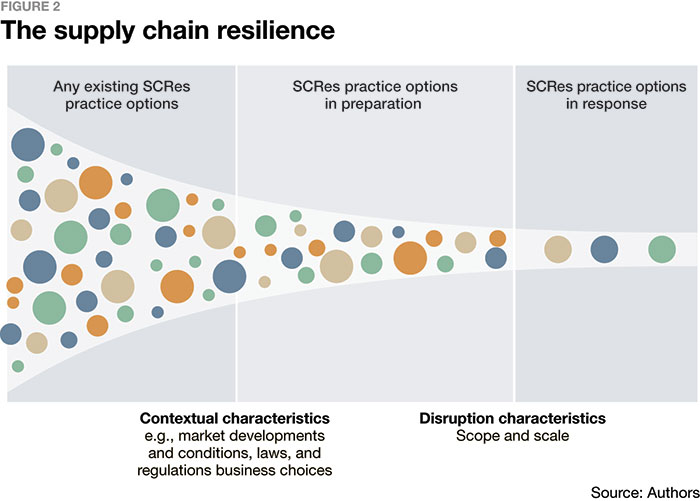
First, context narrows what is feasible and sensible before any disruption even hits. Second, once a disruption emerges, options narrow further because time pressure, capacity constraints, and the disruption’s scope and scale limit what can actually be implemented. In other words, the funnel is a practical way to move from “do everything” advice to a more realistic question: what options do we really have, given our PPS configuration, operating context, legal restrictions, and prior strategic choices? This also helps explain why “best practices” in resilience do not transfer cleanly across companies, industries, and disruptions.
At the same time, the funnel highlights why preparation matters. Companies should implement as broad a set of feasible and useful SCRes practice options as possible in advance, within their constraints, because once a disruption happens, it will only restrict the available option set further. In other words, the goal is not ‘everything,’ but the best option set you can realistically build and afford, given your PPS configuration and context. Our research indicates that particularly global and long-term disruptions require the development of flexibility options. If such options do not exist in advance, they often cannot be built under pressure. By contrast, when disruptions are short-term and localized, flexibility and redundancy that are prepared in advance can be very effective because the time span that needs to be bridged is relatively short.
Developing options is, in general, a good thing. However, as the funnel explains, options developed should also be usable in situations a firm is likely to face. Otherwise, aiming for resilience can actually become a risk. If a context does not allow for flexibility, a company might be better off trying to avoid disruptions where possible and to develop specific responses for specific risks, as traditional risk management suggests. In such contexts, redundancy in preparation for disruption becomes important, and sometimes it is the only realistic lever. Importantly, redundancy is not only inventory; it can also include alternative supply chain strategies, alternative processes, and alternative product configurations.
Referring back to Figure 1, three final outcomes were depicted: persist, adapt or transform. The funnel helps clarify each of these three outcomes.
Persisting through a disruption can happen if an organization had prepared options that enabled it to respond to a disruption without, or almost without, a drop in performance. For example, a rather short disruption can easily be handled with inventories or changes in production schedules.
Adaptation might happen for more extensive disruptions that require the search and finding of new suppliers, a change of product specification or new markets. This can also result in the organization somewhat changing its context, but in essence, the result will be a return (or almost) to the earlier performance level after an initial drop in performance.
Finally, transformation becomes relevant if a disruption is long, global, or fundamentally changes constraints. Adapt or persist will be impossible and in terms of the resilience funnel, the existing contextual characteristics with the scale and scope of the disruption together narrow down the funnel such that there are no options remaining. In other words, “recovering” to the previous state may be unrealistic. In those situations, an organization needs to fundamentally change or transform to a new situation with new products, processes, and/or supply chain. It might be clear that this will be uncomfortable and costly but it might be the only viable path.
So far, this is the logic captured in Figure 2. However, the cases in our study also revealed an additional insight that the funnel does not explicitly depict: where organizations tend to look first for options across product, process, and supply chain. This matters because “having options” is not only about how many options exist, but also where those options sit in the PPS system and how quickly they can be activated. Our findings suggest that the funnel has a PPS direction. Resilience options are not only narrowed by context and by the disruption characteristics; they are also distributed across the product–process–supply chain system. In preparation, organizations typically build resilience primarily in the supply chain, for example, through buffers and supplier-side measures, while keeping process and product configurations relatively stable.
When disruption hits, organizations then tend to activate supply chain options first and try to protect core processes and product choices. That is because process and product are often harder to change quickly, are tightly constrained (e.g., by specifications or regulation), or are central to competitive advantage. However, we also noticed that options in product and process are less considered in preparation for disruptions. Only when supply chain measures are insufficient, especially in long-term or global disruptions, do organizations escalate from supply chain adjustments to process changes, and then to product adjustments, with transformation as the last resort.
This PPS direction also clarifies why disruption characteristics matter. In shorter and more local disruptions, redundancy and supply chain workarounds may be sufficient to persist without visible customer impact. However, particularly global and long-term disruptions reduce supply chain options over time and force organizations to develop new ones. In those situations, flexibility becomes critical because it is often the only way to create options that did not exist before—through changes in routing, sourcing, internal processes, or, eventually, product and packaging requirements.
Ultimately, if resilience is about options, then the managerial task is option management: knowing what options exist given a specific context, where they sit in PPS, and which ones survive different disruption scenarios. The funnel offers a simple way to do that. Map the feasible option set in advance, stress-test it against short/ local versus long/ global disruptions, and decide where redundancy is sufficient and where flexibility must be created. That is the main recommendation from our research which turns resilience from a buzzword into a capability.
Reference
Behzadi, G., O’Sullivan, M. J., & Olsen, T. L. (2020). On metrics for supply chain resilience. European Journal of Operational Research, 287(1), 145–158.
About the authors
Kirstin Scholten is a professor and chair in supply chain management at the University of Dusseldorf. She can be reached at [email protected]
Dirk Pieter van Donk is a professor in the Department of Operations at the University of Groningen.
Stefania Boscari is an assistant professor in the Department of Operations at the University of Groningen.
SC
MR


More Supply Chain Resilience
- Supply chain resilience isn’t a data problem; it’s a judgment problem
- What options do you really have? Shaping the supply chain resilience funnel
- From rules of origin to rules of resilience
- From cost-cutting to cost leadership: A new model for supply chains
- 3 strategies to turn supply chain uncertainty into advantage in 2026
- More Supply Chain Resilience
What's Related in Supply Chain Resilience
 Explore
Topics
Procurement & Sourcing News
- Innovators Netstock, Pickle Robot win NextGen Solution Provider awards
- From salon to dock door: Repurposing scheduling software for inbound flow
- The biggest barrier to AI in supply chains isn’t technology
- Rebuilding a planning function around the physical world
- Why companies blame the wrong supplier … and miss the real failure
- NextGen Supply Chain Conference unveils agenda focused on AI, execution and the future of leadership
- More Procurement & Sourcing
Latest Procurement & Sourcing Resources
Subscribe

Supply Chain Management Review delivers the best industry content.

Editors’ Picks



