
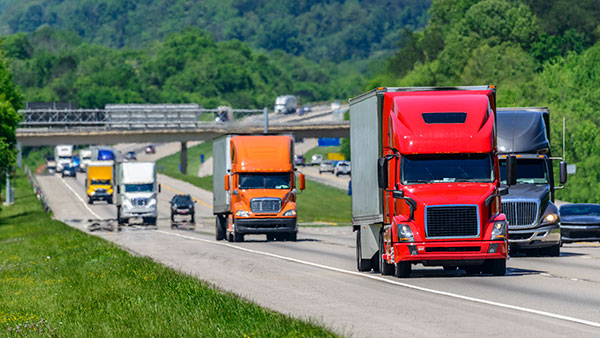
There is little debate that trucks are critical in moving the goods that we need across the final pathways of supply chain journeys that often begin with air, sea, and rail transportation. Truckers face long hours behind the wheel, and don’t have enough safe places to pull over and park for rest stops as I reported in one of my own newsletters several years ago. Truck drivers really do deserve to be paid appropriately for the vital service that they provide.
So, it seems logical that if trucks were allowed to be larger and haul more freight that more goods would be able to get to where they need to be with the same number of truck drivers. One concern is whether these larger trucks would be safe in traffic and be able to maneuver through the streets like the current-sized trailers.
The CABT (Coalition Against Bigger Trucks) is working against proposals—such as those in Congress—to allow trucks to be any bigger out of concern that larger trailers would cause more damage to the nation’s roads and bridges infrastructure.
According to the 2025 Infrastructure Report Card by the American Society for Civil Engineers, the nation’s roads and bridges do not grade very highly. In fact, the nation’s roads received a grade of D+ (Poor, At Risk) and the nation’s bridges received a grade of C (Mediocre, Requires Attention). Other D+ rated infrastructures were: aviation (airports), dams, energy, levees, schools, and wastewater. (stormwater and transit each received a grade of D) The highest-rated infrastructures were Ports (B) and Rail (B-).
The congressional proposal would allow truck weights to be increased from 80,000 pounds to 91,000 pounds. CABT argues that this would hasten the damage to our already fragile roads and bridges infrastructure, causing between 65,157 and 82,457 local bridges nationwide to be at risk of failure. The cost of replacing these bridges is estimated at between $70.5 billion to $98.5 billion, depending upon the gross vehicle weight. The states most impacted are noted as being Arkansas, California, Florida, Georgia, Indiana, Kansas, Louisiana, Massachusetts, Missouri, New Jersey, Ohio, Oregon, Virginia and Washington.
Trucks provide a vital link in our supply chains, but they have to have safe roads and bridges to travel upon. Driverless trucks don’t mean that passengers in vehicles that are sharing the road are any safer if road and bridge infrastructures are compromised. For the safety of truck drivers, vehicle drivers, and all passengers alike, before we go bigger, shouldn’t we first be building better?
Note: This article is based on a Logistics Management article. The original article can be found at: https://www.logisticsmgmt.com/article/anti_truck_group_says_nations_bridges_at_risk_if_congress_allows_bigger_trucks
SC
MR

More Infrastructure
- Bigger trucks versus broken bridges and roads
- Overcoming the obstacles at U.S. ports
- GE Appliances announces $118 million investment in Georgia plant
- The Infrastructure Bill Part III: Balancing resilience and sustainability
- The Infrastructure Bill Part II: The future is decoupling supply chains
- More Infrastructure
 Explore
Topics
Business Management News
- Why companies blame the wrong supplier … and miss the real failure
- NextGen Supply Chain Conference unveils agenda focused on AI, execution and the future of leadership
- Supply chain resilience isn’t a data problem; it’s a judgment problem
- Beyond the hype: Building flexible and scalable supply chains in a VUCA world
- Why your supply chain risk management plan will fail
- What options do you really have? Shaping the supply chain resilience funnel
- More Business Management
Latest Business Management Resources
About the Author
Norman Katz, President of Katzscan

Norman Katz is president of Katzscan Inc. a supply chain technology and operations consultancy that specializes in vendor compliance, ERP, EDI, and barcode applications. Norman is the author of “Detecting and Reducing Supply Chain Fraud” (Gower/Routledge, 2012), “Successful Supply Chain Vendor Compliance” (Gower/Routledge, 2016), and “Attack, Parry, Riposte: A Fencer’s Guide To Better Business Execution” (Austin Macauley, 2020). Norman is a U.S. national and international speaker and article writer, and a foil and saber fencer and fencing instructor.
Follow SCMR on social media.
@SupplyChainManagementReview on Facebook
@SCMR on Twitter
SCMR on Linkedin
Subscribe

Supply Chain Management Review delivers the best industry content.

Editors’ Picks



