
Sorry, but your login has failed. Please recheck your login information and resubmit. If your subscription has expired, renew here.
July-August 2026
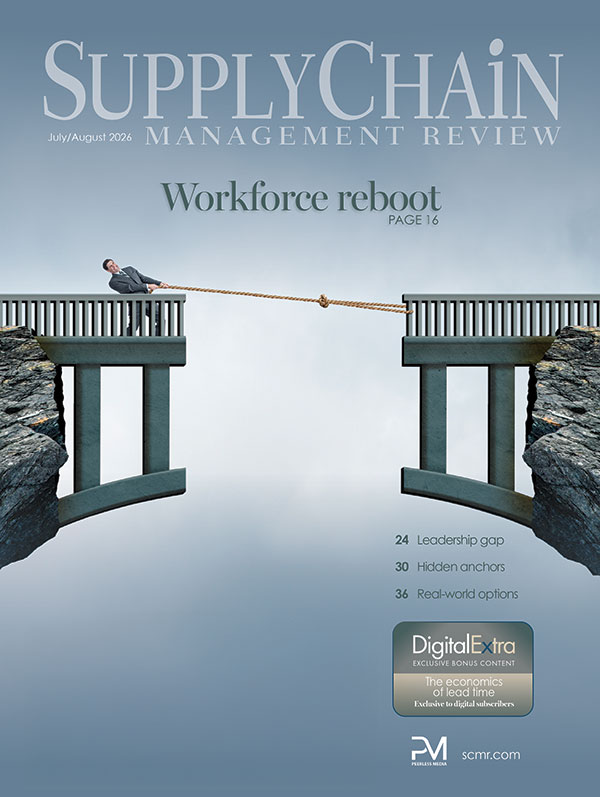
The July issue of Supply Chain Management Review explores how organizations are preparing for the future through workforce development, AI adoption, leadership education, and supply chain resilience. Features examine closing the skills gap, building AI-enabled teams, strengthening supplier networks, and developing practical strategies for navigating disruption in an increasingly complex global marketplace. Browse this issue archive.Need Help? Contact customer service 1-508-503-1313 More options
For decades, trade agreements have focused on fundamental components: product or service features, markets, regulatory standards, investment protections, and dispute resolution. In North America, this logic is embedded in the United States–Mexico–Canada Agreement (USMCA) through rules of origin and regional value content requirements. These provisions determine whether a product or service qualifies for preferential tariff treatment based on the percentage of content sourced or manufactured within the region.
Recent supply chain disruptions have exposed a critical weakness: knowing where a product was manufactured, where it will be sold, or which regulatory or legal conditions apply provide no actionable insight into whether it can move reliably, securely, and sustainably across borders. The next competitive frontier for North American supply chains is not siloed initiatives or traditional maquila approaches; it is the logistics value that resiliency delivers.
SC
MR
Sorry, but your login has failed. Please recheck your login information and resubmit. If your subscription has expired, renew here.
For decades, trade agreements have focused on fundamental components: product or service features, markets, regulatory standards, investment protections, and dispute resolution. In North America, this logic is embedded in the United States–Mexico–Canada Agreement (USMCA) through rules of origin and regional value content requirements. These provisions determine whether a product or service qualifies for preferential tariff treatment based on the percentage of content sourced or manufactured within the region.
Recent supply chain disruptions have exposed a critical weakness: knowing where a product was manufactured, where it will be sold, or which regulatory or legal conditions apply provide no actionable insight into whether it can move reliably, securely, and sustainably across borders.
The next competitive frontier for North American supply chains is not siloed initiatives or traditional maquila approaches; it is the logistics value that resiliency delivers. For three decades, North American trade rules have certified one stage: where a good was made. The next generation must certify the next crucial stage: the resilience of the movement of goods. Supply chain resilience belongs alongside origin in tariff treatment, not below it.
For practitioners and entrepreneurs, negotiations over the North American Trade Agreement extend far beyond government-to-government talks. Business and policy leaders need an actionable agenda to ensure supply chains continue driving value in volatile environments through better planning, scenario analysis, and stakeholder alignment.
The new bottleneck is a moving target
During the Golden Age of low-vulnerability perception, firms invested heavily in optimizing production networks. Manufacturers reduced costs, increased specialization, and expanded cross-border sourcing in search of standardization and cheaper labor.
Today, however, the greatest risks often occur after production is complete, and they vary in severity, frequency, spread, likelihood, and duration. Most of these risks stem from supply chain breaches across diverse stakeholders, decision-making levels, and business units.
Border closures, cargo theft, cyber-enabled freight fraud, infrastructure congestion, labor disruptions, power outages, geopolitical tensions, and environmental regulations increasingly determine whether products arrive on time and at the expected cost. A component that meets every regulatory requirement still loses value if it is delayed at a crossing, diverted through fraud, stranded due to infrastructure failure, or mishandled due to poorly skilled labor. In turn, resilience has become a competitive differentiator.
Organizations that can predict disruptions, recover faster, make informed decisions, and maintain service continuity gain advantages in customer satisfaction, working capital efficiency, inventory management, and risk mitigation. Yet resilience remains largely absent from trade policy discussions and is often treated as a cost center rather than a strategic, value-generating capability.
Four dimensions for the next frontier in competitiveness
Building long-term sustainable capabilities for the U.S., Mexico, and Canada has been challenging. However, four measurable dimensions of supply chain resilience should be addressed to facilitate integration, gain visibility, and enhance competitiveness in the region.
The first is reliability, defined as the predictability of transit times and logistics performance. Since businesses plan around expectations rather than average values, a shipment that consistently arrives in five days is often more valuable than one that averages four days but fluctuates wildly between two and 10 days. Predictability reduces inventory buffers, improves production scheduling, increases service performance and speed, and decreases unexpected costs.
The second dimension is security. Cargo theft and freight fraud have evolved dramatically in recent years, becoming increasingly sophisticated and digital-forward. Criminal activity now extends beyond physical theft to include identity spoofing, double-brokering, and fraudulent load-diversion schemes. As supply chains become more connected, security is inseparable from operational performance.
The third dimension is redundancy. While efficiency initiatives often eliminate redundancy, recent disruptions have underscored the importance of maintaining alternative routes, transportation modes, suppliers, and border crossings. Organizations with options recover faster from disruptions, particularly when single-sourcing is present.
The fourth dimension is governance. The other three dimensions measure what happens to goods, whereas governance measures whether the authorities responsible can set the stage for this system to work and stay prepared when something fails. USMCA corridors cross three customs regimes, dozens of state and provincial transport agencies, and bridge and port authorities whose mutual recognition protocols remain only partially aligned.
Regulatory pressure, customer expectations, and investor scrutiny are making performance expectations too complex for a single entity to manage. A potential board of practitioners, policymakers, and academics should create a master plan for regional development, logistics, and integration to influence market access and competitiveness, particularly in global trade corridors connected to other global regions.
Together, these four dimensions provide a practical lens for assessing resilience in ways that executives can measure and manage.
Turning resilience into a tradable asset
Measuring resilience is feasible and economically valuable. A Logistics Resilience Credit Score may reward organizations as a corridor-level rating that converts measured resilience into a small, additive tariff credit against the Regional Value Content obligation. A shipment moving through a corridor that meets jurisdiction-agreed thresholds for travel-time variability, cargo-loss incidence, emissions intensity, and route redundancy earns a credit calibrated to be small enough to preserve origin requirements yet large enough to mobilize interest in updated telematics, security technology, and clean-fleet conversion. Leading organizations are already moving in this direction through resilience dashboards, control towers, risk-scoring platforms, and company-centric observatories. However, building strategic decision-support systems that translate resilience and scenario planning into common language across governments, carriers, manufacturers, insurers, and logistics providers remains largely underdeveloped.
The rise of digital trust
To cope with the rapidly evolving digital world, supply chain stakeholders should develop a mechanism to document and verify the resilience profile of individual shipments, thereby increasing traceability, visibility, and data sharing among organizations. Therefore, a Digital Certificate of Resilience would convert a shipment’s measured resilience profile into a verifiable trade-policy instrument. Exporters could attach a certificate to each shipment that shows its measured profile across the four dimensions. The certificate does for logistics what the certificate of origin does for content: it makes a private operational record auditable.
As supply chains become more digital, the ability to verify shipment conditions, route integrity, security compliance, and sustainability performance becomes increasingly valuable. Organizations that can demonstrate trusted performance may gain advantages in customs processing, insurance pricing, customer relationships, and regulatory compliance.
The future of industry and policy leaders
Building resilient trade corridors will require more than new policies and digital infrastructure; it will require a new generation of supply chain leaders capable of operating at the intersection of logistics, technology, public policy, and risk management. As artificial intelligence becomes increasingly embedded into transportation planning, customs operations, cargo-security monitoring, and disruption forecasting, organizations must invest in developing the skills needed to deploy these tools responsibly and effectively. Universities, executive education programs, and corporate training initiatives therefore play a critical role in preparing industry and policy leaders to manage resilient, data-driven supply chains across North America.
Why this matters for U.S. leaders
During this significant realignment of manufacturing and sourcing strategies, success depends on more than production capacity. Now, growth requires integrated physical and digital infrastructure, including resilient logistics corridors, strategic decision-support systems with a scenario perspective, and a skilled workforce that creates value rather than merely reducing costs.
Executives evaluating investments in North America should pay close attention to border infrastructure, transportation security, corridor performance, customs modernization, and data-sharing capabilities. These factors increasingly determine economic viability, structural adaptability, and alignment of regional supply chains across industries.
A practical roadmap for the region
Enhanced carrier verification processes, stronger freight security protocols, greater use of visibility technologies, improved data-sharing practices, and corridor-level performance monitoring are all within reach for current supply chain organizations.
Executives do not need a sophisticated treaty amendment to begin measuring reliability. However, the public agencies in the region need to act in coordination to become enablers of the next logistics ecosystem, ensure proper infrastructure development to build trust, drive competitiveness to the next level, and provide a platform for connecting with other regions.
The Bottom line: The non-local isolation
Supply chains have entered a new era. Competitive advantage increasingly depends on the ability to anticipate disruptions, maintain continuity, and recover quickly from failures. Resilience deserves to be the central piece of a new scheme, measured, managed, and rewarded alongside traditional trade metrics.
For years, trade policy has focused on where products are made. The next generation of supply chain leadership will focus equally on how products move. However, organizations that embrace that shift today will be better positioned to compete tomorrow through orchestrated efforts to increase fluidity in our regional supply chain ecosystems.
References
Cedillo-Campos, M., Piña-Barcenas, J., Pérez-González, C. & Mora-Vargas, J. (2022). How to measure and monitor the contribution of transportation infrastructure to the logistics value of supply chains? Transport Policy, Volume 120, May 2022, Pages 120-129. https://doi.org/10.1016/j.tranpol.2022.03.001
Montoya-Torres, J. R., Muñoz-Villamizar, A., & Mejia-Argueta, C. (2023). Mapping research in logistics and supply chain management during the COVID-19 pandemic. International Journal of Logistics Research and Applications, 26(4), 421-441. https://doi.org/10.1080/13675567.2021.1958768
About the authors
Gastón Cedillo, Ph.D., is a Radcliffe Killam Distinguished Faculty Member at Texas A&M International University, a Physical Internet Ambassador (EU), and the founder and inaugural technical director of the National Laboratory for Transportation Systems and Logistics (Mexico). He can be reached at [email protected].
Chris Mejía-Argueta, Ph.D., is the founder and director of the Emerging Market Economies Logistics Lab (EMeL), formerly named the Food and Retail Operations Lab, and the director of the SCALE network for Latin America and the Caribbean at the MIT Center for Transportation and Logistics. He can be reached at [email protected].
SC
MR


More Supply Chain Resilience
- Supply chain resilience isn’t a data problem; it’s a judgment problem
- What options do you really have? Shaping the supply chain resilience funnel
- From rules of origin to rules of resilience
- From cost-cutting to cost leadership: A new model for supply chains
- 3 strategies to turn supply chain uncertainty into advantage in 2026
- More Supply Chain Resilience
What's Related in Supply Chain Resilience
 Explore
Topics
Procurement & Sourcing News
- Innovators Netstock, Pickle Robot win NextGen Solution Provider awards
- From salon to dock door: Repurposing scheduling software for inbound flow
- The biggest barrier to AI in supply chains isn’t technology
- Rebuilding a planning function around the physical world
- Why companies blame the wrong supplier … and miss the real failure
- NextGen Supply Chain Conference unveils agenda focused on AI, execution and the future of leadership
- More Procurement & Sourcing
Latest Procurement & Sourcing Resources
Subscribe

Supply Chain Management Review delivers the best industry content.

Editors’ Picks



