
Sorry, but your login has failed. Please recheck your login information and resubmit. If your subscription has expired, renew here.
July-August 2026
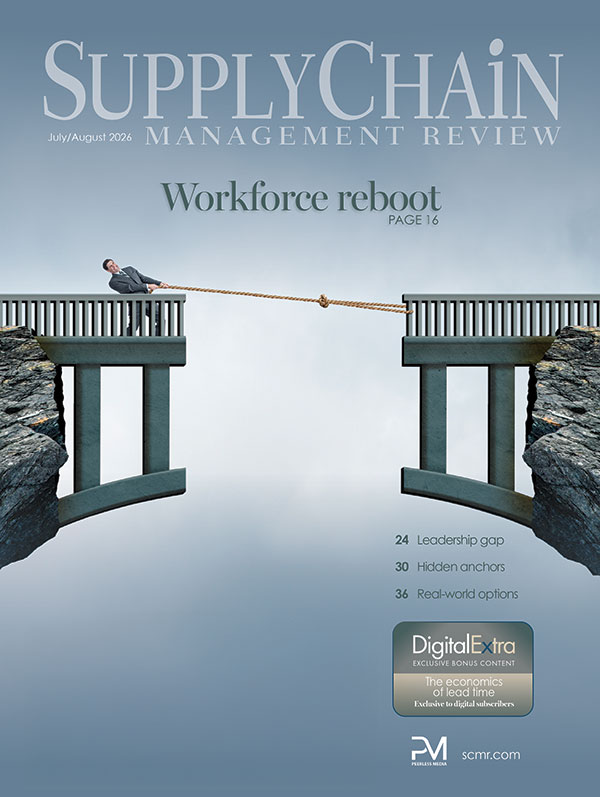
The July issue of Supply Chain Management Review explores how organizations are preparing for the future through workforce development, AI adoption, leadership education, and supply chain resilience. Features examine closing the skills gap, building AI-enabled teams, strengthening supplier networks, and developing practical strategies for navigating disruption in an increasingly complex global marketplace. Browse this issue archive.Need Help? Contact customer service 1-508-503-1313 More options
Executives often assume that decentralizing supply chains makes them more resilient. In practice, it often makes them more fragile.
Over the past decade, many firms—particularly in global consumer goods and textiles—have diversified sourcing away from concentrated production bases. The logic is familiar: spread risk, increase flexibility, and reduce dependence on any single country or supplier. Yet as networks expand, visibility declines. Standards fragment. Coordination weakens. What appears diversified on a sourcing map often operates as fragmentation in execution.
When disruption hits, resilience does not come from the number of suppliers in the network. It comes from how the network holds together—and from which suppliers quietly do the work of holding
it together.
SC
MR
Sorry, but your login has failed. Please recheck your login information and resubmit. If your subscription has expired, renew here.
Executives often assume that decentralizing supply chains makes them more resilient. In practice, it often makes them more fragile.
Over the past decade, many firms—particularly in global consumer goods and textiles—have diversified sourcing away from concentrated production bases. The logic is familiar: spread risk, increase flexibility, and reduce dependence on any single country or supplier. Yet as networks expand, visibility declines. Standards fragment. Coordination weakens. What appears diversified on a sourcing map often operates as fragmentation in execution.
When disruption hits, resilience does not come from the number of suppliers in the network. It comes from how the network holds together—and from which suppliers quietly do the work of holding it together.
Concept introduction
In decentralized supply chains, resilience does not reside evenly across suppliers, nor does it track reliably with spend, scale, or contractual importance. Instead, it is often anchored by a small number of suppliers whose positions and behaviors allow them to stabilize the network when disruptions occur. We refer to these firms as nexus suppliers.
Nexus suppliers are characterized by two defining features. First, they are deeply embedded across the supply network, maintaining connections that span multiple tiers, regions, or partner firms. Second, they exert influence beyond the focal firm, shaping standards, practices, or capacity in ways that affect how other suppliers respond to stress. Importantly, these characteristics are revealed through observed behavior during disruption, not through formal authority or size.
This definition is intended for executive use. It does not rely on formal measurement, maturity scoring, or retrospective performance metrics. Instead, it provides a practical lens for recognizing suppliers whose actions disproportionately affect how decentralized supply chains hold together under pressure.
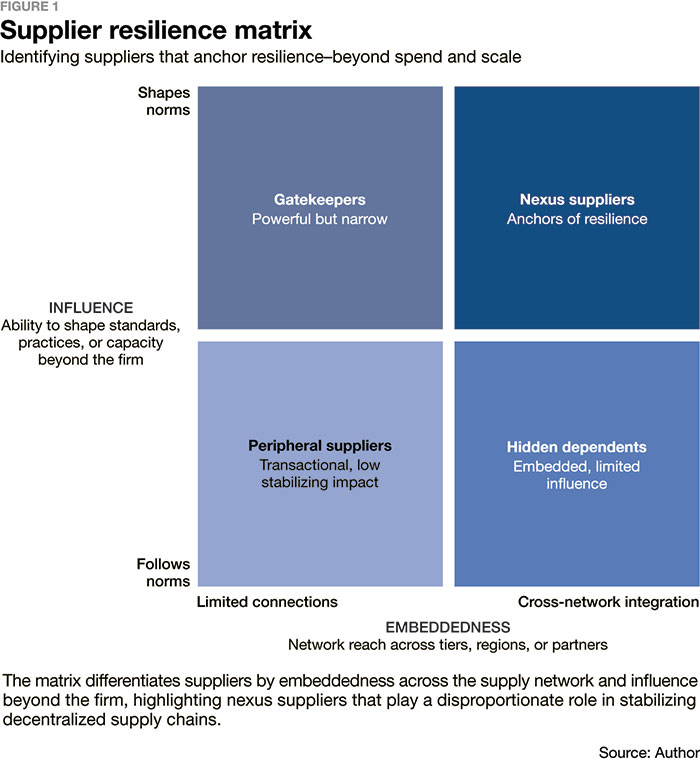
As shown in Figure 1, nexus suppliers represent one of four distinct supplier roles, differentiated by levels of embeddedness and influence within decentralized supply chains.
Four roles: Behavioral patterns that anchor resilience
The Supplier Resilience Matrix highlights four distinct supplier roles based on levels of embeddedness and influence. Within and across these roles, our research identifies a set of recurring behavioral patterns that explain how resilience is actually anchored in decentralized supply chains. These behaviors are not evenly distributed. While they can appear in different quadrants, they are most consistently and reliably observed among nexus suppliers, whose network positions allow these behaviors to scale beyond individual firm boundaries.
Knowledge brokers
Knowledge brokering refers to the ability to transfer technical know-how, process improvements, or problem-solving practices across suppliers and tiers. In decentralized networks, this behavior helps prevent localized disruptions from becoming systemic failures. While some suppliers may broker knowledge episodically, it is most effective when performed by suppliers with broad embeddedness and cross-network visibility. When present, knowledge brokering accelerates recovery by aligning responses across otherwise disconnected partners.
Executive takeaway: Resilience improves when suppliers that see across the network actively share operational knowledge, rather than treating learning as firm-specific.
Standard enforcers
Some suppliers play a critical role in translating, reinforcing, or extending standards related to quality, compliance, or operational practices.
This behavior reduces ambiguity during disruption by clarifying expectations and stabilizing execution across the network. Although standard-setting authority may originate with focal firms or regulators, suppliers with influence beyond the firm often operationalize those standards in practice.
Executive takeaway: Suppliers that help enforce and normalize standards can stabilize decentralized networks more effectively than formal controls alone.
Capacity balancers
Capacity balancing involves reallocating work, smoothing bottlenecks, or coordinating production shifts when disruptions strain specific nodes in the supply chain. This behavior limits cascading failures by absorbing shocks before they propagate. While many suppliers manage their own capacity, those with embedded network positions are better able to rebalance capacity across partners, not just within their own operations.
Executive takeaway: Suppliers that can flex capacity across the network reduce the amplification of disruption during periods of stress.
Influence multipliers
In decentralized supply chains, some suppliers shape responses not through contracts or formal power, but through credibility, experience, and trusted relationships. This influence guides how other suppliers prioritize actions during disruption, often accelerating coordination when time and information are limited. Although influence can exist in multiple roles, it is most consequential when exercised by suppliers connected across tiers and regions.
Executive takeaway: Informal influence—when held by well-embedded suppliers—often matters more than contractual leverage in moments of disruption.
These behavioral patterns should not be mistaken for quadrant roles themselves. Rather, they explain why certain roles—particularly nexus suppliers—anchor resilience more effectively than others. Peripheral suppliers may exhibit one or more behaviors in limited contexts, while hidden dependents and gatekeepers may perform them within narrower scopes. Nexus suppliers stand out because they combine multiple behaviors with positions that allow those behaviors to stabilize the broader network.
The Supplier Resilience Matrix
Executives often struggle to distinguish between suppliers that simply deliver inputs and those that actually stabilize the supply chain during disruption. Traditional approaches—ranking suppliers by spend, volume, or contractual importance—offer limited insight in decentralized networks, where risk and coordination are widely dispersed. To address this gap, our research points to a simple diagnostic tool: the Supplier Resilience Matrix.
The matrix differentiates suppliers along two dimensions that matter most under stress: embeddedness and influence. Embeddedness reflects how deeply a supplier is connected across tiers, regions, or partner networks. Influence captures a supplier’s ability to shape behavior beyond its own operations—by enforcing standards, transferring knowledge, or stabilizing capacity when disruptions occur. Placement in the matrix is not based on size or spend, but on observed behavior during disruption.
Viewed through this lens, four distinct supplier roles emerge. Peripheral suppliers are transactional and contribute little to network stability. Hidden dependents are deeply embedded but lack the influence needed to stabilize others, making them quiet points of fragility. Gatekeepers exert strong influence within narrow scopes, often creating chokepoints that require careful management. Nexus suppliers combine broad embeddedness with the ability to shape practices, knowledge flows, and capacity across the network.
For executives, the matrix is not a scoring model or a prescription to rebalance spend. It is a sensemaking tool that clarifies where resilience actually resides. By identifying which suppliers anchor stability—and which merely appear important—leaders can move beyond reactive risk management and make more deliberate decisions about partnership, visibility, and investment in decentralized supply chains.
How to spot a nexus supplier
Executives often assume their most resilient suppliers are the largest by spend or volume. Our research suggests otherwise. To identify suppliers that actually anchor resilience in decentralized supply chains, ask the following questions:
- Who connects the network? Which suppliers interact across multiple partners, tiers, or regions—especially when issues arise?
- Who sets or enforces standards? Which suppliers help translate, enforce, or extend compliance, quality, or certification requirements beyond their own operations?
- Where does knowledge flow through? Which suppliers share technical know-how, process improvements, or quality practices that others rely on?
- Who stabilizes capacity during disruption? When disruptions occur, which suppliers help rebalance workloads, shift production, or prevent bottlenecks from cascading?
- Who do others listen to under pressure? Which suppliers influence how partners respond during disruptions, even without formal authority or large contract values?
Interpretation
Suppliers that consistently surface across multiple questions—particularly those combining broad network connections with the ability to shape behavior—are likely nexus suppliers. These firms often carry outsized responsibility for stabilizing decentralized supply chains and should be managed as strategic resilience partners rather than transactional vendors.
Mini-case: A supplier that made the difference
This mini-case vignette reinforces the nexus supplier concept through observed behavior during disruption. It is intentionally anonymized and narrowly scoped to illustrate how resilience concentrates around specific supplier actions rather than spend, size, or formal authority.
In one decentralized textile supply network in Southeast Asia, a mid-sized supplier in Vietnam played a central coordinating role during a period of prolonged disruption. Although not among the largest suppliers by spend or volume, the firm maintained working relationships across multiple tiers and regions, allowing it to see emerging issues before they escalated. When upstream capacity constraints and compliance concerns surfaced simultaneously, this supplier became an informal point of coordination for several partners.
Rather than waiting for direction from the focal firm, the supplier proactively shared process adjustments, clarified quality expectations, and facilitated communication between upstream and downstream partners. Other suppliers adapted their responses based on this guidance, even in the absence of formal authority or contractual mandates. Over time, these actions helped prevent localized failures from cascading across the network.
In Figure 1 terms, this supplier functioned as a nexus supplier—combining high embeddedness with influence that extended beyond the focal firm.
The implication is straightforward. Resilience in decentralized supply chains does not always flow through the most visible or highest-spend suppliers. Instead, it often depends on firms whose network positions and behaviors quietly stabilize coordination when formal controls are insufficient.
Conclusion
Resilience in decentralized supply chains is not evenly distributed. As firms extend their networks across regions, tiers, and partners, stability increasingly depends on a small number of suppliers whose positions and behaviors allow them to hold the network together under stress.
As illustrated in Figure 1, resilience concentrates in suppliers that combine embedded network positions with influence beyond the focal firm. These suppliers do not simply execute transactions. They shape how information flows, how standards are interpreted, and how capacity is stabilized when formal controls break down.
For executives, the implication is not to optimize supplier portfolios based solely on spend or scale, but to recognize and manage the roles suppliers actually play in sustaining coordination. If you don’t know who your nexus suppliers are, you don’t know how resilient your supply chain really is.
About the author
Obie (Paul) Byrum, MBA, Ph.D., is a professor of practice in the Department of Management and Supply Chain at East Tennessee State University. He can be reached at [email protected].
SC
MR


More Risk Strategies
- What options do you really have? Shaping the supply chain resilience funnel
- Nexus suppliers: Hidden anchors of resilience in decentralized supply chains
- Why a secure industrial supply chain depends on layered AI
- Nature and supply chain innovation
- The Internet of Animals offers lessons for supply chain management
- More Risk Strategies
What's Related in Risk Strategies
 Explore
Topics
Procurement & Sourcing News
- Innovators Netstock, Pickle Robot win NextGen Solution Provider awards
- From salon to dock door: Repurposing scheduling software for inbound flow
- The biggest barrier to AI in supply chains isn’t technology
- Rebuilding a planning function around the physical world
- Why companies blame the wrong supplier … and miss the real failure
- NextGen Supply Chain Conference unveils agenda focused on AI, execution and the future of leadership
- More Procurement & Sourcing
Latest Procurement & Sourcing Resources
Subscribe

Supply Chain Management Review delivers the best industry content.

Editors’ Picks



