
Over the past five years, innovation in logistics robotics has accelerated at a phenomenal pace. DHL Supply Chain has deployed more than 8,000 robots across its worldwide operations. Tradeshow floors and online videos showcase impressive displays of the latest technology, selling businesses a vision of fully autonomous, “dark warehouse” operations. With the advent of “Physical AI” and the claim that the “ChatGPT moment for robotics and automation is close,” it’s important to draw a line between headline-grabbing early-stage hype and real, scalable value. Operational impact and resilience is not achieved by chasing the next robotic showcase installation or deploying a series of rigid, unconnected, single-process use cases that won’t scale.

Instead, to realize sustainable impact in an environment defined by continuous volatility, uncertainty, complexity and ambiguity, businesses need to strike the right balance. By standardizing core processes, technological building blocks (IT and operational technology) and the interfaces to connect these building blocks, logistics businesses can thrive in this unpredictable landscape. Achieving this balance begins with realizing that the logistics operation of the future won’t be fully automated nor fully human—it will be both.
Orchestrating an evolving—and hybrid—workforce
The foundation for effectively orchestrating a workforce composed of humans, robots, automation and AI is integration. By building reusable standard interfaces between physical automation, for example robots on the warehouse floor, and core IT systems, businesses acquire the capability to performance manage a blended workforce of people and technology working in unison. Rather than scaling headcount or square footage, this digital thread links warehouse management systems (WMS), labor management systems (LMS) and Robotic or Automation Fleet Managers to provide total visibility over operational throughput. In turn, this enables businesses to flexibly reallocate both technology and human resources in real-time, expanding capacity without expanding the physical footprint.
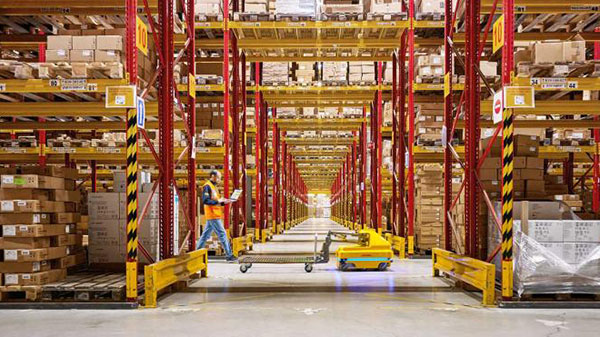
On the warehouse floor, automation covers a range of technologies, from established and scaled tools like autonomous mobile robots (AMRs) to next-generation developments in robotic grippers and mobile manipulators. While AMRs have successfully optimized warehouse transport routes across warehouses all over the world, heavy investment in robotics has led to improvements in how machines interact with individual products. These advanced physical AI systems can reliably identify and grasp items out of warehouse storage totes. By taking over these repetitive and physically demanding tasks, collaborative robots and physical AI systems support teams and free up workers for higher-skilled, technology-assisted roles.
Beyond the warehouse floor, data analytics and artificial intelligence (AI) are significantly improving day-to-day office workflows. In areas like transport planning and customer service, AI Agents can process massive amounts of data across hundreds of carrier networks. This saves office teams from manual web searches, repetitive interface entries, or making dozens of phone calls every day, massively speeding up operations and at the same time also improving quality.
Standard base, sector-specific customisation
Whether optimizing office workflows or scaling operations in the warehouse, managing a hybrid workforce requires a structured approach. Otherwise, operations quickly fracture into a hard-to-manage mix of disconnected tech solutions creating unnecessary technical debt.
A common mistake in designing supply chain solutions is assuming that every new project is 100% unique. In reality, building a responsive supply chain relies on a smart, composable architecture where a foundation of standardized, pre-connected solution modules handles roughly 80% of the requirements, and customized software or hardware adjustments handle the remaining 20% of sector-specific needs.
The baseline technologies, such as WMS, LMS, TMS and a standard integration layer can be reused across different operations. However, the specialized adjustments change based on the industry’s unique demands.
Take omni-channel e-commerce, for example. Here, the focus is on handling sudden demand spikes and fast consumer trends. A sample deployment in a geography where space is scarce may feature dense and high-speed goods-to-person technologies that bring inventory directly to the worker, boosting productivity, complemented with fit-for-purpose packing robotics. In contrast, while speed is still essential for life sciences, absolute quality control and strict compliance are the top priorities. Here, the core composable automation blueprint is paired with precise product tracking software, temperature controls and validation logs to protect product integrity.
Integration as enabler of innovation
While the operational advantages of supply chain automation are clear, businesses often face barriers to deployment. Rapidly evolving tools make it difficult to identify the right solutions, a challenge amplified by complex system integration. At DHL, we therefore decided to introduce a standard integration layer that connects our IT (WMS, LMS, ec.) to our OT (Operational Technology), such as robotics and automation.
We standardize connectors to our strategic IT and OT providers to enable reuse. This massively reduces complexity, speeds up deployment by a factor of up to 12, and maximizes resilience. Centrally managing the build and run of this integration layer while scaling across operations worldwide allows us to lower the financial and technical burdens for our customers. Our global scale converts previously rigid, long-term investments into flexible operational capabilities that can safely scale based on real-time demand shifts. It enables our customers to safely benefit from cutting-edge robotics and draw on a massive, connected ecosystem that can unlock additional volume and insights as needed.
Flexible stability as competitive advantage
Ultimately, the engine that powers this scalability and removes operational friction is data. The warehouse of the future continuously gathers real-time insights from every operational stage, allowing advanced analytics and AI to build precise forecasts that outperform traditional historical projections. Connected tools like Internet of Things (IoT) sensors and asset tracking complement this by maximizing inventory visibility and boosting productivity.
In modern logistics, flexible stability means transforming these digital insights into immediate physical action on the shopfloor. Real visibility ensures that technical equipment and human resources are never locked into one specific use case. If an unexpected bottleneck in inbound processing is observed, robotic and human teams can be instantly redistributed across warehouse processes and levels to absorb the surge.
Flexibility is not just about speed, it’s about the structural freedom to adjust resources seamlessly, based on real-time data and without operational friction, turning market unpredictability into a distinct competitive advantage.
SC
MR

More Warehouse Automation
- Beyond the hype: Building flexible and scalable supply chains in a VUCA world
- DHL Supply Chain bets on data foundations, robotics, and agentic AI to drive growth
- How industrial real estate decisions are shaping supply chain performance
- Your supply chain automation should trade like a hedge fund
- Why trust, flexibility, and execution now matter more than speed
- More Warehouse Automation
What's Related in Warehouse Automation
 Explore
Topics
Business Management News
- What options do you really have? Shaping the supply chain resilience funnel
- Nexus suppliers: Hidden anchors of resilience in decentralized supply chains
- Finding the ROI in supply chain education
- Managing human and AI teams across the supply chain
- Risk sharing is the new advantage in capital project delivery
- The AI-empowered supply chain leader
- More Business Management
Latest Business Management Resources

Subscribe

Supply Chain Management Review delivers the best industry content.

Editors’ Picks



