
As artificial intelligence dominates conversations across the supply chain sector, DHL Supply Chain is focusing less on AI hype and more on the foundational elements it believes will determine whether digital transformation efforts actually succeed: clean data, scalable automation, and operationally grounded use cases.
For Brian Gaunt, who leads digitalization efforts within DHL Supply Chain, the current wave of AI enthusiasm represents more of an acceleration of existing digitization efforts than a completely new direction.
“Digitalization has been kind of our bread and butter for a long time,” Gaunt said during a recent interview at the Gartner Supply Chain Symposium/Xpo. “AI is picking up the pace and making all the headlines and I think there’s a real good opportunity there. But for us, understanding the supply chain business is really understanding the data side of things.”
That focus on foundational data management is central to DHL’s broader digitization strategy. According to Gaunt, the company’s robotics deployments, analytics systems, and AI-driven operational tools all depend on having structured, normalized, and operationally useful data.
“Our people and our robotic solutions and our business generate a ton of data,” he said. “And how we’re able to use that to optimize our operations is really the core.”
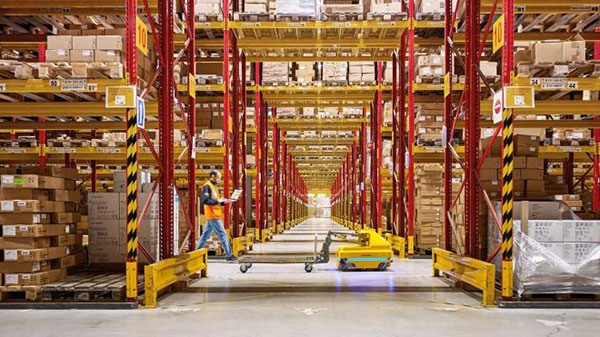
DHL Supply Chain currently operates more than 8,000 robots across its supply chain operations globally, according to Gaunt. Those deployments range from autonomous pallet movement systems to mobile robotics used in piece-picking and warehouse fulfillment operations.
The company has also partnered with robotics providers including Locus Robotics and Robust.AI while integrating warehouse and transportation management systems such as Blue Yonder, Manhattan, and Oracle OTM into broader visibility and operational optimization initiatives.
But Gaunt emphasized that deploying technology at scale requires more than simply collecting large amounts of operational data.
“It starts to catalog your data,” he said. “What’s delivering value?”
Data analysis is key
According to Gaunt, one of the biggest challenges organizations face is determining which data should be retained at detailed transaction levels versus summarized into broader operational insights. While some information must be retained for compliance or customer-specific requirements, operational digitization efforts increasingly depend on data cleansing, normalization, and strategic structuring.
“We are constantly cleansing the data and rolling it up to the right levels to make sense for how we want to optimize and use it,” he said.
That becomes particularly important as companies attempt to scale automation and AI initiatives across large, multi-site operations.
“As an enterprise company, we don’t want to spend a lot of time on a solution for one site,” Gaunt said. “We want this to scale. Grab it, scale, and go from a scalability perspective.”
The company’s approach to robotics deployment also reflects a broader industry shift toward flexibility and scalability rather than highly rigid automation systems designed around fixed forecasts and stable operational assumptions. Gaunt said DHL evaluates automation opportunities based on customer product types, fulfillment requirements, service expectations, and long-term operational flexibility. Mobile robotics solutions have become particularly attractive because they can scale more easily than heavily fixed automation infrastructure.
“Mobile robotics really helps with that because we can scale those things up and down versus some of the really fixed infrastructure automations that are millions of dollars,” he said.
At the same time, DHL continues deploying more advanced automation systems where long-term customer forecasts and operational profiles justify the investment.
“When you’re going to make these big capital investments mutually with the customer, you need to understand that profile and the volumes,” Gaunt said.
The challenges of forecasting
Forecasting itself remains a major challenge across the logistics industry, particularly as social media trends, rapidly shifting consumer behavior, and disruption-driven volatility make demand planning increasingly difficult.
Gaunt acknowledged that DHL’s customers vary significantly in forecasting sophistication and data maturity.
“Some of our customers are very sophisticated in their demand planning and forecasting, and it’s right on,” he said. “Other ones, they’re playing to the market like everyone else.”
To manage that uncertainty, DHL designs operations with built-in flexibility thresholds that allow facilities to absorb varying levels of demand fluctuation before requiring major redesign or operational changes.
“We can quickly flex up to this, and then beyond this is going to be something different,” Gaunt said.
Controlled AI deployments
While AI remains a major focus across the industry, Gaunt warned companies against adopting AI simply to satisfy executive pressure or market hype.
“I do think you got to be careful not to fall in the trap of applying it just to apply it,” he said.
Instead, he encouraged companies—particularly smaller or less mature organizations—to experiment cautiously within controlled operational environments while focusing heavily on data governance and security.
“I think there needs to be a bit of exploration in a safe space,” Gaunt said.
Inside DHL, AI deployments currently focus heavily on operational efficiency, exception management, analytics, and labor optimization.
“It’s not something a person can’t do,” Gaunt said. “But a person can’t monitor 200 pieces of data sets and look for variance at the same time.”
The company still maintains a “human in the loop” operating philosophy where employees oversee exceptions, validate recommendations, and maintain operational accountability while automation handles repetitive monitoring and analysis tasks.
Looking ahead, DHL is increasingly exploring agentic AI models, including agent-to-agent communication structures capable of coordinating operational workflows across systems.
“We’re building agent models,” Gaunt said. “We will continue to expand our use of analytics tool sets, building agentic agents to drive decision making and make those smarter and smarter and have agent-to-agent kinds of structures where one agent’s calling another agent to get work done and to manage exceptions.”
For DHL, those investments are tied directly to long-term growth ambitions.
“We’re focused on doubling our business by 2030,” Gaunt said. “We want to do that with some efficiency.”
SC
MR

More Warehouse Automation
- DHL Supply Chain bets on data foundations, robotics, and agentic AI to drive growth
- How industrial real estate decisions are shaping supply chain performance
- Your supply chain automation should trade like a hedge fund
- Why trust, flexibility, and execution now matter more than speed
- Modex 2026: Now & next
- More Warehouse Automation
What's Related in Warehouse Automation
 Explore
Topics
Business Management News
- What options do you really have? Shaping the supply chain resilience funnel
- Nexus suppliers: Hidden anchors of resilience in decentralized supply chains
- Finding the ROI in supply chain education
- Managing human and AI teams across the supply chain
- Risk sharing is the new advantage in capital project delivery
- The AI-empowered supply chain leader
- More Business Management
Latest Business Management Resources
About the Author
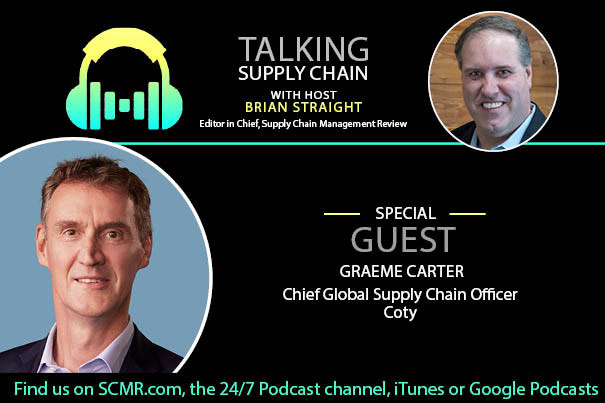
Brian Straight, SCMR Editor in Chief

Brian Straight is the Editor in Chief of Supply Chain Management Review. He has covered trucking, logistics and the broader supply chain for more than 15 years. He lives in Connecticut with his wife and two children. He can be reached at [email protected], @TruckingTalk, on LinkedIn, or by phone at 774-440-3870.
Follow SCMR on social media.
@SupplyChainManagementReview on Facebook
@SCMR on Twitter
SCMR on Linkedin
Subscribe

Supply Chain Management Review delivers the best industry content.

Editors’ Picks



