
Editor's note: The SCM thesis Elucidating Import Container Flows: A Simulation Study of Port of New York/New Jersey was authored by Kevin Power and Yassine Lahlou‑Kamal and supervised by Dr. Elenna Dugundji ([email protected]) and Dr. Thomas Koch ([email protected]). For more information on this research, please contact the thesis supervisors.
Examining inefficiencies at the Port of New York and New Jersey
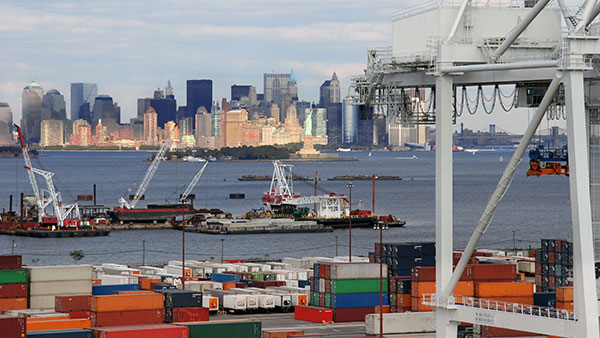
Chronic inefficiencies at major seaports have impacts that ripple through the entire supply chain, driving up shipping costs and consumer prices. Our capstone project looked for opportunities to improve operational efficiency by examining bottlenecks at the Port of New York and New Jersey, the largest port on the East Coast.
Our research identified three key challenges:
- Limited system-level visibility that prevents stakeholders from fully understanding the downstream effects of their individual operational decisions
- A lack of robust tools to test the potential impacts of proposed infrastructure investments, policy changes, or operational strategies before implementation
- Insufficient granular, container-level insights, particularly regarding the characteristics of the cargo itself and how they influence flow patterns and dwell times
Model and insights
To address these challenges, we created a discrete-event simulation model of import container flows through the Port of NY/NJ to enable structured experimentation that could help us understand complex interdependencies and quantify the impacts of various interventions. The model integrated real-world data from AIS vessel tracking and ImportGenius shipping manifests, and we used port infrastructure data and rail schedules for calibration to ensure that the model reflected realistic terminal dynamics. We employed a fine-tuned BERT model to classify cargo by commodity, enabling us to analyze dwell times by cargo type and explore targeted interventions for specific commodities.
Our research revealed the following key insights:
- Yard waiting time was the largest contributor to total dwell time, averaging nearly 59 hours (65% of total dwell time). This indicates that the interventions likely to yield the most significant reductions of dwell time are those that optimize yard operations, streamline container availability, and expedite inland transport (both truck and rail).
- The Port of NY/NJ has untapped rail capacity; raising the outbound rail share from 15% to 25% reduces truck queues by 11% and median dwell time by more than 2.5% for refrigerated containers.
- Extending gate hours by two hours could reduce median dwell time by more than 6% for refrigerated containers.
- Identifying specific high-volume commodity groups that are suitable candidates for shifts to rail transport and investigating the reasons why some commodity types consistently experience longer dwell times (e.g., specific inspection requirements, specialized handling needs, less frequent pickup patterns) could improve resource allocation.
Conclusions
Our simulation model and quantitative results offer valuable guidance for port authorities, policymakers, and private stakeholders, providing a shared platform to explore scenarios, anticipate consequences, and collaboratively work towards a more efficient, resilient, and sustainable port ecosystem.
SC
MR

More Port Strategy
 Explore
Topics
Procurement & Sourcing News
- When component verification becomes operational
- Caught between a rock and a hard place: Mapping your supply chain
- What options do you really have? Shaping the supply chain resilience funnel
- Nexus suppliers: Hidden anchors of resilience in decentralized supply chains
- Lead time economics: What semiconductor supply chains reveal about strategic planning
- Risk sharing is the new advantage in capital project delivery
- More Procurement & Sourcing
Latest Procurement & Sourcing Resources
Subscribe

Supply Chain Management Review delivers the best industry content.

Editors’ Picks



