March-April 2026
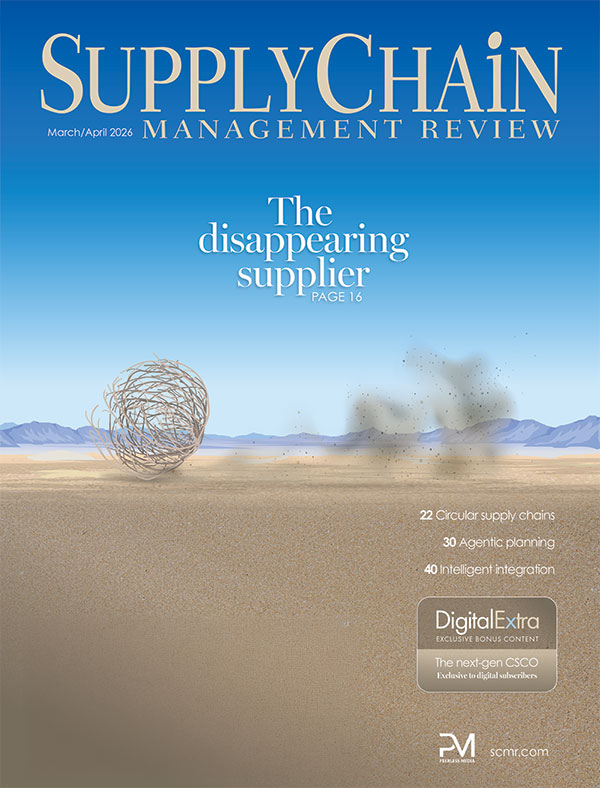
The March/April 2026 issue of Supply Chain Management Review examines how supply chain leaders are managing supplier risk, circular supply chain design, AI-driven retail planning, CPG network optimization, and shifting LTL market dynamics to improve resilience and performance. Features include frameworks to prevent supplier failure, operationalize circular economy strategies, prevent retail stockouts using AI, and eliminate costly DC transfer patterns, plus insights from the 34th Annual Study of Logistics and Transportation Trends and a digital-exclusive on the evolving CSCO role.
Not a subscriber?
Subscribe today
Align AI adoption with climate goals
APQC research shows that while organizations pursue aggressive AI adoption and Net Zero emissions goals, most fail to account for AI’s energy use and GHG impact—creating a…
1
Suppliers may evaporate, but leadership does not
Supplier volatility is just another risk that must be actively managed, and that means setting up processes to monitor all suppliers, not just those perceived to be most important.
4
Futurists: Dubious long-term planning help
Futurism often overpromises insight into distant futures while offering limited practical value for the real planning decisions supply chain leaders must make today.
8
Why Scope 3 demands collaboration—not just compliance
Scope 3 is not a firm-level problem. It is a system-level problem, and it requires system-level solutions.
12
Decision velocity: The new operating advantage for supply chain leaders
In a world of constant disruption and exponential data growth, supply chain performance increasingly depends on how quickly leaders can detect change, decide with confidence,…
16
Suppliers can evaporate: Five ways to improve SCM risk management
Suppliers can “evaporate” without warning, making proactive supply chain risk management essential. Procurement leaders can take “intelligent risks” rather than…
22
Circular supply chains: The backbone of a successful circular economy
Circular supply chains are emerging as a foundational operating model for the circular economy, enabling organizations to drive sustainability, resilience, and long-term value…
30
From human-in-the-loop to human-on-the-loop: An AI agent architecture for proactive planning
Supply chain planning tools are not new. Most organizations today rely on established systems for demand planning, supply planning, inventory optimization, and network design.…
40
To lead with Gen AI, become an integrator
As generative AI reshapes knowledge work, supply chain leaders must orchestrate people, processes, and intelligent systems, shifting from automation to integration to unlock…
46
34th Annual Study of Logistics and Transportation Trends: The Great Disconnect—Bridging the knowing/doing gap in logistics
Our survey team discovers a persistent gap between knowing what’s possible in logistics and actually putting it into practice. From AI adoption to talent development and…
52
How procurement teams are managing Tier 2 suppliers to lower costs and improve resilience
As tariffs, volatility, and compressed launch cycles expose the limits of Tier 1 oversight, procurement leaders are leveraging AI-driven Tier 2 visibility to cut upstream costs,…
56
Sustainability and AI: A complicated and often overlooked relationship
Supply chains are expanding the use of AI across functions, and that expansion means more data storage and more computation, which all require more electricity use and…
62
2026 Market Update: LTL holds the line
LTL carriers are maintaining rare pricing discipline in a tepid market, but rising costs and lingering overcapacity will test how long that resolve can last.
70
From operations to orchestration: The CSCO’s nexus role in a synergistic C-Suite
As volatility, digital acceleration, and cross-functional complexity intensify, the CSCO is evolving from operational leader to enterprise orchestrator, aligning finance,…