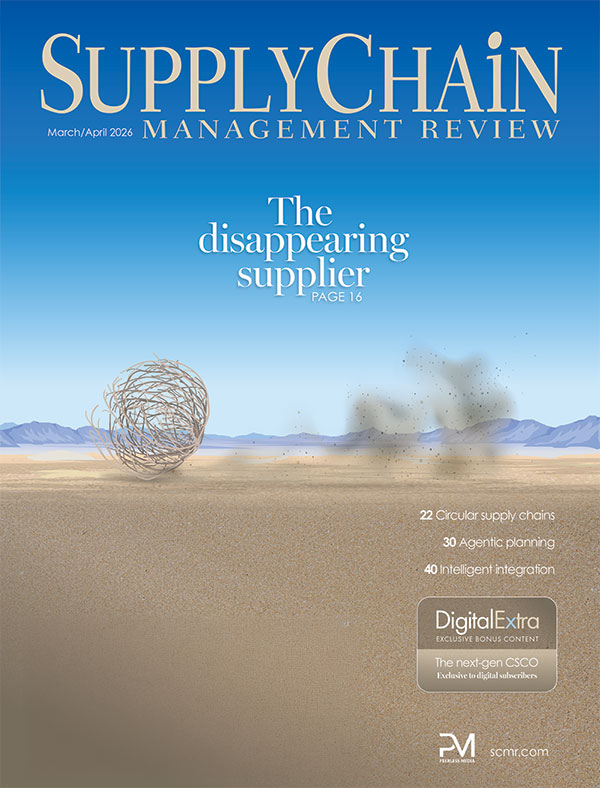
January-February 2026
The January 2026 issue of Supply Chain Management Review explores how rapid advances in autonomous trucking, AI-driven optimization, and workforce development are redefining what it means to lead a modern supply chain. As autonomy, data intelligence, and new operating models reshape logistics networks, supply chain managers must rethink how they orchestrate freight, develop talent, manage suppliers, and design resilient operations.
Inside, readers will find practical frameworks for scaling autonomous freight management, diagnosing fragile supply chains, uncovering hidden cost drivers, strengthening frontline education programs, and overcoming the data barriers preventing Agentic AI from delivering real business value. Together, these articles present a comprehensive look at the strategies supply chain leaders need to succeed in the decade ahead.
Not a subscriber?
Subscribe today
4
Oil 2026 update: Souring on climate politics
A shifting political landscape and stalled climate commitments are reshaping oil markets, energy security, and supply chain planning in 2026.
8
Human-aware automation: The future of vehicle intelligence depends on understanding people
Driving automation is advancing rapidly, yet the biggest challenges ahead have less to do with sensing the road and more to do with understanding the human behind the wheel.…
12
Global Links, the next chapter: Honoring a legacy, shaping what’s next
As Global Links welcomes a new editor, the focus remains clear: help supply chain leaders cut through the noise, harness AI and decision intelligence, and turn their supply…
12
How to make your CFO a supply chain superfan
College football superfans are fully invested, and their dedication elevates the sport. What if we could create that same enthusiasm, loyalty, and management commitment in the…
12
Starting inside the company: Supply chain resilience demands new initiatives and investments
So much is beyond any company’s control, including geopolitical and economic issues, new regulations, natural disasters, and shifting sustainability expectations. What is in a…
16
Supply chain and logistics management in the emerging age of autonomous trucking
The recent decade witnessed the rapidly evolving nature of autonomous trucking technologies, offering promises of improved logistics, inventory management, and customer service…
26
Not-so-sweet spots: Diagnosing cocoa supply chain woes using FMEA
A proactive approach using Failure Mode and Effects Analysis can help the cocoa and candy industry reduce waste, improve product quality, and strengthen supply chain resilience…
34
Seeing the full picture: Why service markups are the missing link in cost, quality, and workforce stability
Most companies track bill rates, but few understand the hidden markup forces driving cost overruns, turnover, and supplier performance risk.
4
When tech outruns talent
AI, autonomy, and digital transformation are accelerating, but unless organizations build the skills to use them, supply chains will remain stuck in pilot mode.
40
From perk to strategy: Rethinking tuition programs for supply chain success
Traditional tuition benefits often fail frontline workers. But smarter design and consistent messaging can help fix the supply chain talent crisis.
48
Today’s digital supply chains: On the road to maturity
Digital supply chains are gaining ground as businesses refocus their attention on the true technology business drivers.
Making innovation a measurement priority
To ensure precision and efficiency, supply chain organizations look for the right measures to track their performance. These efforts focus on identifying key performance…
52
The new logistics playbook for consumer and retail growth
Organizations that view logistics as an evolving system, rather than a fixed set of assets, position themselves to respond more effectively to these pressures and to capture the…