
Sorry, but your login has failed. Please recheck your login information and resubmit. If your subscription has expired, renew here.
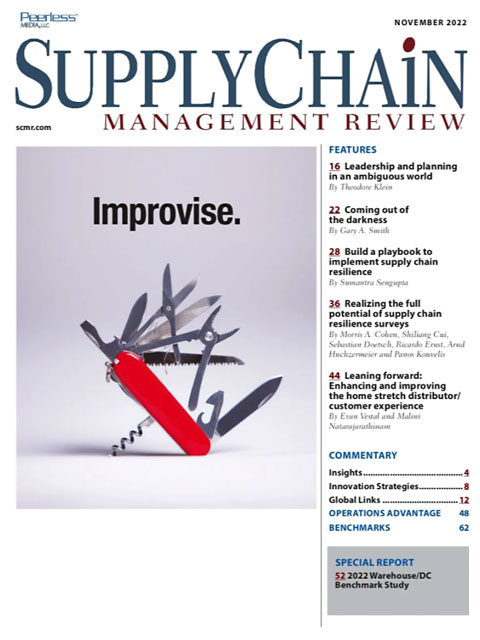
November 2022
Are you resilient? It’s not an idle question. If there’s one word that I’ve heard at every supply chain event I’ve attended this year, its resilience. It is, of course, in response to the last few years in supply chain management. I think its fair to say that supply chains have been knocked to the canvas more times than Rocky. What has become clear as we do our post-pandemic reviews is that the firms that demonstrated the ability to get up off the canvas and keep punching were those that invested in resiliency before the pandemic—even if they didn’t use that term. Browse this issue archive.Need Help? Contact customer service 1-508-503-1313 More options
In my September 2022 Insights column,* I assessed the state of the omni-channel market from demand-side and supply-side perspectives. I also discussed the evolution of Amazon and Walmart. I concluded that the e-tailing market grew more rapidly during the pandemic as more consumers chose the convenience of ordering on-line when stores were closed. However, brick-and-mortar retailers are starting to win back some market share from e-tailers through innovation. Still, uncertainties abound inventories with respect to which trends will continue and how to capitalize on them.
One of the supply-side assessments dealt with the buildup of inventory as the impact of the pandemic eases. A Wall Street Journal article from last June, “Retail Lead Times Spur Inventory Woes,” noted that as demand is picking up for different items than those routinely sold during the pandemic, “retailers are left with increasing inventories in concert with product shortages.” The combination of long production cycle times, factory closures, shipping delays, port backlogs and other supply-chain bottlenecks were prompting firms “to start designing and placing orders with overseas factories further in advance, making it harder to match supply with demand.”
Winners succeeded by having goods
I understand the problem of matching supply and demand based on an uncertain future. However, the article’s title implies that having excess inventory as the pandemic eases is a bad thing. Is it really? It depends.

This complete article is available to subscribers only.
Log in now for full access or start your PLUS+ subscription for instant access.
SC
MR
Sorry, but your login has failed. Please recheck your login information and resubmit. If your subscription has expired, renew here.
November 2022
Are you resilient? It’s not an idle question. If there’s one word that I’ve heard at every supply chain event I’ve attended this year, its resilience. It is, of course, in response to the last few years in… Browse this issue archive. Access your online digital edition. Download a PDF file of the November 2022 issue.In my September 2022 Insights column,* I assessed the state of the omni-channel market from demand-side and supply-side perspectives. I also discussed the evolution of Amazon and Walmart. I concluded that the e-tailing market grew more rapidly during the pandemic as more consumers chose the convenience of ordering on-line when stores were closed. However, brick-and-mortar retailers are starting to win back some market share from e-tailers through innovation. Still, uncertainties abound inventories with respect to which trends will continue and how to capitalize on them.
One of the supply-side assessments dealt with the buildup of inventory as the impact of the pandemic eases. A Wall Street Journal article from last June, “Retail Lead Times Spur Inventory Woes,” noted that as demand is picking up for different items than those routinely sold during the pandemic, “retailers are left with increasing inventories in concert with product shortages.” The combination of long production cycle times, factory closures, shipping delays, port backlogs and other supply-chain bottlenecks were prompting firms “to start designing and placing orders with overseas factories further in advance, making it harder to match supply with demand.”
Winners succeeded by having goods
I understand the problem of matching supply and demand based on an uncertain future. However, the article’s title implies that having excess inventory as the pandemic eases is a bad thing. Is it really? It depends.
SUBSCRIBERS: Click here to download PDF of the full article.
SC
MR


Latest Supply Chain News
- What options do you really have? Shaping the supply chain resilience funnel
- Nexus suppliers: Hidden anchors of resilience in decentralized supply chains
- Developing the next generation of supply chain leaders: Is higher education serving the needs of the marketplace?
- The value proposition: Bridging the skills gap between the SCM degree and the workplace
- Lead time economics: What semiconductor supply chains reveal about strategic planning
- More News
Latest Podcast

 Explore
Business Management News
- What options do you really have? Shaping the supply chain resilience funnel
- Nexus suppliers: Hidden anchors of resilience in decentralized supply chains
- Finding the ROI in supply chain education
- Managing human and AI teams across the supply chain
- Risk sharing is the new advantage in capital project delivery
- The AI-empowered supply chain leader
- More Business Management
Latest Business Management Resources

Subscribe

Supply Chain Management Review delivers the best industry content.

Editors’ Picks



