
Sorry, but your login has failed. Please recheck your login information and resubmit. If your subscription has expired, renew here.
July-August 2026
The July issue of Supply Chain Management Review explores how organizations are preparing for the future through workforce development, AI adoption, leadership education, and supply chain resilience. Features examine closing the skills gap, building AI-enabled teams, strengthening supplier networks, and developing practical strategies for navigating disruption in an increasingly complex global marketplace. Browse this issue archive.Need Help? Contact customer service 1-508-503-1313 More options
For graduates walking across the stage with a degree in supply chain management (SCM), it may feel like receiving a key to the engine room of the global economy. An investment of four years at tens of thousands of dollars in tuition seems like a fair trade for the engine room key, but that comes with expectations.
A few months into the first “real-world” role brings this into focus. The sophisticated ERP systems discussed in textbooks have been replaced by a fragmented series of legacy spreadsheets or systems held together by tribal knowledge. The strategic sourcing strategies practiced in case studies, which always turned out, are not relevant as they are sidelined by the immediate, chaotic necessity of finding a single missing container on a rail siding in Omaha. After just one year, so much has changed that you are now behind if you have not already begun to upgrade your SCM skills for the role.
SC
MR
Sorry, but your login has failed. Please recheck your login information and resubmit. If your subscription has expired, renew here.
For graduates walking across the stage with a degree in supply chain management (SCM), it may feel like receiving a key to the engine room of the global economy. An investment of four years at tens of thousands of dollars in tuition seems like a fair trade for the engine room key, but that comes with expectations.
“If you always do what you’ve always done, you’ll always get what you’ve always got.” - Henry Ford
A few months into the first “real-world” role brings this into focus. The sophisticated ERP systems discussed in textbooks have been replaced by a fragmented series of legacy spreadsheets or systems held together by tribal knowledge. The strategic sourcing strategies practiced in case studies, which always turned out, are not relevant as they are sidelined by the immediate, chaotic necessity of finding a single missing container on a rail siding in Omaha. After just one year, so much has changed that you are now behind if you have not already begun to upgrade your SCM skills for the role.
Reality sets in: Utility-to-effort dissonance
As this new SCM professional looks at their first student loan statement, a quiet but persistent dissonance begins to set in—was all this worth it? There may be a growing frustration that the “effort-to-utility” ratio used to evaluate the value of the degree is skewed. Typically, degrees are assigned a level of utility (value) based on a scale of values for assessing their worth in the marketplace (Mosteller & Nogee, 1951). Degrees in SCM must combine “science” with application in a work setting if young professionals are to be adequately equipped for the operational and strategic requirements defining their day-to-day roles.
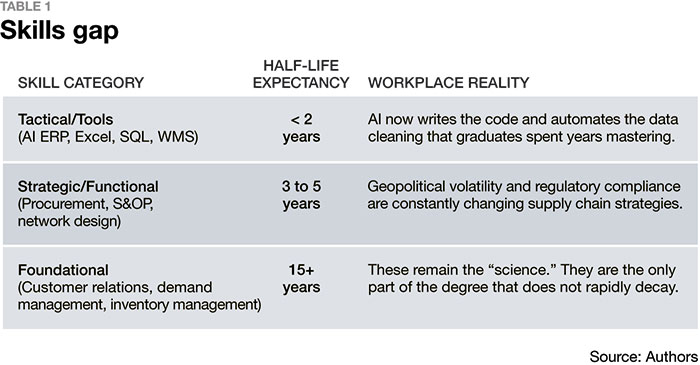
The harsh reality facing new employees and their employers today is the “half-life” period of the SCM degree has accelerated at an alarming rate. This is a sobering metric for a new graduate as they face an ever-changing environment. In the context of today’s workspace, the shelf life of the technical and tactical skills acquired during a four-year SCM program has reached an all-time low. While a degree provides a permanent credential, the utility of the specific technical skills within that degree now follows a rapid decay curve.
Current industry data suggests that the half-life of technical skills in business and technology fields—including SCM—is now approximately 2.5 to 5 years (Morson Group, n.d.) In highly digitalized areas of supply chain operations like AI-driven forecasting, robotic process automation (RPA), and real-time logistics tracking, the half-life can be as short as 18 to 24 months. By the time a graduate celebrates their third work anniversary, nearly 50% of the specific software tools, tactical methodologies, and technical frameworks they learned in their SCM degree program are either obsolete or have been significantly superseded by AI-augmented systems (World Economic Forum, 2025). This creates a gap between the skills required in the workplace today versus those that students were taught in academia just a few years prior (see Table 1 below).
How did we get here?
As greater access to college education increased the number of degree holders over the decades, the four‑year SCM degree has emerged as a primary mechanism for developing work‑ready supply chain talent. In the past decade alone, universities witnessed more than a 105% increase with an average of 16,000 SCM degrees being awarded annually (National Center for Education Statistics, 2023). The growth in this field can be partly attributed to the rise of importance of the supply chain function in firms. The SCM major provides graduates with structured exposure to operationally critical skills such as:
- customer relationship management;
- demand management;
- economic order/production quantity;
- inventory management;
- procurement;
- project management; and
- supplier relationship management.
The goal is to ensure SCM program graduates are adequately trained with the basic skillset needed to tackle the challenges of the workspace. Industry is seeking entry-level hires to be “operationally bilingual” who can handle new and highly complex market environments. Young SCM professionals need to speak the language of high-level SCM concepts as well as be able to apply this knowledge in the successful execution of operations in the firm today.
To further strengthen SCM graduates’ skills and overall competitiveness, universities established formal partnerships with industry leaders to couple the delivery of critical SCM knowledge with experiential opportunities such as case studies, in-class assignments, internships, projects, etc., to apply conceptual theory in a practical work setting.
Unfortunately, these partnerships frequently result in predictable or “sanitized” learning experiences because of the use of basic assignments using normalized data. Often done for cost and expediency reasons, students gain little hands-on opportunity in the development of applying SCM in the very real-world scenario they will face in industry. Here we have what is fast becoming an obsolete model for talent acquisition, despite the academic/industry partnership.
Adding to the talent development challenges are ever-changing global pressures. Firms are facing these changes at unprecedented levels, requiring the development of new “must-have” skills for a successful entry-level SCM professional (see Table 2).
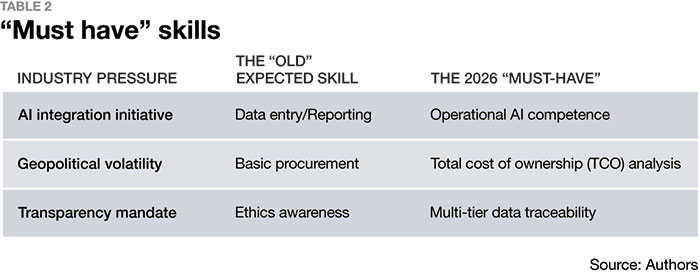
In this section we take a deeper look at each of these pressures, as well as the new “must-have” skills if entry-level SCM professionals are to bring value to firms. To ensure SCM professionals are ready for the workspace, forward-thinking firms and universities MUST rethink their traditional partnerships.
1. The AI integration initiative.
Due to the rapidity of changing workspace skill needs and previously discussed half-life value of the SCM degree, AI now handles the easy stuff (routine forecasting and replenishment). This has created a pressure-cooker environment where the only tasks left for humans are the exceptions (Sudirman, A., et al., 2026). These are the messy, non-mathematical problems like a port strike, a warehouse fire, or a sudden labor shortage.
Must-have skill: Exception management & AI literacy.
- The workplace reality: New graduates are expected to be equipped with operational AI competence to audit supply chain performance to determine AI’s optimal suggestion using real-world scenarios.
- Success metric: Can you look at an AI-generated delivery route, recognize a localized weather event the system missed, and manually override it to save the client relationship?
2. Geopolitical volatility.
Firms are currently trapped in a cycle of rapid-fire geopolitical shifts. Supply chains are suddenly facing unprecedented global upheaval events related to geoeconomic confrontation, state-based armed conflict, and societal polarization, changing
the cost of doing business almost weekly. Companies are under immense pressure to keep relationships profitable even as landed costs jump by nearly 11% (World Economic Forum, 2026).
Emerging must-have skills: Financial & sourcing literacy
- The workplace reality: New graduates must be able to perform total cost of ownership (TCO) analysis on changing supply chain environments “on the fly.”
- Success metric: Can you explain to a manager how a 10% tariff increase on a Tier 2 supplier in Asia ripples through the entire margin of a finished product?
3. The transparency mandate.
Sustainability compliance is now a legal requirement of the supply chain landscape (EY, 2026). New regulations such as the International Ethics Standards for Sustainability Assurance or International Standard on Sustainability Assurance 5000 now require firms to stay up to date with global sustainability standards to meet changing compliance and transparency requirements. Non-compliance issues can result in monetary fines, product seizure, along with loss of brand reputation.
Emerging must-have skill: Digital traceability & data auditing
- The workplace reality: New graduates must be able to clean messy supply chain data by providing the firm with supply chain multi-tier data traceability. Firms need professionals who can navigate Blockchain or Digital Product Passports to verify compliance.
- Success metric: Can you audit a supplier’s ESG data and flag a “red zone” risk before the shipment hits customs?
What can we (academia and industry) do?
In response to growing global pressures we, academia and industry, have identified three critical SCM program enhancements. Incorporating these enhancements into the SCM curriculum will better arm young professionals with the requisite value and skills firms demand.
1. Applied digital fluency and AI integration
SCM programs must teach digital fluency by designing curricula that move beyond basic data management toward applied technology, where students are trained to be “techno-strategists” (Attaran et al., 2023).
- Generative AI & machine learning: Programs are integrating AI to improve forecasting accuracy and operational efficiency (He et al., 2024).
- Digital twins: Digital twins (DT) are used in simulating entire supply chains. This allows students to stress-test scenarios, model different nodes, and uncover abnormalities before they manifest in real-world settings (Attaran et al., 2023).
- Data-driven decision making: Schools are embedding big data analytics and real-time information sharing into core modules to develop data literacy and analytical reasoning (Industry 4.0 in Logistics Higher Education, 2026).
2. Strategic resilience and risk management
Disruptive global events have shifted the focus from just-in-time efficiency to just-in-case supply chain resilience (Jiang, B., Rigobon, D. E., & Rigobon, R.,2021), necessitating supply chain resiliency as a core competency.
- Scenario planning: Curricula now emphasize using predictive analytics to assist in forecasting future difficulties and shifting market demands.
- Cybersecurity & data governance: As networks become more interconnected via the internet of things (IoT), graduates are viewing data security and ethical data governance as a means of protecting the integrity of the supply chain (Industry 4.0 in Logistics Higher Education, 2026).
- Agility: Educational models are incorporating immersive environments, such as AR/VR, to help students develop cognitive agility when responding to complex disruptions.
3. Supply chain sustainability and circular economy metrics
The shift toward sustainable supply chain management (SSCM) is no longer a peripheral concern but a fundamental component of modern business strategy, incorporating economic, environmental, and social dimensions to ensure long-term viability (Esan et al., 2024). Industry leaders expect SCM graduates to have the skill set necessary to lead this transition toward sustainable supply chain networks design incorporating circular economy metrics.
- ESG integration: Curricula are being adjusted to teach students how to integrate environmental, social, and governance (ESG) metrics into traditional finance and operations frameworks (Abdel Magid et al., 2023; Beyond Greenwashing, 2026).
- Circular metrics: Programs are introducing objective evaluations of resource efficiency, such as circular material use rate (CMUR) and lifecycle carbon intensity, to move beyondgreenwashing (Beyond Greenwashing, 2026).
- SDG alignment: HEIs are increasingly aligning their logistics modules with sustainable development goals (SDGs), focusing on renewable resource management and ethical sourcing (Sustainability-Oriented Higher Education Activities, 2026).
Expected employment growth and outcomes for skilled SC professionals
The U.S. economy is projected to grow employment for all sectors of industry by 3.1% CAGR from 2024 to 2034, according to the U.S. Bureau of Labor Statistics (BLS, 2025). However, employment of SCM professionals is projected to grow to 17% CAGR for the same period. Annually, the supply chain will generate over 26,000 openings for SCM professionals over the next decade.
Globalization and technological advancements are driving demand for graduates possessing the skill set discussed in this article, emphasizing AI integration and fluency, data analytics, risk management, and sustainability.
In its recent 2025 supply chain salary survey, the Association for Supply Chain Management (ASCM) found supply chain professionals holding a bachelor’s degree have a median salary of $92,000. Of the supply chain professions participating in the survey, individuals reported:
- 81% higher job satisfaction levels than their peers;
- 85% express pride in their roles as industry professionals and value contribution; and
- 83% enthusiastically recommend supply chain to those seeking a change or students charting their professional futures.
A similar positive outlook is demonstrated in graduate outcomes for top-tier supply chain management programs. Programs report exceptional employment placement rates of approximately 82% (on graduation) and 93% ninety days following graduation (Note: data represents the aggregation of employment results from top 10 SCM programs listed in article references.) Based on the growth and outcomes in the supply chain profession, the answer to whether to partnership or not in alignment of SCM program curriculum is a resounding ‘yes’ for firms and institutions.
Moving forward
Supply chain pioneering legend Bernard (Bud) LaLonde (2001) stated that upon graduation SC professionals will “need to spend 20% of the time investing in new skills so as not to become obsolete.” This applies not only to professionals but their employers and universities responsible for their training.
For those who choose to move forward with the strategy outlined here, making a collaborative and concentrated effort in the development talent a habit is a win-win for employers, employees, students and of course universities. This effort starts at the entry of students into the SCM program and continues as the graduate walks across the stage and moving into the “engine room” of the global economy.
In adopting the suggested enhancements outlined in this article, SCM programs can ensure their graduates’ degrees have a longer functional half-life and that graduates enter the workforce with the requisite value firms are demanding. Achieving these ends, however, is not a one-time collaboration. Industry leaders and universities with forward-thinking programs must establish deeper and ongoing partnerships to ensure SCM program curricula incorporates the three critical SCM program enhancements discussed above.
Many top SCM programs across the country are taking deliberate actions to ensure program curriculum consistently develops capabilities mapping directly to modern supply chain requirements. Graduates of these programs easily demonstrate proficiency in quantitative analysis, data interpretation, process mapping, and cross‑functional communication when entering the workspace, but graduating is only the first step on a new path.
They are trained by SCM program curriculum to frame ambiguous problems, evaluate tradeoffs, and support recommendations with conceptual, financial, and operational reasoning. These new SCM skills reflect the interdisciplinary nature of supply chain management, its growing importance in industry and society, and prepare graduates to operate interdependently within complex corporate systems, rather than executing disconnected tasks in corporate and/or market isolation.
Well-prepared SCM professionals can help their firms reap improvements (i.e., performance, productivity, and profit) that compound quickly. Possessing the ability to make informed operational enhancements such as forecast accuracy improvements, reduced premium freight, or safety stock adjustments, generate disproportionately higher financial returns for the firm.
Enhanced supply chain capabilities directly influence overall revenue growth and operating cost savings. An efficient supply chain minimizes waste from excess inventory and reduces logistics-related opportunity costs, which typically account for a substantial portion of a firm’s total expenditures (He et al., 2024).
Not only will these actions result in operational cost savings and performance, SCM professionals graduating from such programs described in this article compress the employee investment payback period measured in weeks rather than years. Accompanying this is improvement of employee fit culturally and managerially. Industry firms actively partnering with innovative universities to design-redesign SCM curricula to meet market needs experience lowered replacement costs for entry‑level employees. These replacement expenses include activities related to employee recruiting, onboarding, and lost productivity which represents 20% to 30% of an annual salary (Warner, 2025).
In closing, graduates with SCM degrees obtained through universities’ programs with the characteristics discussed in this article provide early‑career success representing a substantial, though often hidden, source of return on degree‑aligned hiring decisions for industry and universities alike. It is the authors’ hope this paper is a call for deeper conversation and collaboration between academia and business partners to create a winning outcome for everyone.
*Note: article grammar, clarity, spelling, and structure was enhanced via AI (Gemini)
References:
Arizona State University. (2025). W. P. Carey School of Business undergraduate career outcomes report: Class of 2025. https://career.wpcarey.asu.edu/
Association for Supply Chain Management. (2025). 2025 supply chain salary and career report. https://www.ascm.org/making-an-impact/research/salary-survey
Abdel Magid, A., Hussainey, K., De Andrés, J., & Lorca, P. (2023). The moderating role of online social media in the relationship between corporate social responsibility disclosure and investment decisions: Evidence from Egypt. International Journal of Financial Studies, 11(2), 60. https://doi.org/10.3390/ijfs11020060
Attaran, M., Attaran, S., & Celik, B. G. (2023). The impact of digital twins on the evolution of intelligent manufacturing and Industry 4.0. Advances in Computational Intelligence, 3. https://doi.org/10.1007/s43674-023-00058-y
Beyond greenwashing: how circular economy metrics could revolutionize ESG investing. (2026). Frontiers in Sustainability. https://doi.org/10.3389/frsus.2025.1588374/full
Esan, O., Ajayi, F. A., & Olawale, O. (2024). Supply chain integrating sustainability and ethics: Strategies for modern supply chain management. World Journal of Advanced Research and Reviews, 22(1), 1930-1953.
EY. (2026, March 17). What do shifting sustainability regulations mean for business? https://www.ey.com/en_gl/insights/climate-change-sustainability-services/what-do-shifting-sustainability-regulations-mean-for-business
Georgia Institute of Technology. (2025). Scheller College of Business undergraduate employment profile: Class of 2025. https://www.scheller.gatech.edu/career-services/undergraduate/index.html
He, J., Fan, M., & Fan, Y. (2024). Digital transformation and supply chain efficiency improvement: An empirical study from a-share listed companies in China.
PLOS ONE, 19, e0302133. https://doi.org/10.1371/journal.pone.0302133
Industry 4.0 in Logistics Higher Education. (2026). IntechOpen. https://www.intechopen.com/online-first/1233793
Jiang, B., Rigobon, D. E., & Rigobon, R. (2021). From Just in Time, to Just in Case, to Just in Worst-Case: Simple models of a Global Supply Chain under Uncertain Aggregate Shocks (No. w29345). National Bureau of Economic Research.
Michigan State University. (2025). Eli Broad College of Business: 2025 undergraduate program employment report. https://broad.msu.edu/career-management/outcomes/
Morson Group. (n.d.). The technical half-life: What skill decay means for productivity. https://morson-group.com/news/technical-half-life-skills-decay/
Mosteller, F., & Nogee, P. (1951). An experimental measurement of utility. Journal of political economy, 59(5), 371-404.
National Center for Education Statistics. (2023). Table 322.10. Bachelor’s degrees conferred by postsecondary institutions, by field of study: Selected academic years, 1970-71 through
2021-22. Digest of Education Statistics. https://nces.ed.gov/programs/digest/d23/tables/dt23_322.10.asp
The Ohio State University. (2025). Fisher College of Business: 2024-2025 undergraduate salary and outcome data. https://fisher.osu.edu/careers-recruiting/salary-outcome-data
Pennsylvania State University. (2025). Smeal College of Business: Undergraduate career statistics class of 2025. https://ugstudents.smeal.psu.edu/career-connections/statistics
Purdue University. (2025). Mitch Daniels School of Business: Undergraduate career success and outcomes 2025. https://business.purdue.edu/undergraduate/career-success/
Rutgers University. (2025). Rutgers Business School: Undergraduate placement and salary report 2025. https://www.business.rutgers.edu/career-management/undergraduate-outcomes
Sudirman, A., et al. (2026). Procurement 4.0: A three-pillar framework for ethical AI adoption in small businesses. Journal of Small Business Strategy, 36(1). https://jsbs.scholasticahq.com/article/157792
Sustainability-Oriented Higher Education Activities: Insights from Institutional Isomorphism Perspective. (2026). MDPI. https://www.mdpi.com/2071-1050/17/24/11034
Texas A&M University. (2025). Mays Business School: 2025 undergraduate employment statistics. https://mays.tamu.edu/career-management-center/statistics/
University of Arkansas. (2025). Sam M. Walton College of Business: 2024-2025 undergraduate employment outcomes. https://walton.uark.edu/career/employment-outcomes.php
U.S. Bureau of Labor Statistics. (2024, August 29). Logisticians. Occupational outlook handbook. https://www.bls.gov/ooh/business-and-financial/logisticians.htm
University of Tennessee, Knoxville. (2025). Haslam College of Business: Supply chain management career outcomes report 2025. https://haslam.utk.edu/career-management/outcomes/
Warner, C. (2025, April 23). The real cost of employee turnover now. HRMorning. https://www.hrmorning.com/articles/real-cost-employee-turnover/
World Economic Forum. (2026). The global risks report 2026 (21st ed.). https://www.weforum.org/publications/global-risks-report-2026/in-full/
About the authors
David Widdifield, DBA, is a clinical associate professor and vice chair of the Department of Marketing & Logistics at the Fisher College of Business at The Ohio State University. He can be reached at [email protected].
Misty Blessley, Ph.D., is an associate professor in the Department of Information Systems and Supply Chain Management at the John Chambers College of Business and Economics at West Virginia University. She can be reached at [email protected].
SC
MR


More Executive Education
- Developing the next generation of supply chain leaders: Is higher education serving the needs of the marketplace?
- The value proposition: Bridging the skills gap between the SCM degree and the workplace
- Developing supply chain talent for new product development
- From perk to strategy: Rethinking tuition programs for supply chain success
- Leadership turmoil threatens supply chain resilience, Gartner survey finds
- More Executive Education
What's Related in Executive Education

 Explore
Topics
Education News
- Innovators Netstock, Pickle Robot win NextGen Solution Provider awards
- NextGen Supply Chain Conference unveils agenda focused on AI, execution and the future of leadership
- Developing the next generation of supply chain leaders: Is higher education serving the needs of the marketplace?
- The value proposition: Bridging the skills gap between the SCM degree and the workplace
- Finding the ROI in supply chain education
- Wayfair executive to share lessons from building a tech-driven delivery network in NextGen Keynote
- More Education
Latest Education Resources
Subscribe

Supply Chain Management Review delivers the best industry content.

Editors’ Picks



