
Sorry, but your login has failed. Please recheck your login information and resubmit. If your subscription has expired, renew here.
Every new process or system needs a safe place to fail. In software development, teams use staging environments or “sandboxes” to test new ideas before they go live. They can build, experiment, and fix problems without real-world risk. If something doesn’t work or show promise, they move on to the next idea.
Supply chain planners don’t have these luxuries. Most of their experiments happen in the real world, where production schedules, budgets, and customer expectations are all on the line. Volatility has always been a part of supply chain management, of course, but there’s just more of it coming from many different directions now. Shifting trade policies, new tariffs, the push to reshore and nearshore, and constant disruption are just some of the variables that can hit harder and faster than traditional planning models can handle.
Planning through that volatility requires more than experience or instinct, and that’s where the digital twin comes in. Gartner defines a digital twin as a digital representation of a real-world object or system. In practice, it’s a software model that mirrors a specific physical asset, process, or organization. Companies can also combine data from multiple digital twins to create a broader view of connected operations (i.e., an entire plant, network, or city).
SC
MR
Sorry, but your login has failed. Please recheck your login information and resubmit. If your subscription has expired, renew here.
Every new process or system needs a safe place to fail. In software development, teams use staging environments or “sandboxes” to test new ideas before they go live. They can build, experiment, and fix problems without real-world risk. If something doesn’t work or show promise, they move on to the next idea.
Supply chain planners don’t have these luxuries. Most of their experiments happen in the real world, where production schedules, budgets, and customer expectations are all on the line. Volatility has always been a part of supply chain management, of course, but there’s just more of it coming from many different directions now. Shifting trade policies, new tariffs, the push to reshore and nearshore, and constant disruption are just some of the variables that can hit harder and faster than traditional planning models can handle.
Planning through that volatility requires more than experience or instinct, and that’s where the digital twin comes in. Gartner defines a digital twin as a digital representation of a real-world object or system. In practice, it’s a software model that mirrors a specific physical asset, process, or organization. Companies can also combine data from multiple digital twins to create a broader view of connected operations (i.e., an entire plant, network, or city).
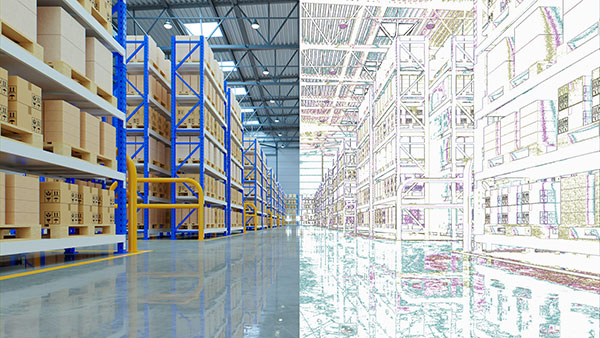
Virtual replicas of supply chains, digital twins help planners model new ideas, test scenarios, and see how changes ripple through the network before acting on them. It’s the closest thing the supply chain world has ever had to a sandbox, and it enables faster, data-driven responses amid changing conditions.
Testing scenarios & modeling risk
Once considered a buzzword, digital twins are now a practical tool for supply chain planning. By creating a live digital replica of their operations—or, of one specific segment of their operations—companies can test scenarios, model risks, and adjust plans in real-time. In a market where change is constant, having this level of foresight turns planning accuracy into a competitive advantage.
When Om Prakash reflects on the use of digital twins in supply chain planning, he describes it as a “major step forward” compared to traditional modeling approaches. “Imagine you have a living, breathing virtual copy of your entire supply chain that updates in real-time and runs what-if scenarios constantly,” says Prakash, senior procurement project manager at PIP Global Safety, Honeywell Safety Products, in Sterling Heights, Mich. “That’s fundamentally different from traditional models.”
Drawing on his experience at a previous company, Prakash says earlier data models acted like snapshots. They showed inventory levels or supplier performance—but only after the fact. Procurement data lived in one system, quality metrics in another, and inventory in a third. When a semiconductor supplier in Europe shut down, teams spent hours piecing together the full picture before they could act.
That fragmentation began to disappear when the company integrated 20-plus different data sources (e.g., supplier financial health, weather patterns, geopolitical risk, etc.) and built a dynamic model that mirrored every node, flow and relationship in its physical supply chain. The system ran continuous simulations to identify vulnerabilities and test responses before disruptions occurred.
The digital twin ran thousands of what-if scenarios automatically, and constantly stress-tested the network against real-world variables. That visibility helped planners quantify exposure instead of guessing. “We went from being blindsided by disruptions to having 14 days of advance warning on average,” Prakash explains. During the October 2022 China lockdown, for example, companies with digital twin capabilities were actually simulating that precise situation one or two months earlier.
“While competitors were scrambling, these companies executed their playbooks within 48 hours,” says Prakash, who now sees digital twins being used for demand forecasting, network optimization, and sustainability scenario modeling. Companies can pull in external signals like weather data, social trends, and economic indicators to create forecasts that adjust in real time.
Those insights help planners more confidently test whether supply can meet potential demand. The same technology advances network optimization by letting planners simulate long-term structural changes like nearshoring components, adding distribution centers, or rebalancing supplier capacity before taking action.
Prakash expects the next wave of digital twin usage to focus on sustainability scenario modeling. For example, organizations can use the technology to map carbon footprints across their networks, measure the effects of new environmental policies, and test circular economy strategies prior to implementation. “The key is that digital twins don’t just give you better data; they give you actionable intelligence,” he notes. “That’s where the real value lies.”
The AI acceleration factor
Picture a smart home that adjusts automatically to weather, energy prices and how many people are inside. Sensors feed data into one hub that learns, anticipates, and keeps everything running efficiently. A digital twin does the same for supply chain planning by connecting data from across the network, spotting patterns, and helping planners adjust their operations in real-time.
Jan Snoeckx, director analyst at Gartner, says the fully connected, end-to-end digital twin remains aspirational for most companies, although some are already moving closer to it. He says companies need stronger data connections, smarter analytics and clear boundaries that show where automation ends and human judgment begins. “The idea of a single model that mirrors the entire supply chain from end to end is powerful,” he says. “But it also sets a very high bar.”
Digital twins are also reshaping what it means to be a planner. As analytics and artificial intelligence (AI) handle the repetitive data work, planners are stepping into more strategic roles that Snoeckx describes as “orchestration.” So instead of keying in data or approving every change, planners guide and supervise intelligent systems, set boundaries and make sure decisions align with business goals.
“It’s not about replacing the planners,” he says. “It’s about giving them the visibility and intelligence to act as strategic partners to the business.”
Looking ahead, Snoeckx expects AI to continue pushing digital twin adoption even further. For example, digital twins provide the context AI needs to make intelligent, supply chain-specific decisions. Without that foundation, automation can’t work reliably. “AI and IoT are mirror enablers,” he says. “Together, they’ll drive the next wave of intelligent planning.”
The digital twin as a technologist
A digital twin isn’t just another analytical model. It’s a living system that continuously monitors, learns and adapts across the supply chain. “Think of it as a digital replica of a physical supply chain,” says Shashank Mane, VP of sales and go-to-market at Capgemini. “Traditional simulation tools could predict outcomes but a digital twin goes further by monitoring and diagnosing the network in real-time.”
Digital twins can also predict what will happen and—if they’re built properly—even prescribe actions, says Mane, who recently worked with a manufacturer that used a digital twin to handle a last-minute order from a top customer without disrupting other commitments.
In the past, planners would’ve spent weeks collecting data from multiple systems and testing options manually. The twin did it in minutes by pulling live data from production, logistics, and inventory systems to test every scenario. “It allows experimentation at a completely different level,” he says. “That’s where companies see the real value of digital twins in planning.”
First things first
For companies ready to start using digital twins, Mane says it’s best to begin with a strong foundation built on three essentials: digital insight, which connects equipment and software so data flows vertically; digital continuity, which links processes across departments; and digital convergence, where modeling and simulation come together. “When those layers work in sync,” he notes, “you get a system that scales easily and provides continuous value.”
To avoid common pitfalls, Prakash suggests these five starting points.
- Secure executive support. Digital twin projects span departments, so they need leadership that can align goals and resources. A visible sponsor helps maintain momentum and keeps teams focused when priorities shift.
- Start narrow but go deep. Build a full twin for one product line or region, show clear results, then expand. Early wins prove value and create internal advocates for the next phase.
- Clean your data first. Standardize and validate data before layering in analytics or automation. A single, accurate data source prevents missteps and strengthens every decision that the twin supports.
- Invest in change management. Training and adoption often take more time and budget than technology itself. People have to understand how to use the system and trust what it’s
- telling them.
- Celebrate the small wins loudly. Success stories drive adoption better than any training program can, so make sure everyone from the CEO to the shop floor manager hears about it. Recognizing quick wins builds momentum for long-term transformation.
By learning in stages, adding complexity gradually and celebrating small wins early, companies can build digital twins that actually work in practice. The enthusiasm will spread quickly when the digital twin prevents its first disruption. “Building an end-to-end digital twin can be challenging,” Prakash says, “but once it’s up and running, you’ll wonder how you ever managed without it.”
SC
MR

More Digital Twins
- From orbit to operations: Winning the race for the earliest disruption signal
- Supply chain resilience and AI readiness start with location-based data
- Why Agentic AI is finally working in supply chains
- How autonomous fulfillment is rewriting the rules of supply chain execution
- Using digital twins to master supply chain volatility
- More Digital Twins
 Explore
Topics
Business Management News
- What options do you really have? Shaping the supply chain resilience funnel
- Nexus suppliers: Hidden anchors of resilience in decentralized supply chains
- Finding the ROI in supply chain education
- Managing human and AI teams across the supply chain
- Risk sharing is the new advantage in capital project delivery
- The AI-empowered supply chain leader
- More Business Management
Latest Business Management Resources
About the Author
Bridget McCrea, Contributing Editor

Bridget McCrea is a Contributing Editor for Logistics Management based in Clearwater, Fla. She has covered the transportation and supply chain space since 1996 and has covered all aspects of the industry for Logistics Management and Supply Chain Management Review. She can be reached at [email protected], or on Twitter @BridgetMcCrea
Follow SCMR on social media.
@SupplyChainManagementReview on Facebook
@SCMR on Twitter
SCMR on Linkedin
Subscribe

Supply Chain Management Review delivers the best industry content.

Editors’ Picks



