
Sorry, but your login has failed. Please recheck your login information and resubmit. If your subscription has expired, renew here.
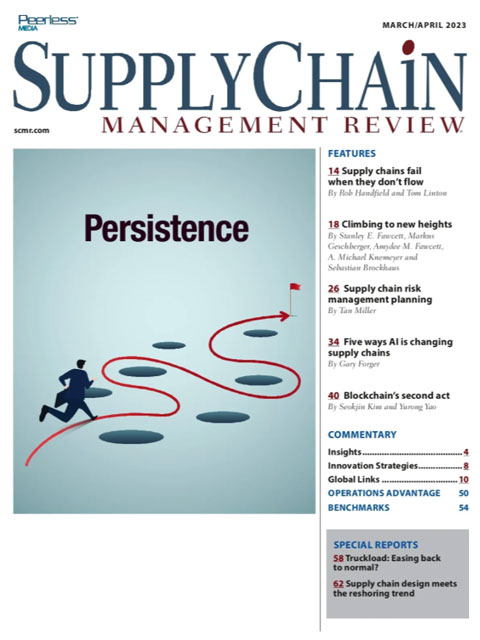
March-April 2023
In June 2013, Frank Quinn stepped down as the only editorial director Supply Chain Management Review had ever known. “In thinking about those whom I’m indebted to for the success of SCMR over 16 years, there is one constituency that must rank first on the list—you, the reader,” Frank wrote, as he handed over the reins to Bob Trebilcock. Now, Bob has done the same, handing over the reins to the next generation. I am very proud to be that next generation. In a farewell letter of sorts, Bob wrote that he was the “old” and I as the “new.” Nothing could be further from the truth. There is no old or new, only continuity. That continuity is… Browse this issue archive.Need Help? Contact customer service 1-508-503-1313 More options
In early 2020, the tragic onset of a global pandemic dramatically raised the visibility of supply chain risk management (SCRM). The sudden disruptions to everyday life, businesses and supply chains worldwide brought on by the coronavirus forced an almost instantaneous rethinking of supply chain operations, management and risk across all industries.
In this article, recognizing the heightened importance of risk management, we illustrate practical, easy-to-implement SCRM frameworks and analyses to support supply chain decision-making and management. We begin with a short review of the types of risk that firms must assess in creating their risk management strategy. This review provides context for the frameworks that we will introduce. After this brief review, we then turn to the focus of the article and present several illustrative SCRM frameworks and analysis templates.
Risks to consider
When constructing a supply chain risk management strategy, a firm can assure that it undertakes a holistic view of all potential threats by first evaluating general categories of risk, and then considering specific individual risks. Why take this two-step approach? The danger of immediately focusing on a few specific known risks to a firm before first performing a broad review across all risk types is that immediately diving into specifics may cause some less obvious, but important risks to be overlooked. Hence the need for a two-step approach. Figure 1 presents nine broad categories of generic risks (column 1), and offers examples of each category of risk (column 2).

This complete article is available to subscribers only.
Log in now for full access or start your PLUS+ subscription for instant access.
SC
MR
Sorry, but your login has failed. Please recheck your login information and resubmit. If your subscription has expired, renew here.
March-April 2023
In June 2013, Frank Quinn stepped down as the only editorial director Supply Chain Management Review had ever known. “In thinking about those whom I’m indebted to for the success of SCMR over 16 years, there is… Browse this issue archive. Access your online digital edition. Download a PDF file of the March-April 2023 issue.In early 2020, the tragic onset of a global pandemic dramatically raised the visibility of supply chain risk management (SCRM). The sudden disruptions to everyday life, businesses and supply chains worldwide brought on by the coronavirus forced an almost instantaneous rethinking of supply chain operations, management and risk across all industries.
In this article, recognizing the heightened importance of risk management, we illustrate practical, easy-to-implement SCRM frameworks and analyses to support supply chain decision-making and management. We begin with a short review of the types of risk that firms must assess in creating their risk management strategy. This review provides context for the frameworks that we will introduce. After this brief review, we then turn to the focus of the article and present several illustrative SCRM frameworks and analysis templates.
Risks to consider
When constructing a supply chain risk management strategy, a firm can assure that it undertakes a holistic view of all potential threats by first evaluating general categories of risk, and then considering specific individual risks. Why take this two-step approach? The danger of immediately focusing on a few specific known risks to a firm before first performing a broad review across all risk types is that immediately diving into specifics may cause some less obvious, but important risks to be overlooked. Hence the need for a two-step approach. Figure 1 presents nine broad categories of generic risks (column 1), and offers examples of each category of risk (column 2).
SUBSCRIBERS: Click here to download PDF of the full article.
SC
MR


More Risk Management
- When component verification becomes operational
- Caught between a rock and a hard place: Mapping your supply chain
- What options do you really have? Shaping the supply chain resilience funnel
- Nexus suppliers: Hidden anchors of resilience in decentralized supply chains
- Lead time economics: What semiconductor supply chains reveal about strategic planning
- Risk sharing is the new advantage in capital project delivery
- More Risk Management
Latest Resources
 Explore
Procurement & Sourcing News
- Coordinating AI-enabled supply chain operations
- The hidden supply chain risk no dashboard shows
- AI is reshaping the last meter of delivery
- Last-mile delivery success begins before the driver arrives
- Elucidating import container flows: A simulation study of Port of New York/New Jersey
- Wayfair executive to share lessons from building a tech-driven delivery network in NextGen Keynote
- More Procurement & Sourcing
Latest Procurement & Sourcing Resources
Subscribe

Supply Chain Management Review delivers the best industry content.

Editors’ Picks



