
Sorry, but your login has failed. Please recheck your login information and resubmit. If your subscription has expired, renew here.
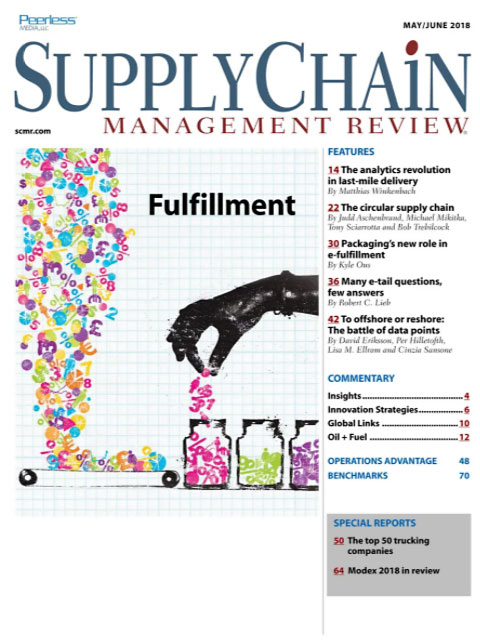
May-June 2018
Last month, I was in Atlanta at the Modex trade show. In one sense, it is a tribute to the automation technologies managing today’s distribution networks. And, I’m not only talking about automated materials handling systems, but also the software and NextGen technologies such as robotics, wearable technologies, including smart glasses and augmented reality solutions and sensors enabling the Internet of Things. In another sense, all of these solutions are coming together to drive fulfillment. With the increase in e-commerce, getting the right product to the right customer at the right time has never been more important. Browse this issue archive.Need Help? Contact customer service 1-508-503-1313 More options
Two reports from prominent global think tanks bring into question some past “best practices” of supply chain management, which may soon be regarded as not only antiquated, but wasteful as well.
Researchers from the Ellen MacArthur Foundation maintain that the linear “take, make, dispose” model—the dominant economic template of our time—relies on large quantities of easily accessible resources and energy, and therefore is increasingly unfit for today’s complex global trade networks.
Unfortunately, researchers add, working toward efficiency by reducing the resources and fossil energy consumed per unit of economic output will not alter the finite nature of their stocks—but can only “delay the inevitable.”
They conclude that a more fundamental change of the operating system is necessary because the concept of the circular economy has been gaining traction for a variety of obvious reasons. According to the Ellen MacArthur Foundation, the circular economy is characterized (more than defined) as “an economy that is restorative and regenerative by design and which aims to keep products, components and materials at their highest utility and value at all times.”

This complete article is available to subscribers only.
Log in now for full access or start your PLUS+ subscription for instant access.
SC
MR
Sorry, but your login has failed. Please recheck your login information and resubmit. If your subscription has expired, renew here.
May-June 2018
Last month, I was in Atlanta at the Modex trade show. In one sense, it is a tribute to the automation technologies managing today’s distribution networks. And, I’m not only talking about automated materials… Browse this issue archive. Access your online digital edition. Download a PDF file of the May-June 2018 issue.Two reports from prominent global think tanks bring into question some past “best practices” of supply chain management, which may soon be regarded as not only antiquated, but wasteful as well.
Researchers from the Ellen MacArthur Foundation maintain that the linear “take, make, dispose” model—the dominant economic template of our time—relies on large quantities of easily accessible resources and energy, and therefore is increasingly unfit for today's complex global trade networks.
Unfortunately, researchers add, working toward efficiency by reducing the resources and fossil energy consumed per unit of economic output will not alter the finite nature of their stocks—but can only “delay the inevitable.”
They conclude that a more fundamental change of the operating system is necessary because the concept of the circular economy has been gaining traction for a variety of obvious reasons. According to the Ellen MacArthur Foundation, the circular economy is characterized (more than defined) as “an economy that is restorative and regenerative by design and which aims to keep products, components and materials at their highest utility and value at all times.”
SC
MR


Latest Supply Chain News
- When component verification becomes operational
- Caught between a rock and a hard place: Mapping your supply chain
- What options do you really have? Shaping the supply chain resilience funnel
- Nexus suppliers: Hidden anchors of resilience in decentralized supply chains
- Developing the next generation of supply chain leaders: Is higher education serving the needs of the marketplace?
- More News
Latest Resources
 Explore
Procurement & Sourcing News
- When component verification becomes operational
- Caught between a rock and a hard place: Mapping your supply chain
- What options do you really have? Shaping the supply chain resilience funnel
- Nexus suppliers: Hidden anchors of resilience in decentralized supply chains
- Lead time economics: What semiconductor supply chains reveal about strategic planning
- Risk sharing is the new advantage in capital project delivery
- More Procurement & Sourcing
Latest Procurement & Sourcing Resources
About the Author
Patrick Burnson, Executive Editor

Patrick is a widely-published writer and editor specializing in international trade, global logistics, and supply chain management. He is based in San Francisco, where he provides a Pacific Rim perspective on industry trends and forecasts. He may be reached at his downtown office: [email protected].
Follow SCMR on social media.
@SupplyChainManagementReview on Facebook
@SCMR on Twitter
SCMR on Linkedin
Subscribe

Supply Chain Management Review delivers the best industry content.

Editors’ Picks



