
Sorry, but your login has failed. Please recheck your login information and resubmit. If your subscription has expired, renew here.
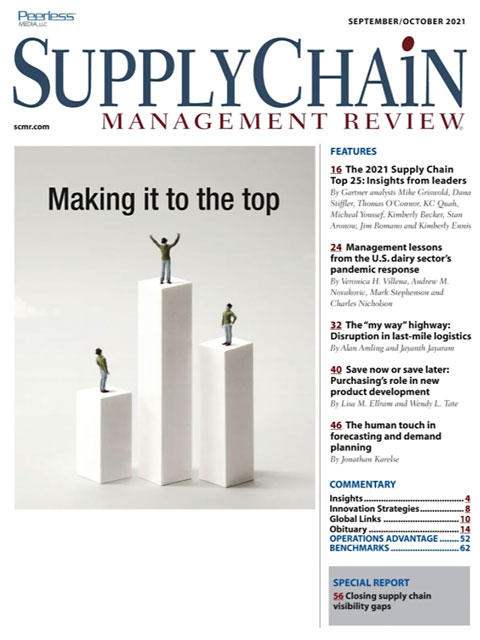
September-October 2021
This time every year, we publish Gartner’s Top 25 supply chains, the annual list of the supply chains that have made it to the top, a list that now also includes 5 Masters, or companies that have consistently outperformed year after year. You can read the article in this issue, along with the web exclusive material we publish on scmr.com, to find out what it takes to become a supply chain leader. Browse this issue archive.Need Help? Contact customer service 1-508-503-1313 More options
Regulatory mandates, investor demands and consumer sentiment are compelling organizations to deliver on their sustainability promises. To that end, nothing is more vital than dispelling the misconception that sustainable operations always cost more. In truth, no such trade-off is required. Organizations can operate cost-effectively and sustainably.
For example, we helped a major consumer packaged goods company redesign its supply chain to reduce overall miles traveled by 11%. The change trimmed 10% from $250 million in supply chain costs, while also reducing the company’s carbon footprint by 6,700 metric tons of carbon dioxide emissions. Over a decade, that’s equivalent to planting 110,000 trees, or creating more than five Central Parks.
The formula for concurrently lowering your costs and carbon footprint is strikingly simple.
- Measure the waste in what you do.
- Calculate the environmental impact associated with that waste.
- Pinpoint and pursue actions to minimize waste, cut costs and reduce your carbon footprint.
Applying this formula, however, requires a willingness to rethink your fundamental assumptions, coupled with coordinated expertise and sustained collective effort.

This complete article is available to subscribers only.
Log in now for full access or start your PLUS+ subscription for instant access.
SC
MR
Sorry, but your login has failed. Please recheck your login information and resubmit. If your subscription has expired, renew here.
September-October 2021
This time every year, we publish Gartner’s Top 25 supply chains, the annual list of the supply chains that have made it to the top, a list that now also includes 5 Masters, or companies that have consistently… Browse this issue archive. Access your online digital edition. Download a PDF file of the September-October 2021 issue.Regulatory mandates, investor demands and consumer sentiment are compelling organizations to deliver on their sustainability promises. To that end, nothing is more vital than dispelling the misconception that sustainable operations always cost more. In truth, no such trade-off is required. Organizations can operate cost-effectively and sustainably.
For example, we helped a major consumer packaged goods company redesign its supply chain to reduce overall miles traveled by 11%. The change trimmed 10% from $250 million in supply chain costs, while also reducing the company’s carbon footprint by 6,700 metric tons of carbon dioxide emissions. Over a decade, that’s equivalent to planting 110,000 trees, or creating more than five Central Parks.
The formula for concurrently lowering your costs and carbon footprint is strikingly simple.
- Measure the waste in what you do.
- Calculate the environmental impact associated with that waste.
- Pinpoint and pursue actions to minimize waste, cut costs and reduce your carbon footprint.
Applying this formula, however, requires a willingness to rethink your fundamental assumptions, coupled with coordinated expertise and sustained collective effort.
SC
MR


Latest Supply Chain News
- Caught between a rock and a hard place: Mapping your supply chain
- What options do you really have? Shaping the supply chain resilience funnel
- Nexus suppliers: Hidden anchors of resilience in decentralized supply chains
- Developing the next generation of supply chain leaders: Is higher education serving the needs of the marketplace?
- The value proposition: Bridging the skills gap between the SCM degree and the workplace
- More News
Latest Podcast
 Explore
Business Management News
- What options do you really have? Shaping the supply chain resilience funnel
- Nexus suppliers: Hidden anchors of resilience in decentralized supply chains
- Finding the ROI in supply chain education
- Managing human and AI teams across the supply chain
- Risk sharing is the new advantage in capital project delivery
- The AI-empowered supply chain leader
- More Business Management
Latest Business Management Resources
Subscribe

Supply Chain Management Review delivers the best industry content.

Editors’ Picks



