
The pharmaceutical supply chain has entered a new era—one defined not just by compliance and safety, but by digital agility, operational efficiency, and data-driven decision-making. According to Shabbir Dahod, CEO of TraceLink, the convergence of full serialization and emerging AI capabilities marks a turning point for life sciences supply chains.
“We’ve been working on this for 20 years,” Dahod said during an appearance on the Talking Supply Chain podcast. “After nearly 12 years, the industry is about to go live with end-to-end track and trace, where every product sold in the U.S. will have a unique serial number on it. The information about it is being transmitted between supply chain partners all the way down to pharmacies to make sure the supply chain is completely safe from counterfeiting and diversion.”
Dahod joined Talking Supply Chain to discuss how TraceLink is preparing for this next phase—where visibility, automation, and intelligent collaboration will be just as critical as compliance.
From serialization to supply chain synchronization
With the U.S. pharmaceutical industry now on the verge of full digital traceability, TraceLink sees an opportunity to move beyond protection and toward optimization.
“We now have the opportunity to actually leap forward because we’re the only supply chain globally that has that level of capability,” Dahod said.
LISTEN: Shabbir Dahod talks AI, pharma supply chains, and future possibilities
To support that leap, TraceLink unveiled two new platforms at its recent FutureLink conference: MINT and POET.
MINT “enables the whole industry to layer on top of all the information about the movement of the product with all the different business transactions related to it,” Dahod explained. That includes purchase orders, inventory levels, and shipment notices—all in real time and networked across supply chain partners.
POET, meanwhile, is built for collaborative, people-to-people processes:
“There are many, many processes between people that are collaborating as they conduct business across the end-to-end supply chain,” Dahod said, from exchanging certificates of analysis to resolving batch documentation issues.
Together, these tools are designed to close the data gaps that prevent true orchestration—laying the groundwork for AI to deliver value.
Enter AI
While much of the industry conversation around AI still centers on theory, Dahod believes supply chains—and particularly pharmaceutical ones—are uniquely positioned to benefit.
“AI, and specifically Generative AI, is going to be the largest beneficiary in supply chain,” he said. “On the productivity side, it’s going to reduce costs. On the agility side, it’s going to enable companies to be more effective and actually generate more revenue.”
TraceLink is currently building Agentic AI capabilities—AI agents that can reside inside an organization and perform real, repeatable tasks. These agents will initially take over routine supply management activities like monitoring order statuses, verifying lead times, and flagging exceptions.
“You can train and fine-tune a large language model to understand supply chain and to understand a specific platform like [our] Opus platform,” Dahod said. From there, the agent can “propose actions—how much to order, when should it be delivered, if a particular supplier is not going to be able to deliver it on time, is there a different result or impact?”
Productivity, agility—and control
While the promise is clear, Dahod is equally focused on safe, responsible deployment. That includes building in strict controls—especially in a regulated industry like pharma.
“We are putting lots of guardrails around it,” he said. “The agent will suggest, will make recommendations, but humans will actually make the final decisions. It is more of an aid and assistant to drive productivity than to necessarily take over someone’s job.”
The company is using a “teacher-student” AI training model and verticalizing its systems to constrain them within narrowly defined supply chain use cases. “You end up constraining the actual large argument models into that verticalization,” Dahod said.
Use cases already in motion
While most deployments are still exploratory, the use cases are quickly coming into focus. For example, a supply manager might come in each day to find a curated summary of flagged issues, upcoming delays, or demand shifts.
“All those capabilities, which are basically in work instructions, are what the agent will do for you,” Dahod said. “Sometimes what may occur is that maybe you have a quality issue. That quality issue is then raised, and it can automatically notify you, put the product on quarantine, and then notify others that may be dependent on that supply for a production run.”
Similarly, in the event of a pharmacy recall, the AI can generate inventory reports and distribution lists for affected products—automating tasks that would otherwise require manual work.
But, Dahod cautions, all of this depends on one thing: full digitalization.
“It is shocking how much is still done in PDFs and email messages and WhatsApp notifications,” he said. “AI is only as effective as the extent to which you are digitalized in your end-to-end supply chain.”
Smarter compliance, faster insights
AI also has the potential to make regulatory compliance more efficient—a key advantage in a sector where good manufacturing and distribution practices (GxP) require extensive documentation.
“There are estimates out there that 40% of the cost of distributing a pharmaceutical product is all these [compliance] processes,” he said. “That’s the 40%... that can be digitalized and made more agentic, and at the same time actually be more effective, because humans make more errors.”
Through automation and consistent workflows, organizations can improve both compliance and speed—while freeing up human workers for more strategic, creative tasks.
The road ahead
Asked to forecast where AI in supply chain is headed next, Dahod didn’t hesitate.
“I view this wave as fundamental as the introduction of the microprocessor,” he said. “You can imagine that there will be intelligence that scales up and down—from the massive to the micro—that will be available in everything we do.”
As that intelligence matures, he expects user interfaces themselves to change radically.
“How you interact with your computer is going to completely change,” he said. “It’s going to become much more verbally driven. Your whole interaction model with computing is going to completely change.”
And for an industry that has long lagged in digital maturity, that shift can’t come soon enough.
SC
MR


More Pharmaceutical Supply Chain
- The complexity of the pharma supply chain
- NextGen Supply Chain Conference 2026 opens speaker submission process
- NextGen Supply Chain Conference returns to Nashville in 2026 with focus on innovation, talent, and transformation
- Optimizing procurement analytics with Generative AI and automated data visualization
- Boosting new product launches with supplier know-how in pharma
- More Pharmaceutical Supply Chain
What's Related in Pharmaceutical Supply Chain
 Explore
Topics
Procurement & Sourcing News
- When component verification becomes operational
- Caught between a rock and a hard place: Mapping your supply chain
- What options do you really have? Shaping the supply chain resilience funnel
- Nexus suppliers: Hidden anchors of resilience in decentralized supply chains
- Lead time economics: What semiconductor supply chains reveal about strategic planning
- Risk sharing is the new advantage in capital project delivery
- More Procurement & Sourcing
Latest Procurement & Sourcing Resources
About the Author
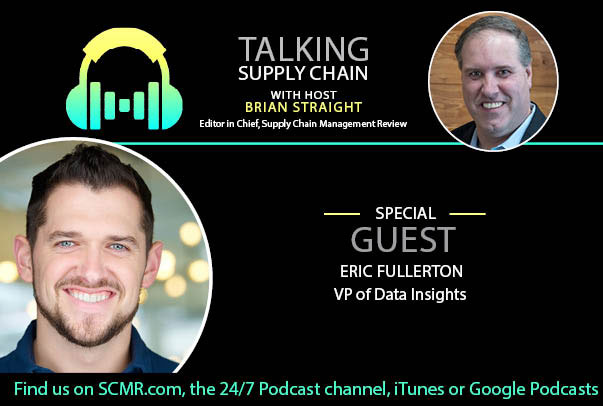
Brian Straight, SCMR Editor in Chief

Brian Straight is the Editor in Chief of Supply Chain Management Review. He has covered trucking, logistics and the broader supply chain for more than 15 years. He lives in Connecticut with his wife and two children. He can be reached at [email protected], @TruckingTalk, on LinkedIn, or by phone at 774-440-3870.
Follow SCMR on social media.
@SupplyChainManagementReview on Facebook
@SCMR on Twitter
SCMR on Linkedin
Subscribe

Supply Chain Management Review delivers the best industry content.

Editors’ Picks



