
Sorry, but your login has failed. Please recheck your login information and resubmit. If your subscription has expired, renew here.

January-February 2026
The January 2026 issue of Supply Chain Management Review explores how rapid advances in autonomous trucking, AI-driven optimization, and workforce development are redefining what it means to lead a modern supply chain. As autonomy, data intelligence, and new operating models reshape logistics networks, supply chain managers must rethink how they orchestrate freight, develop talent, manage suppliers, and design resilient operations. Inside, readers will find practical frameworks for scaling autonomous freight management, diagnosing fragile supply chains, uncovering hidden cost drivers, strengthening frontline education programs, and overcoming the… Browse this issue archive.Need Help? Contact customer service 1-508-503-1313 More options
The term “digital supply chain” has evolved over the years, from an initial vision of radically transformed companies using cutting-edge technologies to a more realistic view that focuses on solving business challenges. It now includes not only the implementation of advanced technologies, but also foundational aspects like process standardization and data management. APQC recently collected data from 2,500 organizations from a variety of industries to identify what business problems drove them to digitize, what they include in their digital supply chains, and the availability of critical data.
Bottom line: Despite the adoption of numerous technologies, many organizations still have a way to go in developing their digital supply chain maturity.
SC
MR
Sorry, but your login has failed. Please recheck your login information and resubmit. If your subscription has expired, renew here.
January-February 2026
The January 2026 issue of Supply Chain Management Review explores how rapid advances in autonomous trucking, AI-driven optimization, and workforce development are redefining what it means to lead a modern supply… Browse this issue archive. Access your online digital edition. Download a PDF file of the January-February 2026 issue.The term “digital supply chain” has evolved over the years, from an initial vision of radically transformed companies using cutting-edge technologies to a more realistic view that focuses on solving business challenges. It now includes not only the implementation of advanced technologies, but also foundational aspects like process standardization and data management. APQC recently collected data from 2,500 organizations from a variety of industries to identify what business problems drove them to digitize, what they include in their digital supply chains, and the availability of critical data.
Bottom line: Despite the adoption of numerous technologies, many organizations still have a way to go in developing their digital supply chain maturity.
Making the case for transformation
The first question APQC wanted to answer was why companies embraced moving to a digital model for supply chain. Although a common refrain is that organizations digitize to keep up with the technology developments of their peers and competitors, APQC’s data shows that the reasons are more business focused.
As shown in Figure 1, the top drivers in organizations’ business case for supply chain digital transformation are to improve efficiency, reduce costs, and improve quality. These are familiar reasons as they are the business challenges behind so many organizations’ investments in both technology and process improvements: faster, better, cheaper. For supply chains, the drivers also include challenges such as the need to optimize inventory and improve agility.
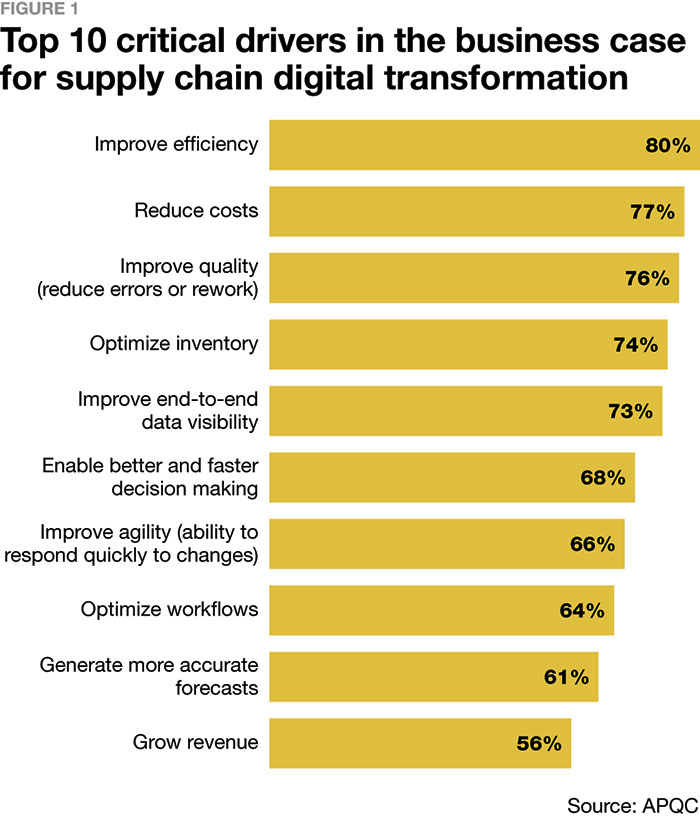
The promise of digital supply chains has not disappeared, but the focus has changed over time. Organizations now look for a return on investment from transformation that delivers value by targeting specific business needs, signaling a more realistic and directed approach toward technology adoption. Companies are connecting the capabilities of digital supply chains with the very real enterprise goals of maximizing investment and efficiency. In this way, organizations tie digital transformation to business strategy.
Scope of transformation
Organizations are not limiting their transformations to only one kind of technology for their digital supply chains. In fact, they are using a combination of software, cloud computing, and physical technology such as robotics. Figure 2 shows the top 10 technologies that organizations include as part of their digital supply chains. Despite the attention currently paid to AI, it is not explicitly listed among the top 10 elements noted in Figure 2. However, supply chains are using machine learning, which is a subset of AI, and AI is the engine under the hood of some of the other technologies.
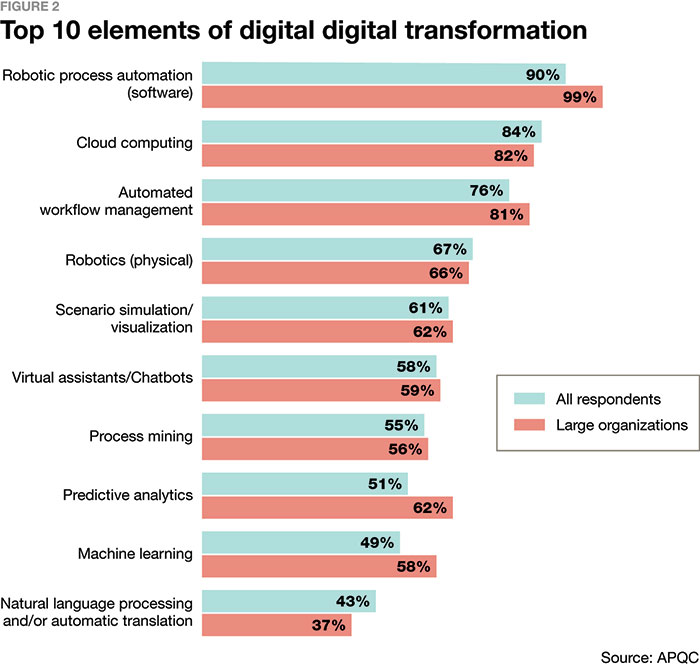
Interestingly, there are a few differences in technology adoption to note when comparing all the respondents in APQC’s research against only organizations with a revenue of $500 million or more (noted as large organizations in Figure 2). For example, nearly all of the larger organizations (99%) use robotic process automation. This is an essential investment for many companies as it enables them to automate repetitive tasks and reallocate staff to more strategic work.
Related infographic: Digital supply chain maturity is advancing
More of the larger organizations have also improved their supply chain operations with predictive analytics, machine learning, and automated workflow management when compared to the entire group of respondents. Complex supply chains need technologies like predictive analytics and machine learning to keep their operations flexible in a changing environment.
Availability of data
For an organization to fully digitize its supply chain, information must be freely available across systems. In its research, APQC examined the level of visibility for several key types of supply chain data. For organizations with the highest level of maturity in this area, real-time data is accessible both across the enterprise and across their ecosystem of suppliers, partners, and customers. At the lower end of the maturity scale, organizations have no or limited operational data visibility.
The results paint a complex picture. As shown in Figure 3, availability varies depending on the type of data.
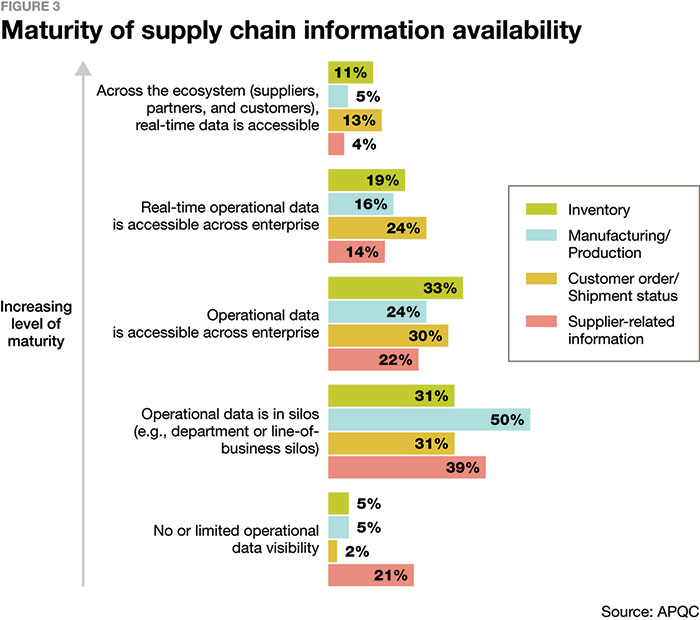
At the highest level of maturity, more organizations have real-time data accessible across the ecosystem for customer order and shipment status (13%), as well as inventory levels (11%). Yet even for these types of data, fewer than 20% of organizations have widespread availability. Far more organizations have data visibility restricted to specific departments or internal groups. In fact, half of organizations (50%) have their manufacturing data in silos. This makes it hard for companies to have a complete understanding of the impact from risks posed by changes in geopolitical issues that may require considering dramatic action such as relocating manufacturing facilities.
Silos also impact an organization’s ability to react quickly to natural disasters. Should a facility become unavailable, companies lose valuable time when they do not have access to real-time data about the extent of damage or to aid in recovery.
Maturity of digital supply chains
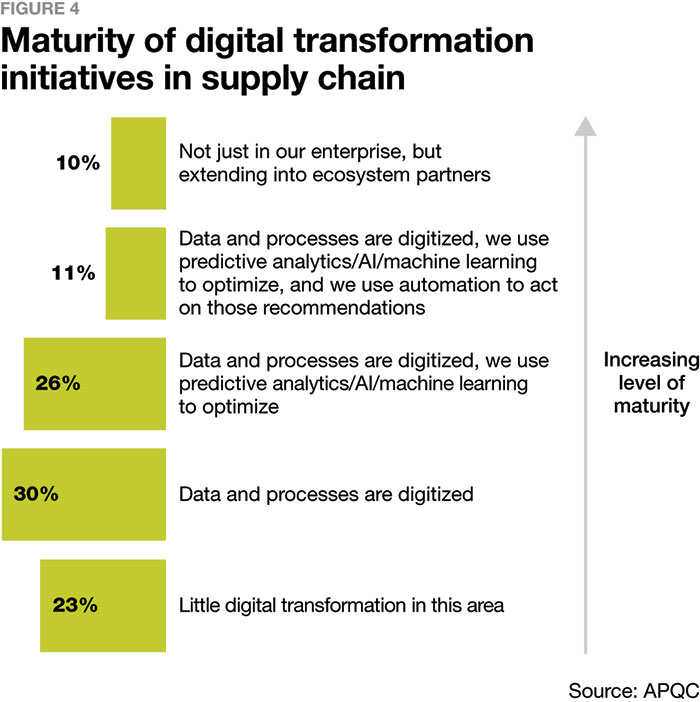
We can also understand digital transformation initiatives using a maturity scale. As Figure 4 shows, there is still room for growth for the majority of organizations, as only 10% have reached the highest level of maturity by extending their initiatives to include their ecosystem partners. As you move down the scale to the next level, automation helps 11% of organizations take action on the outputs from predictive analytics, AI, and machine learning. By contrast, at the lowest level of maturity, 23% of organizations have implemented little digital transformation in their supply chains. The largest group of organizations (30%) is lower on the scale, having only digitized their data and processes.
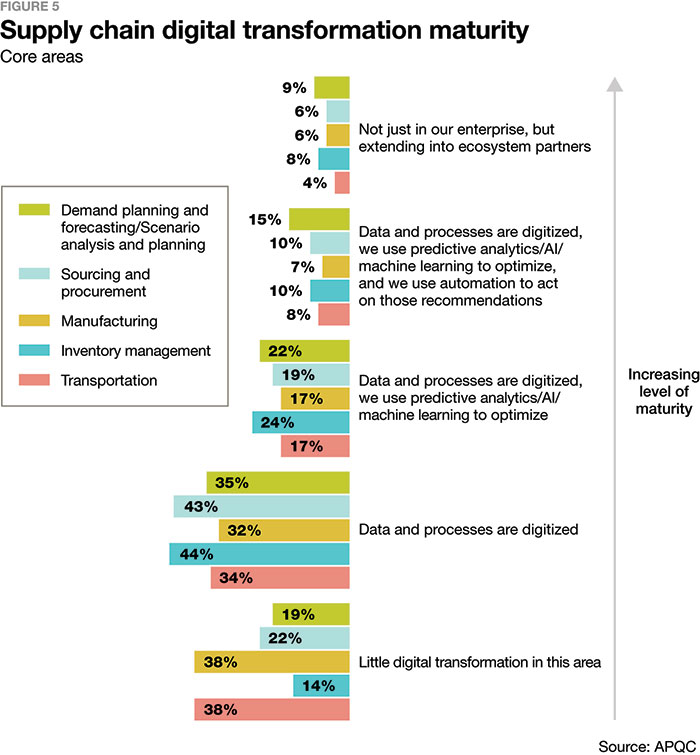
As with information accessibility, digital transformation initiatives vary in maturity across different parts of the supply chain. Figure 5 shows that demand planning and forecasting/scenario analysis and planning tends to lead the other parts of supply chain in digital maturity. A small group of organizations has reached the highest level of digital maturity in this critical area by extending beyond the enterprise to include ecosystem partners. Transportation, on the other hand, is the area with the lowest level of digital transformation maturity.
Make data widely available
Digital transformation is a multifaceted undertaking. Organizations have made progress over the last decade in embracing digital transformation and tying it to business goals and challenges. Digitization has aligned with technologies that correspond to business drivers of increasing efficiency, reducing costs, and improving quality.
Yet the maturity of many digital supply chains is still in the early stages. A major factor for this is the availability of information. If information is held in silos, organizations are undermining their own efforts. It is no longer enough to ensure data is shared across departments. To provide maximum flexibility and speed, companies need to make their data available in real time cross-functionally.
Factors such as an organization’s industry and size can certainly influence which types of data it prioritizes for digital transformation. But ultimately, all data types should be at least digitized and preferably made available for predictive analytics and to ecosystem partners. This maximizes the organization’s ability to make informed predictions that lead to effective decision making and greater maturity.
Data in this content was accurate at the time of publication. For the most current data, visit apqc.org.
About APQC
APQC (American Productivity & Quality Center) is the world’s foremost authority in benchmarking, best practices, process and performance improvement, and knowledge management (KM). With more than 1,000 member organizations worldwide, APQC provides the information, data, and insights organizations need to support decision-making and develop internal skills.
This content includes median values sourced from APQC’s Open Standards Benchmarking database. If you’re interested in having access to the 25th and 75th percentiles or additional metrics, including various peer group cuts, they are either available through a benchmark license or the Benchmarks on Demand tool depending on your organization’s membership type.
APQC’s Resource Library content leverages data from multiple sources. The Open Standards Benchmark repository is updated on a nightly cadence, whereas other data sources have differing schedules. To provide as much transparency as possible, APQC will always attempt to provide context for the data included in our content and leverage the most up-to-date data available at the time of publication.
SC
MR


More Digital Supply Chain
- From pilots to performance: Embedded AI agents are reshaping retail operations
- Today’s digital supply chains: On the road to maturity
- From platform wars to business impact: A story of change, data, and AI in supply chain planning
- 4 steps for CSCOs to emerge as digital leaders in supply chain
- What really works in the digital supply chain?
- More Digital Supply Chain
What's Related in Digital Supply Chain

 Explore
Topics
Procurement & Sourcing News
- When component verification becomes operational
- Caught between a rock and a hard place: Mapping your supply chain
- What options do you really have? Shaping the supply chain resilience funnel
- Nexus suppliers: Hidden anchors of resilience in decentralized supply chains
- Lead time economics: What semiconductor supply chains reveal about strategic planning
- Risk sharing is the new advantage in capital project delivery
- More Procurement & Sourcing
Latest Procurement & Sourcing Resources

About the Author
Marisa Brown, Senior Principal Research Lead

Marisa Brown is senior principal research lead, supply chain management, APQC.
Follow SCMR on social media.
@SupplyChainManagementReview on Facebook
@SCMR on Twitter
SCMR on Linkedin
Subscribe

Supply Chain Management Review delivers the best industry content.

Editors’ Picks



