
Sorry, but your login has failed. Please recheck your login information and resubmit. If your subscription has expired, renew here.
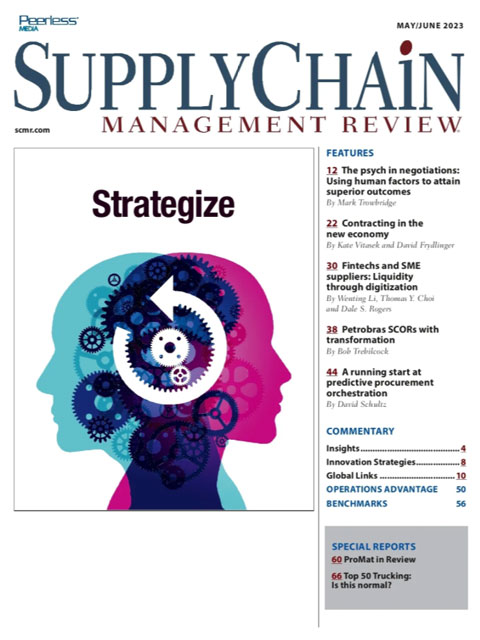
May-June 2023
If you were dropped onto this planet and landed at McCormick Place in the heart of Chicago in the middle of March, you would probably conclude that planet Earth had been overrun by robots. Everywhere you turned on the ProMat conference floor, there was a robot lifting something, putting something away, or carrying something to another location. But, despite a conference hall overrun by technology, the on-the-ground reality is a bit different. Not so long ago, commercial real estate firm Prologis estimated the number of facilities with any type of automation at about 10%. But that is changing—quickly. A recent report from JLL found that one-in-two… Browse this issue archive.Need Help? Contact customer service 1-508-503-1313 More options
Politics notwithstanding, the Earth’s atmosphere is warming, and the warming curve is steepening. Increasingly severe and frequent weather events are taking a toll on lives and livelihoods as they disrupt agriculture, critical infrastructure and global supply chains.
Recent years have brought a string of unprecedented extreme weather events across the globe: heat waves and drought across the Indian subcontinent and parts of Europe; more devastating wildfire seasons in western U.S. states and Australia; intensifying monsoon rains and flooding across Southeast Asia and China; and record hurricanes, flooding and even freezing temperatures in the southern U.S. and Gulf of Mexico.
Regional events can often have global impacts, from crop shortages and higher food prices, to production shutdowns from power outages or water rationing. Unprecedented freezing temperatures in Texas and Louisiana in 2021, for example, shut down facilities producing automotive semiconductors and chemical resins critical to plastics manufacturing, resulting in months of global shortages.
Viewing such events as one-off, regional occurrences in isolation is no longer a comforting option. Organizations that fail to properly acknowledge and assess climate-related risks in their operations and take proper mitigating steps face not only potential direct climate-related damage and disruption but also increasing prices paid in carbon, lawsuits, reputational damage and lost business and investments over time.
Corporate boards and CEOs know they will need to strengthen the specific focus on decarbonization within their broader environmental, social and governance (ESG) objectives.
A major question is how best to manage the enormous challenge of climate resilience and emission reduction—both within and outside the organizational boundaries.

This complete article is available to subscribers only.
Log in now for full access or start your PLUS+ subscription for instant access.
SC
MR
Sorry, but your login has failed. Please recheck your login information and resubmit. If your subscription has expired, renew here.
May-June 2023
If you were dropped onto this planet and landed at McCormick Place in the heart of Chicago in the middle of March, you would probably conclude that planet Earth had been overrun by robots. Everywhere you turned on the… Browse this issue archive. Access your online digital edition. Download a PDF file of the May-June 2023 issue.Politics notwithstanding, the Earth’s atmosphere is warming, and the warming curve is steepening. Increasingly severe and frequent weather events are taking a toll on lives and livelihoods as they disrupt agriculture, critical infrastructure and global supply chains.
Recent years have brought a string of unprecedented extreme weather events across the globe: heat waves and drought across the Indian subcontinent and parts of Europe; more devastating wildfire seasons in western U.S. states and Australia; intensifying monsoon rains and flooding across Southeast Asia and China; and record hurricanes, flooding and even freezing temperatures in the southern U.S. and Gulf of Mexico.
Regional events can often have global impacts, from crop shortages and higher food prices, to production shutdowns from power outages or water rationing. Unprecedented freezing temperatures in Texas and Louisiana in 2021, for example, shut down facilities producing automotive semiconductors and chemical resins critical to plastics manufacturing, resulting in months of global shortages.
Viewing such events as one-off, regional occurrences in isolation is no longer a comforting option. Organizations that fail to properly acknowledge and assess climate-related risks in their operations and take proper mitigating steps face not only potential direct climate-related damage and disruption but also increasing prices paid in carbon, lawsuits, reputational damage and lost business and investments over time.
Corporate boards and CEOs know they will need to strengthen the specific focus on decarbonization within their broader environmental, social and governance (ESG) objectives.
A major question is how best to manage the enormous challenge of climate resilience and emission reduction—both within and outside the organizational boundaries.
SC
MR


More Sustainability
- Wayfair executive to share lessons from building a tech-driven delivery network in NextGen Keynote
- PepsiCo moves its startup sustainability program from pilots to operational scale across Asia Pacific
- Eli Lilly’s Mar Gimeno to keynote at NextGen Supply Chain Conference 2026
- NextGen extends 2026 award, speaker submission deadlines amid strong industry interest
- Amazon Supply Chain 101: Enabling efficiency and growth for businesses everywhere—and everywhere they sell
- Why do supply chains need to think beyond sustainability?
- More Sustainability
Latest Resources
 Explore
Topics
Procurement & Sourcing News
- When component verification becomes operational
- Caught between a rock and a hard place: Mapping your supply chain
- What options do you really have? Shaping the supply chain resilience funnel
- Nexus suppliers: Hidden anchors of resilience in decentralized supply chains
- Lead time economics: What semiconductor supply chains reveal about strategic planning
- Risk sharing is the new advantage in capital project delivery
- More Procurement & Sourcing
Latest Procurement & Sourcing Resources

Subscribe

Supply Chain Management Review delivers the best industry content.

Editors’ Picks



