
UPS announced at the recent Modex conference in Atlanta the expansion of RFID-based package sensing across its entire network. While UPS claims it is the first rollout of RFID sensing across an entire network among major transportation providers, it represents an advancement in strategy in the quest for freight shipping visibility and operational flexibility. By shifting from a scanning solution to a sensing solution, UPS is helping usher in a new era of visibility where tracking is no longer just about determining a delivery ETA, but rather about an always-on, end-to-end visibility approach that enables more operational flexibility and rapid decision-making.
“We’re announcing the deployment of RFID package sensing at scale across our network… to enable unprecedented levels of visibility, transparency and reliability for customers of all sizes,” said Michael Yoshida of UPS, told Supply Chain Management Review at Modex.
UPS has used RFID package sensing in areas of its network for years now, most notably in its pharmaceutical cold chain, but the rollout across its entire network, which will take place over the next 18 months around the globe, represents a step forward.
The technology is pretty straightforward and is similar to what many people experience at airports and some retail locations where you can simply walk out with items in your hand and the sensors automatically charge your account. The UPS tech will use RFID to sense packages as they move through the network, generating more data points and providing more visibility of any given package as it moves around the globe. The RFID is part of the label, providing no additional friction for shippers.
From event-based tracking to continuous sensing
For decades, logistics visibility has been built on events such as barcode scans that require manual intervention. A missed scan or duplicate scan created inconsistencies and black holes in the visibility chain.
“Scanning has been the industry standard … since the early 1990s,” Yoshida said. “With sensing, it’s going to happen automatically.”
UPS’s RFID deployment replaces those point-in-time updates with persistent tracking, creating what Yoshida describes as an “always-on” sensing environment. In traditional models, a package is only visible when someone scans it. In a sensing model, its location and movement are continuously understood as it flows through the network.
This is part of a broader industry shift of visibility evolving from passive monitoring into an active input for decision-making. Guy Yehiav, president of SmartSense by Digi, told Supply Chain Management Review at the NRF Big Show in January that visibility is not a single checkpoint, but a continuous thread. In food production, for example, monitoring begins before freezing, with checks on temperature, humidity, and even pH levels. From there, products move into transportation, where route validation and condition monitoring become critical. UPS has done this in its cold chain, but is now moving it into the mainstream.
Visibility alone isn’t the goal, flexibility is
UPS’s rollout highlights a how many organizations are now thinking about visibility. Continuous sensing enables earlier detection of issues, allowing organizations to respond quicker to those issues. UPS has already seen measurable gains.
“We’ve been able to reduce misloads by nearly 70% with RFID tech that we’ve already enabled,” Yoshida said, noting that those errors can be corrected in real time. “If you walked [a package] onto the wrong truck … the shift to sensing is going to notify us you’re on the wrong truck so that they walk it off and put it on the right truck,” he said.
That kind of real-time visibility is the missing ingredient that organizations are looking for as they seek to move from insight to execution.
Earlier data, better decisions
Another key shift is when visibility begins. “Today our data starts when the package gets into our building,” Yoshida said. “With this RFID announcement, that data is going to start at the time of the label getting created and us picking it up.”
That earlier signal extends the decision window for both UPS and its customers. In practice, that could mean earlier exception detection, more accurate delivery commitments, and improved coordination across upstream and downstream partners.
In January, GreyOrange and Zebra Technologies announced a real-time, location-level visibility solution for retailers to help close the gap between store execution and inventory planning.
“Stores and supply chains are very, very connected,” Akash Gupta, CEO of GreyOrange, told Supply Chain Management Review in a conversation at the NRF retail show. “As we start bringing both of them together, there is a lot of intelligence that you can bring all across.”
The rollout of RFID brings another level of visibility to the entire supply chain.
The economics of RFID
RFID itself isn’t new, but it has remained a technology used only in specialty applications. UPS has used it in healthcare logistics, where shipment sensitivity demands higher visibility. What’s changed is the cost and scalability.
“One of the big drivers were the cost of the RFID labels, which are now down to just a few cents,” Yoshida said.
That cost curve allows RFID to move from niche, high-value use cases into network-wide deployment by making continuous sensing economically viable at scale.
While RFID dramatically increases data volume, UPS is taking a selective approach to how that data is exposed to customers. There is a chance of data overload, and for many customers, they don’t need all the insight RFID sensing will bring.
“We will continue to evaluate what value our customers need versus what we need … and balance what we turn on,” Yoshida said. “We’ve already talked to customers where they’re like, ‘I don’t need every one of those [but] I need to know it was on [the truck] for the final time and it’s now off.’”
Visibility becomes a foundation for execution
UPS’s rollout is part of a larger transformation starting to take place across supply chains. As sensing technologies expand, the definition of visibility is changing from event-based notifications to continuous data generation. This is allowing supply chains, with the help of AI and digital twins, to move to predictive decision-making and active execution.
The winners will not be who has the best data, but who makes the best use of that data.
SC
MR


More Supply Chain Visibility
- Nexus suppliers: Hidden anchors of resilience in decentralized supply chains
- Penske Logistics jumps into the end-to-end visibility pool as industry options grow
- Closing the execution gap: Why supply chain investments still struggle to deliver results
- UPS RFID rollout signals next phase of supply chain visibility
- Spend aggregation gives way to new approaches in a tariff-driven supply chain
- More Supply Chain Visibility
What's Related in Supply Chain Visibility
 Explore
Topics
Procurement & Sourcing News
- Why companies blame the wrong supplier … and miss the real failure
- NextGen Supply Chain Conference unveils agenda focused on AI, execution and the future of leadership
- From fragmented negotiations to coordinated negotiation performance: an AI-enabled approach
- Supply chain resilience isn’t a data problem; it’s a judgment problem
- Why your supply chain risk management plan will fail
- When component verification becomes operational
- More Procurement & Sourcing
Latest Procurement & Sourcing Resources
About the Author
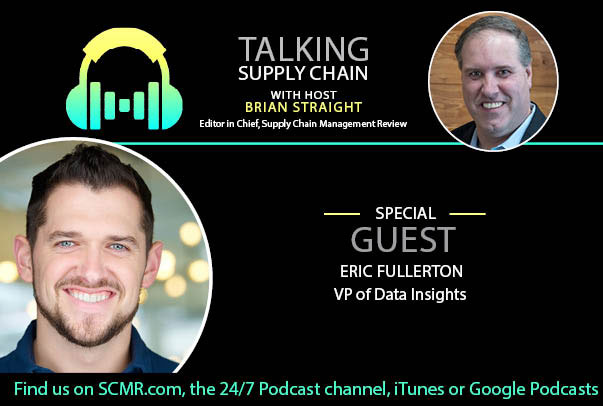
Brian Straight, SCMR Editor in Chief

Brian Straight is the Editor in Chief of Supply Chain Management Review. He has covered trucking, logistics and the broader supply chain for more than 15 years. He lives in Connecticut with his wife and two children. He can be reached at [email protected], @TruckingTalk, on LinkedIn, or by phone at 774-440-3870.
Follow SCMR on social media.
@SupplyChainManagementReview on Facebook
@SCMR on Twitter
SCMR on Linkedin
Subscribe

Supply Chain Management Review delivers the best industry content.

Editors’ Picks



