
Sorry, but your login has failed. Please recheck your login information and resubmit. If your subscription has expired, renew here.
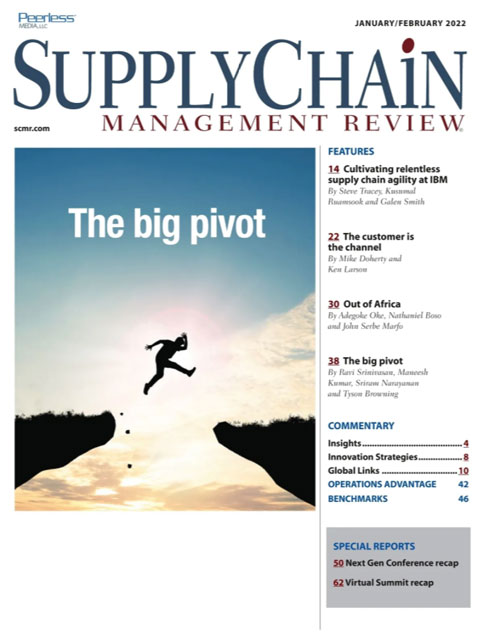
January-February 2022
Well, that’s over, and aren’t we all glad to put 2020 in the rear-view mirror? For a minute, however, let’s look at a silver lining, because I think there is one for supply chain managers. That’s because the pandemic put supply chain in the spotlight like never before—and, with the approval of a vaccine just a few weeks ago in December, supply chain and cold chain are back in the news… While sales usually gets all the attention, maybe 2021 is our time to shine.” That’s the beginning of the column I wrote for the January 2021 issue, and maybe I was a little too pollyannish. Browse this issue archive.Need Help? Contact customer service 1-508-503-1313 More options
Some 1.8 million industrial robots are in operation around the world, yet these machines are not fully integrated into the human workforce.
Research underway at the Massachusetts Institute of Technology is facilitating more effective collaboration between humans and machines, and recent advances indicate that human/machine interdependency may not be far off. MIT researchers are using artificial intelligence and machine learning to give robots the ability to work in teams with humans and even identify ways to improve team performance.
Low profile, low value
Julie Shah, professor in the Department of Aeronautics and Astronautics at MIT, and leader of the Interactive Robots Group of MIT’s Computer Science and Artificial Intelligence Laboratory, has spent much of her career developing robots for manufacturing applications. Her overriding vision is developing machines that augment human capabilities.
People often underestimate the number of working robots over and above those in industrial settings, says Shah. For example, there are some 30 million robots in U.S. homes, and numerous units working in other locations including sidewalks and supermarkets.
However, “it doesn’t feel like” the population is this large, she says, mainly because these machines are engaged on narrowly defined tasks supervised by humans. The problem is “if they are not integrated at scale, we miss opportunities to gain value from these systems.”

This complete article is available to subscribers only.
Log in now for full access or start your PLUS+ subscription for instant access.
SC
MR
Sorry, but your login has failed. Please recheck your login information and resubmit. If your subscription has expired, renew here.
January-February 2022
Well, that’s over, and aren’t we all glad to put 2020 in the rear-view mirror? For a minute, however, let’s look at a silver lining, because I think there is one for supply chain managers. That’s because the… Browse this issue archive. Access your online digital edition. Download a PDF file of the January-February 2022 issue.Some 1.8 million industrial robots are in operation around the world, yet these machines are not fully integrated into the human workforce.
Research underway at the Massachusetts Institute of Technology is facilitating more effective collaboration between humans and machines, and recent advances indicate that human/machine interdependency may not be far off. MIT researchers are using artificial intelligence and machine learning to give robots the ability to work in teams with humans and even identify ways to improve team performance.
Low profile, low value
Julie Shah, professor in the Department of Aeronautics and Astronautics at MIT, and leader of the Interactive Robots Group of MIT’s Computer Science and Artificial Intelligence Laboratory, has spent much of her career developing robots for manufacturing applications. Her overriding vision is developing machines that augment human capabilities.
People often underestimate the number of working robots over and above those in industrial settings, says Shah. For example, there are some 30 million robots in U.S. homes, and numerous units working in other locations including sidewalks and supermarkets.
However, “it doesn’t feel like” the population is this large, she says, mainly because these machines are engaged on narrowly defined tasks supervised by humans. The problem is “if they are not integrated at scale, we miss opportunities to gain value from these systems.”
SUBSCRIBERS: Click here to download PDF of the full article.
SC
MR


More Robotics
- Innovators Netstock, Pickle Robot win NextGen Solution Provider awards
- NextGen Supply Chain Conference unveils agenda focused on AI, execution and the future of leadership
- Beyond the hype: Building flexible and scalable supply chains in a VUCA world
- Technology isn’t strategy
- Wayfair executive to share lessons from building a tech-driven delivery network in NextGen Keynote
- The real reason supply chain tech ROI falls short
- More Robotics
Latest Podcast

 Explore
Topics
Business Management News
- Innovators Netstock, Pickle Robot win NextGen Solution Provider awards
- Bigger trucks versus broken bridges and roads
- From salon to dock door: Repurposing scheduling software for inbound flow
- The biggest barrier to AI in supply chains isn’t technology
- Rebuilding a planning function around the physical world
- Why companies blame the wrong supplier … and miss the real failure
- More Business Management
Latest Business Management Resources

Subscribe

Supply Chain Management Review delivers the best industry content.

Editors’ Picks



