
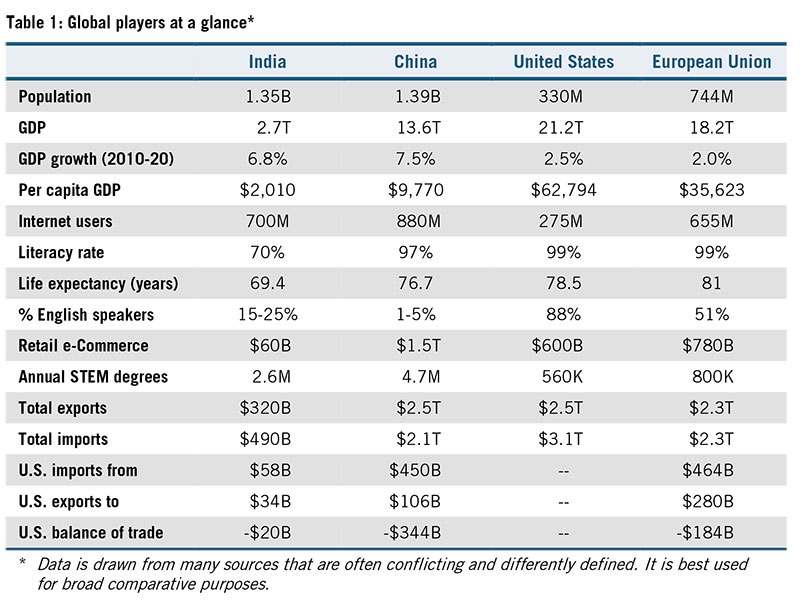
As the United States seeks to counter a rising China, no nation is more important than India, with its vast size, abundance of highly skilled technical professionals, and strong political and cultural ties with the United States. But America’s increasing reliance on India for information technology (IT) services is very similar to its dependency on China for manufacturing, according to a new report released today by the Information Technology and Innovation Foundation (ITIF), the leading think tank for science and technology policy.
The report cautions that over reliance on India as an IT services provider could become a strategic problem if major disagreements emerge between the two countries on issues such as intellectual property, data governance, tariffs, taxation, local content requirements, or individual privacy.
“The same forces that increasingly divide the United States and China are now pushing the United States and India closer together,” said David Moschella, a non-resident senior fellow at ITIF and co-author of the report. “The interplay between the United States, India, and China will shape global competition and digital innovation for years to come. While there is a wide range of possible scenarios, two things are clear: India should be an essential part of U.S. efforts to compete with and reduce its dependence on China, and this will inevitably expand America’s global dependencies from manufacturing to services.”
The report describes how India is making important progress in research and development, innovation centers, machine learning, analytics, product design and testing, and other areas, especially in IT and life sciences. While leading U.S. tech companies are well positioned in India’s booming Internet and e-commerce marketplaces, strong local competitors are now emerging. Outside of the technology sector, U.S. companies operating in India face stiff competition from Chinese, Japanese, Korean, Indian, and other firms.
Although doing business in India is still often difficult, most large U.S. companies have expanded significantly to having IT service providers, large operations, or their own India-based capability centers.
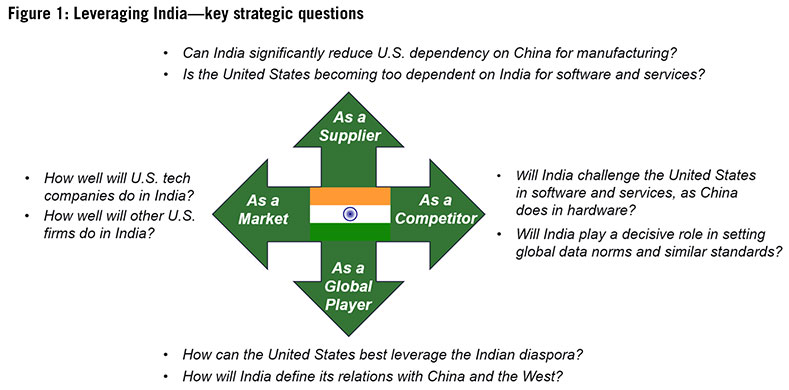
The report assesses the outlook for the India-U.S. relationship by examining four key dimensions that will prove critical in the coming decade: India’s role as a supplier, as a competitor, as a geopolitical player, and as a market. The analysis considers key strategic questions in each area, outlining goals and recommendations for policymakers.
The report concludes by describing the worst and best case scenarios. In the former, tensions between India and China are reduced, and the many business synergies between these two neighboring nations come to the fore—in which case, the heart of the global economy would shift to the East, and there would be little the United States could do about it. In the second scenario, the interests of India and the United States become increasingly aligned, as the economic, military, and international relations challenges from China grow—in which case, democratic norms could prevail across most of the developed world, as developing nations start looking to the “Delhi model” instead of the “Beijing model.”
“America’s technology dependencies on India in the 2020s seem certain to rise, yet it is important to know whether the United States will be dependent on a strategic partner with strong mutual interests, or on an increasingly neutral rival,” said ITIF President Robert D. Atkinson, who co-authored the report with Moschella. “Much will depend on the strategic choices that the Biden administration and Indian government make in the next several years. One thing that is clear: the economic and geopolitical stakes could not be higher”.
SC
MR

Latest Supply Chain News
- Innovators Netstock, Pickle Robot win NextGen Solution Provider awards
- Bigger trucks versus broken bridges and roads
- From salon to dock door: Repurposing scheduling software for inbound flow
- The biggest barrier to AI in supply chains isn’t technology
- Rebuilding a planning function around the physical world
- More News
Latest Podcast
 Explore
Business Management News
- Innovators Netstock, Pickle Robot win NextGen Solution Provider awards
- Bigger trucks versus broken bridges and roads
- From salon to dock door: Repurposing scheduling software for inbound flow
- The biggest barrier to AI in supply chains isn’t technology
- Rebuilding a planning function around the physical world
- Why companies blame the wrong supplier … and miss the real failure
- More Business Management
Latest Business Management Resources
Subscribe

Supply Chain Management Review delivers the best industry content.

Editors’ Picks



