
Sorry, but your login has failed. Please recheck your login information and resubmit. If your subscription has expired, renew here.
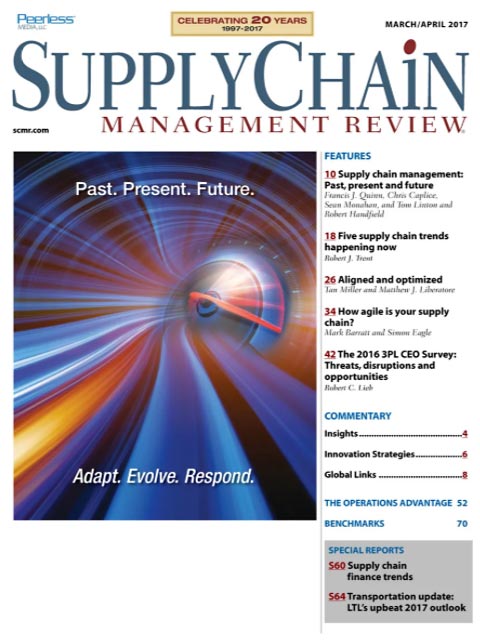
March-April 2017
Supply Chain Management Review, which is celebrating its 20th anniversary with this issue.Twenty years after the premier issue, our goal remains the same: To present thought leadership around best practices in supply chain fundamentals, publish case study examples of what leading companies are doing in their supply chains and keep our finger on the pulse of emerging trends and technologies that will shape the future. While Frank’s essay looks to the past and brings us to the present, we also have essays from four experienced supply chain professionals looking to the future of supply chain management. Browse this issue archive.Need Help? Contact customer service 1-508-503-1313 More options
Global supply chains have more links than ever, and not all of those links are completely in sync when it comes to payments, cash flow and financing. And while the current economic climate is decidedly more amicable than it was during the Great Recession, that doesn’t necessarily mean buyers are cutting checks any faster (or that suppliers are getting paid any quicker). This reality creates bottlenecks in the supply chain, where even one insolvent or financially unhealthy supplier can interrupt its entire flow.
Enter supplier financing (aka supply chain financing), a concept that was popularized in the mid-2000s, when companies in nearly all industries were struggling to stay afloat. The concept is formally defined as a financing method that allows buyers to lengthen their payment terms to their suppliers while also giving those vendors the opportunity to receive payment earlier (that’s where the “financing” portion—typically provided by a bank or other financing company—comes into play). Through this process, the buyer is able to optimize its own working capital while the supplier generates more cash flow to support its own operations.
Jose Aguayo, product manager for cash flow and payment solutions at UPS Capital, credits increasing globalization and the lengthening of the supply chain with driving demand for supplier financing. “Companies now rely on a complex network of suppliers and buyers that stretch across the globe to manufacture, transport, store and distribute their products,” says Aguayo. “Where once the majority of a company’s capital may have been allocated to properties and facilities, it now goes to working capital (e.g. inventory, receivables, etc.).”

This complete article is available to subscribers only.
Log in now for full access or start your PLUS+ subscription for instant access.
SC
MR
Sorry, but your login has failed. Please recheck your login information and resubmit. If your subscription has expired, renew here.
March-April 2017
Supply Chain Management Review, which is celebrating its 20th anniversary with this issue.Twenty years after the premier issue, our goal remains the same: To present thought leadership around best practices in supply… Browse this issue archive. Access your online digital edition. Download a PDF file of the March-April 2017 issue.Global supply chains have more links than ever, and not all of those links are completely in sync when it comes to payments, cash flow and financing. And while the current economic climate is decidedly more amicable than it was during the Great Recession, that doesn't necessarily mean buyers are cutting checks any faster (or that suppliers are getting paid any quicker). This reality creates bottlenecks in the supply chain, where even one insolvent or financially unhealthy supplier can interrupt its entire flow.
Enter supplier financing (aka supply chain financing), a concept that was popularized in the mid-2000s, when companies in nearly all industries were struggling to stay afloat. The concept is formally defined as a financing method that allows buyers to lengthen their payment terms to their suppliers while also giving those vendors the opportunity to receive payment earlier (that's where the “financing” portion—typically provided by a bank or other financing company—comes into play). Through this process, the buyer is able to optimize its own working capital while the supplier generates more cash flow to support its own operations.
Jose Aguayo, product manager for cash flow and payment solutions at UPS Capital, credits increasing globalization and the lengthening of the supply chain with driving demand for supplier financing. “Companies now rely on a complex network of suppliers and buyers that stretch across the globe to manufacture, transport, store and distribute their products,” says Aguayo. “Where once the majority of a company's capital may have been allocated to properties and facilities, it now goes to working capital (e.g. inventory, receivables, etc.).”
SC
MR


More Finance
- Wayfair executive to share lessons from building a tech-driven delivery network in NextGen Keynote
- Finance as a transformation catalyst: A How-To guide for supply chain finance leaders
- AI won’t fix a broken supply chain foundation
- Eli Lilly’s Mar Gimeno to keynote at NextGen Supply Chain Conference 2026
- NextGen extends 2026 award, speaker submission deadlines amid strong industry interest
- Amazon Supply Chain 101: Enabling efficiency and growth for businesses everywhere—and everywhere they sell
- More Finance
Latest Resources
 Explore
Business Management News
- Why companies blame the wrong supplier … and miss the real failure
- NextGen Supply Chain Conference unveils agenda focused on AI, execution and the future of leadership
- Supply chain resilience isn’t a data problem; it’s a judgment problem
- Beyond the hype: Building flexible and scalable supply chains in a VUCA world
- Why your supply chain risk management plan will fail
- What options do you really have? Shaping the supply chain resilience funnel
- More Business Management
Latest Business Management Resources
About the Author
Bridget McCrea, Contributing Editor

Bridget McCrea is a Contributing Editor for Logistics Management based in Clearwater, Fla. She has covered the transportation and supply chain space since 1996 and has covered all aspects of the industry for Logistics Management and Supply Chain Management Review. She can be reached at [email protected], or on Twitter @BridgetMcCrea
Follow SCMR on social media.
@SupplyChainManagementReview on Facebook
@SCMR on Twitter
SCMR on Linkedin
Subscribe

Supply Chain Management Review delivers the best industry content.

Editors’ Picks



