
Sorry, but your login has failed. Please recheck your login information and resubmit. If your subscription has expired, renew here.

January-February 2026
The January 2026 issue of Supply Chain Management Review explores how rapid advances in autonomous trucking, AI-driven optimization, and workforce development are redefining what it means to lead a modern supply chain. As autonomy, data intelligence, and new operating models reshape logistics networks, supply chain managers must rethink how they orchestrate freight, develop talent, manage suppliers, and design resilient operations. Inside, readers will find practical frameworks for scaling autonomous freight management, diagnosing fragile supply chains, uncovering hidden cost drivers, strengthening frontline education programs, and overcoming the… Browse this issue archive.Need Help? Contact customer service 1-508-503-1313 More options
The global cocoa industry forms the backbone of the chocolate and candy manufacturing sector but it faces serious risks and inefficiencies in its chain. Any failure in any of the stages such as farming, processing after harvesting, storage, transportation, and manufacturing, contributes to poor product quality, operational delays, and increased costs.
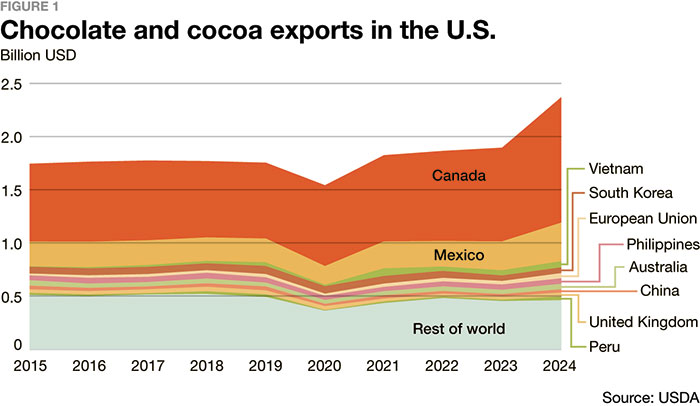
Cocoa is the ingredient that accounts for the highest value of chocolate products, and supplying high-quality cocoa is quite important, with increasing demand for chocolate and candy bars occurring around the world. Total export value of chocolate and cocoa products in the United States in 2024 was $2.36 billion with a compound average growth of 3.1% from 2015 to 2024 according to U.S. Department of Agriculture data.
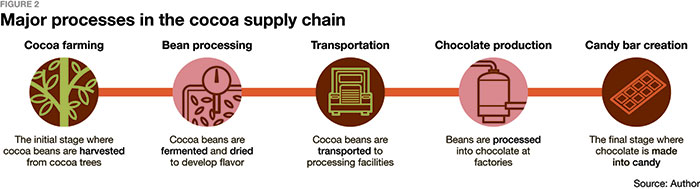
Still, this industry faces many challenges, from environmental risks affecting the quality of cocoa beans, to logistics in hauling beans to the manufacturers. Candy manufacturers must ensure consistency in the quality of their products and also manage disruptions in the supply chain.
SC
MR
Sorry, but your login has failed. Please recheck your login information and resubmit. If your subscription has expired, renew here.
January-February 2026
The January 2026 issue of Supply Chain Management Review explores how rapid advances in autonomous trucking, AI-driven optimization, and workforce development are redefining what it means to lead a modern supply… Browse this issue archive. Access your online digital edition. Download a PDF file of the January-February 2026 issue.The global cocoa industry forms the backbone of the chocolate and candy manufacturing sector but it faces serious risks and inefficiencies in its chain. Any failure in any of the stages such as farming, processing after harvesting, storage, transportation, and manufacturing, contributes to poor product quality, operational delays, and increased costs.
Cocoa is the ingredient that accounts for the highest value of chocolate products, and supplying high-quality cocoa is quite important, with increasing demand for chocolate and candy bars occurring around the world. Total export value of chocolate and cocoa products in the United States in 2024 was $2.36 billion with a compound average growth of 3.1% from 2015 to 2024 according to U.S. Department of Agriculture data (see Figure 1).
Still, this industry faces many challenges, from environmental risks affecting the quality of cocoa beans, to logistics in hauling beans to the manufacturers. Candy manufacturers must ensure consistency in the quality of their products and also manage disruptions in the supply chain (Figure 2).
By identifying at the outset possible failure points in each step of the cocoa supply chain and candy production process, companies are in a position to minimize waste, reduce operational downtime, improve product quality, and have healthy relations with suppliers and customers.
The following article describes the application of Failure Mode and Effects Analysis (FMEA) to cocoa farming, the supply chain, post-harvest handling and transportation, and candy manufacturing processes. It points out the usual risks during every process, develops examples of failure modes, and shows how this approach may contribute to better risk management and higher-quality products for the candy manufacturing industry.
Understanding Failure Mode and Effects Analysis (FMEA)
FMEA is a structured, systematic approach using a risk assessment tool to identify and evaluate a process, product, or system for possible failure modes. It is an excellent method for prioritizing risks according to their seriousness, occurrence, and detectability; thus, organizations can concentrate resources on the realization of corrective actions before problems arise. FMEA, first developed in the aerospace industry, has been applied in various other industries since, including automotive, healthcare, and food manufacturing.
Failure Mode and Effects Analysis originated in the United States military in the late 1940s as a systematic approach to identify and mitigate potential failure modes in complex systems and is now a core part of Six Sigma methodology.
Initially, FMEA was employed to classify failures based on their impact on mission success and personnel safety. In the 1960s, NASA adopted FMEA for the Apollo missions, underscoring its significance to enhance reliability and safety in aerospace applications. The automotive industry recognized its value in the late 1970s, with Ford Motor Company implementing FMEA to address safety and regulatory concerns, particularly following the Pinto model issues. Over time, FMEA has been integrated into various industries, including semiconductor processing, food service, and healthcare, becoming a cornerstone in quality and risk management practices.
FMEA becomes highly valued in industries that rely on complex processes, like those of farming cocoa and manufacturing candies, since many variables could influence the quality of the products. For such industries, FMEA allows stakeholders to identify modes of failures that could lead to impairment in product quality or delay; evaluate the potential consequences of each failure mode on product quality, production timelines, and costs; and prioritize risks through the Risk Priority Number (RPN), which is the product of the severity, occurrence, and detection ratings. It then helps to develop corrective actions to reduce or eliminate high-risk failure modes that increase reliability and consistency.
Key elements of FMEA
The methodology of FMEA comprises a number of key elements.
- Failure mode. The way or mode in which a procedure or system can fail. Taking the cocoa supply chain for example, a failure mode would be a delayed shipment of beans because of poor logistics.
- Effect. The impact that would result from a certain failure mode on the product or process. In this regard, delayed shipment of supplies might disrupt production schedules therefore creating a shortage of key ingredients needed for candy bars.
- Cause. It defines the possible cause for such failure. The cause, in this case, may be anything from poor storage to poor transportation networks.
- Severities (S). A ranking for the estimated effect of a failure on the final product or process. The higher the severity score, the more critical the failure.
- Occurrence (O). This is a ranking of the estimated likelihood of occurrence of each failure mode.
- Detection (D). This is a ranking of estimated likelihood that the failure will be detected by current controls before it reaches the final product. The less detectable it is, the higher the score, indicating higher risk.
The RPN is calculated by multiplying the scores for Severity, Occurrence, and Detection:
RPN = Severity (S) × Occurrence (O) × Detection (D)
After the RPNs are calculated, the failure modes with the highest RPNs are prioritized, and corrective actions are developed to mitigate these risks.
Application of FMEA to the cocoa supply chain
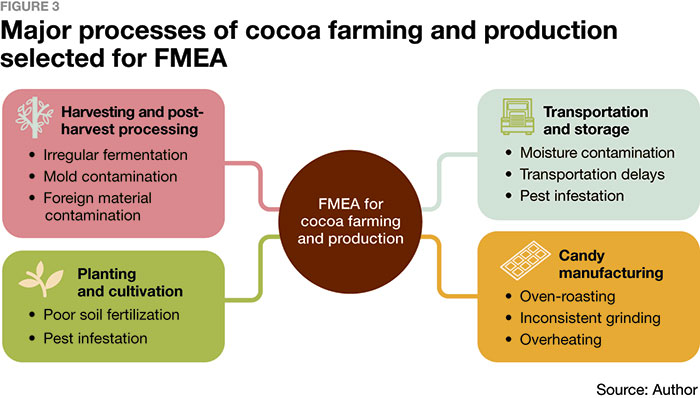
There are a few key steps in the supply chain for cocoa, each of which may contain its own possible failure points. Understanding the stages and common failure modes helps manufacturers proactively understand risk and improve quality (Figure 3).
1. Cocoa farming: risks and failure modes
Farming is the first step in the supply chain of cocoa, and it is where the quality of the beans is determined. However, cocoa farming faces many challenges, especially from environmental factors and the nature of smallholder farming.
Failure modes
- Poor soil fertility. When the soil is poor, yields are low, and the quality of the beans will be poor, which could affect the flavor of the final product.
- Pests and disease infestation. Cocoa trees are susceptible to certain pests, like the cocoa pod borer and diseases such as black pod rot, which could result in high crop losses.
- Poor planting. Planting with poor-quality seedlings or in poor conditions often leads to weak trees with low yields.
Mitigation strategies
- Farmers could adopt soil management practices that would improve soil fertility, for example, the use of organic fertilizers and crop rotation.
- Insects and other animals can also be used in integrated methods of pest control, like using natural predators and utilizing resistant varieties.
2. Processing and storage after harvesting
After cocoa is harvested, fermentation and drying develop the beans’ flavor and quality critical steps post-harvest. This practice would, however, encourage off-flavors and development and could be contaminated with mold if done wrong.
Failure modes
- Irregular fermentation. Bad timing for fermentation and turning provides negative uniformity in flavor quality.
- Poor drying of cocoa. Beans dried too quickly and without a good environment preserve additional moisture, which would enable mold to grow.
- Contamination. Contact with foreign materials such as sand, wood, or other contaminants, can result in the deterioration of quality.
Mitigation strategies
- Farmers will use fermentation boxes that allow for temperature control and turning to ensure uniform fermentation.
- Adequate drying racks with proper ventilation systems can easily reduce moisture content and thus prevent mold formation.
3. Cocoa transportation and storage
After processing, the beans are warehoused and shipped to the manufacturers. This is a very vulnerable phase in supply, where delays, contamination, and spoilage occur easily.
Failure modes
- Moisture contamination. Poor packaging or humidity exposure during transport may cause mold and mildew growth on the beans.
- Delayed shipments: This disrupts manufacturing schedules, hence delaying production.
- Infestation. Poor or unsealed package invites the pests that cause infestation to the beans.
Mitigation strategies
- Package the beans in sealed, moisture-tight containers and ship them in controlled climates to avoid moisture damage.
- GPS and shipment monitoring shall be installed for real-time tracking.
- Transportation with pest-resistant packages that are sealed and packed well can minimize the possibilities of contamination with pests.
4. Candy manufacturing
Once the beans reach the processing plant, they are processed into the various ingredients such as cocoa liquor, cocoa butter, and cocoa powder that go into candy bars. Each step in the processing chain brings with it opportunities for things to go wrong.
Roasting. Roasting is a very basic process in candy bar manufacture to develop the distinctive flavor of the cocoa. Disruption in this process usually brings out flavors that will not please the customer connoisseur and may reduce the quality of the product generally.
Failure modes
- Over-roasting. Roasting at too high a temperature or for too long increases the possibility of burned beans and bitter smells.
- Under-roasting. Under-roasting can make the taste of the beans raw, at the expense of full flavor development.
Mitigation strategies
- Automatic roasting systems with proper temperature control ensure that beans are consistently and evenly roasted.
- Regular calibration and maintenance of roasting equipment can avoid any variation in temperature that leads to uneven roasting.
Grinding. After roasting, cocoa beans are ground into a variety of products such as cocoa liquor, cocoa butter, and cocoa powder. Not properly controlling grinding may result in a gritty particle that produces an unpleasant mouthfeel when chewing chocolate.
Failure modes
- Inconsistent grinding. If the grinding process isn’t uniform, cocoa particles may be too coarse, resulting in a gritty texture.
- Excessive heat generation. While grinding, temperature is invariably generated; if not carried out properly, the free cocoa butter that separates out will result in nonuniform texture and consistency in the chocolate.
Mitigation strategies
- Inconsistency can be avoided by employing a precision grinding machine that would provide the possibility of regulation in particle size distribution.
- Employing water-cooled grinding equipment can offer control of the temperature in grinding.
A summary of this information is given in Table 1, which demonstrates an example of FMEA on cocoa farming and production.
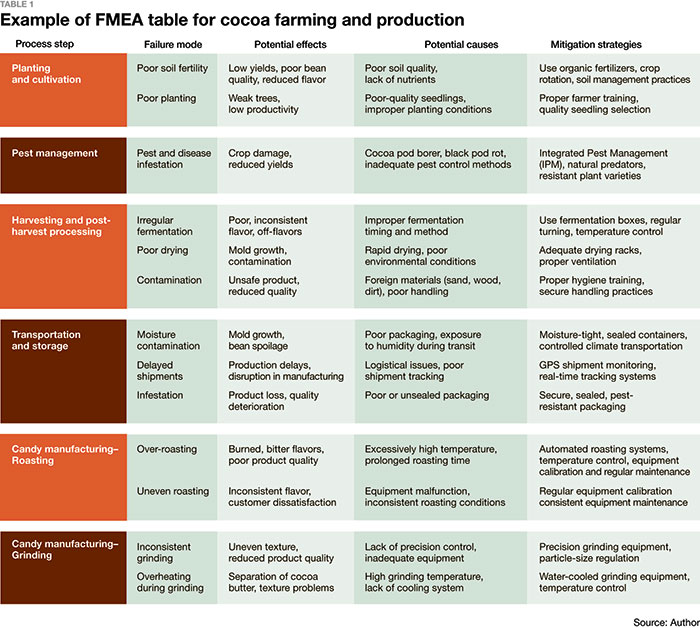
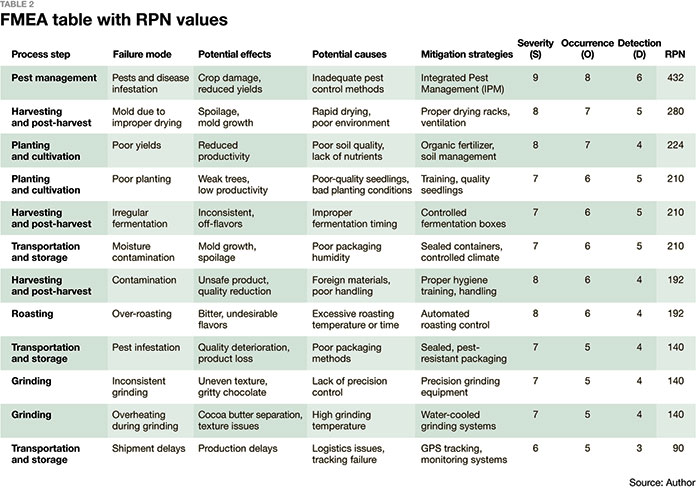
The Failure Mode and Effects Analysis (FMEA) given in Table 2 systematically evaluates potential risks across critical stages of cocoa farming and processing, emphasizing Risk Priority Numbers (RPN) to identify and prioritize failure modes. The table outlines each process step alongside corresponding failure modes, potential effects and causes, and proposed mitigation strategies. To illustrate the practical application of FMEA, hypothetical Severity, Occurrence, and Detection ratings were assigned at the author’s discretion, resulting in RPN values presented purely for demonstrative purposes. These randomly assigned ratings yield RPN values calculated as the product of the three factors, arranged in descending order to effectively illustrate how high-risk failure modes are prioritized within a typical FMEA framework. For instance, pest and disease infestation during the pest management stage of cocoa farming—assigned an illustrative RPN of 432—demonstrates a high-priority risk scenario warranting immediate attention. Similarly, mold due to improper drying (RPN=280) and poor yields resulting from poor soil fertility (RPN=224) exemplify other significant risks. While the actual RPN scores presented herein do not reflect empirical data, their use effectively demonstrates the methodology and benefits of FMEA in systematically identifying, prioritizing, and mitigating risks within cocoa farming and processing.
Managerial recommendations
- Strengthen farmer partnerships. This could be achieved through training at the point of origin regarding best practices in planting, fermentation, and drying for improved quality from the start. Supportive equipment like fermentation boxes and drying racks promotes consistency in quality, minimizing post-harvest losses.
- Leveraging technology. IoT sensors could monitor temperature and humidity conditions in real-time at various points in the fermentation and drying process, thus creating a consistent product quality standard. Applying blockchain for traceability would bring transparency into sourcing and add to the integrity of the cocoa bean down the value chain.
- Implement regular audits. Routine quality inspection, auditing, and FMEA review at every stage of the supply chain could help in ascertaining emerging risks and opportunities for improvements.
- Promote sustainable practices. From a sustainability standpoint, these recommended interventions align closely with global environmental, social, and economic sustainability objectives. Promoting sustainable agricultural practices such as the use of organic fertilizers, crop rotation, and integrated pest management reduces environmental degradation, preserves biodiversity, and enhances long-term soil fertility. Investments in standardized infrastructure, like improved fermentation boxes and drying racks, not only decrease post-harvest losses but also minimize resource wastage and environmental impact. The adoption of technology such as IoT sensors contributes to energy efficiency and optimized resource utilization, while blockchain-driven transparency supports ethical and responsible sourcing.
Furthermore, strengthening farmer partnerships through training and capacity-building initiatives encourages fair trade practices, equitable economic opportunities, and increased farmer resilience, thereby addressing key social sustainability goals. Collectively, these strategies reinforce a comprehensive sustainability framework within the cocoa industry, fostering environmental stewardship, economic stability, and social well-being across the entire supply chain.
Conclusion
Both farming cocoa and manufacturing candies are very complicated processes, carrying risks at every step of the supply chain. Application of FMEA helps the stakeholders identify in advance, prioritize, and mitigate the risks to arrive at better product quality with reduced cost, thereby bringing efficiency in the overall supply chain.
FMEA has proved to be a reliable, systematic method of controlling risks and making the chain sustainable, given the rise in global demand for high-value chocolate, coupled with increased complexities facing the cocoa industry. Stronger collaboration, more intensive use of technology, and building sustainable resilience within processes all play their role in ensuring the final product meets consumer and investor expectations, as well as those of the regulating bodies.
About the author
Dr. Senali Amarasuriya is an assistant professor of supply chain management in the Jennings A. Jones College of Business at Middle Tennessee State University. Her research interests include sustainable supply chain management and operations management. She also has industry experience in procurement and supply chain coordination at Nestlé Sri Lanka and MAS Bodyline, a leading Sri Lankan apparel manufacturer for brands such as Victoria’s Secret, Nike, and Lululemon.
SC
MR


More Supply Chain Management
- Managing human and AI teams across the supply chain
- AI won’t fix a broken supply chain foundation
- Stop moving boxes, start moving dollars: The new math of global supply chain velocity
- Consensus won’t cut it: Why assertive advocate CSCOs deliver sustained cost excellence
- Here comes the new supply chain: Is your organization ready?
- More Supply Chain Management
What's Related in Supply Chain Management

 Explore
Topics
Procurement & Sourcing News
- Why companies blame the wrong supplier … and miss the real failure
- NextGen Supply Chain Conference unveils agenda focused on AI, execution and the future of leadership
- From fragmented negotiations to coordinated negotiation performance: an AI-enabled approach
- Supply chain resilience isn’t a data problem; it’s a judgment problem
- Why your supply chain risk management plan will fail
- When component verification becomes operational
- More Procurement & Sourcing
Latest Procurement & Sourcing Resources

Subscribe

Supply Chain Management Review delivers the best industry content.

Editors’ Picks



