
Sorry, but your login has failed. Please recheck your login information and resubmit. If your subscription has expired, renew here.
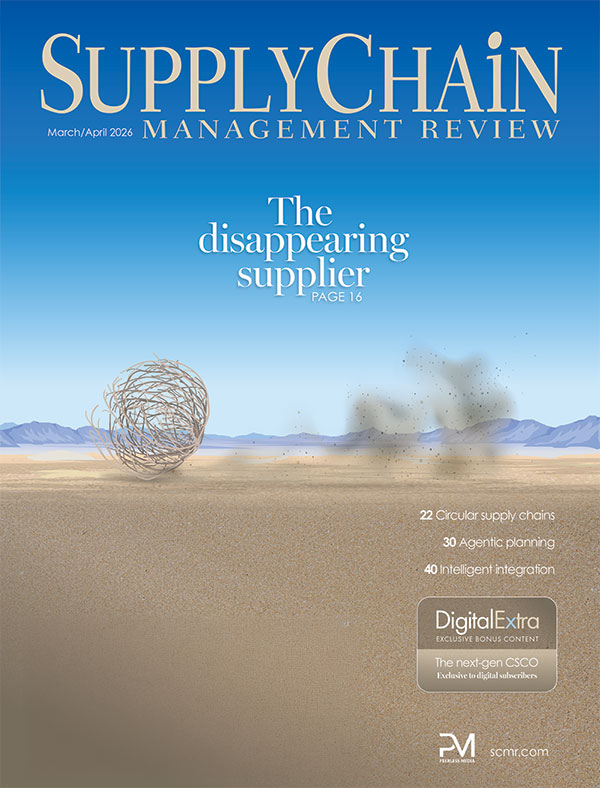
March-April 2026
The March/April 2026 issue of Supply Chain Management Review examines how supply chain leaders are managing supplier risk, circular supply chain design, AI-driven retail planning, CPG network optimization, and shifting LTL market dynamics to improve resilience and performance. Features include frameworks to prevent supplier failure, operationalize circular economy strategies, prevent retail stockouts using AI, and eliminate costly DC transfer patterns, plus insights from the 34th Annual Study of Logistics and Transportation Trends and a digital-exclusive on the evolving CSCO role. Browse this issue archive.Need Help? Contact customer service 1-508-503-1313 More options
Most procurement and supply chain teams focus their efforts on Tier 1 suppliers and contract manufacturers—tracking performance, negotiating pricing and managing SLAs. But when input costs swing wildly, tariffs shift overnight and product launches compress into weeks, relying solely on Tier 1 relationships leaves critical gaps. The real operational leverage sits one layer deeper, with Tier 2 suppliers.
Tier 2 visibility has become essential for finding cost reduction opportunities while protecting supply bases from hidden risks. AI-powered analytics tools and supply chain platforms have made this visibility achievable without massive teams or perfect data. Core innovation and technical know-how now live at Tier 2. Without that visibility, teams operate blindly on cost drivers and face concentration risks they can’t see.
SC
MR
Sorry, but your login has failed. Please recheck your login information and resubmit. If your subscription has expired, renew here.
March-April 2026
The March/April 2026 issue of Supply Chain Management Review examines how supply chain leaders are managing supplier risk, circular supply chain design, AI-driven retail planning, CPG network optimization, and… Browse this issue archive. Access your online digital edition. Download a PDF file of the March-April 2026 issue.Most procurement and supply chain teams focus their efforts on Tier 1 suppliers and contract manufacturers—tracking performance, negotiating pricing and managing SLAs. But when input costs swing wildly, tariffs shift overnight and product launches compress into weeks, relying solely on Tier 1 relationships leaves critical gaps. The real operational leverage sits one layer deeper, with Tier 2 suppliers.
Tier 2 visibility has become essential for finding cost reduction opportunities while protecting supply bases from hidden risks. AI-powered analytics tools and supply chain platforms have made this visibility achievable without massive teams or perfect data. Core innovation and technical know-how now live at Tier 2.
Without that visibility, teams operate blindly on cost drivers and face concentration risks they can’t see. Direct relationships and transparency with Tier 2 suppliers enable collaborative innovation, cost validation and compressed lead times, making supply chains more responsive when it matters most.
Why Tier 2 has become mission-critical
Supply networks have grown simultaneously more fragile and more strategic. Tariffs, trade shifts and inflation now demand visibility into cost and performance drivers across all supply tiers, not just Tier 1. As IP, specialized materials and design know-how migrate to Tier 2 suppliers, many companies now depend on invisible contributors they neither contract with nor understand.
AI-driven supplier mapping, automated data extraction and predictive analytics have made deep-tier management feasible at scale, a critical development for COOs and operations executives facing pressure from two directions. They must simultaneously shield the organization from cost volatility and hidden risks while unlocking the innovation and agility that Tier 2 suppliers possess.
Translating Tier 2 visibility into business value
Leading companies now co-design solutions with suppliers by mapping the broader ecosystem’s cost drivers, then harmonizing materials, rationalizing suppliers, and building resilient dual-sourcing structures. This shift elevates supply chain management to a boardroom issue by tying directly to enterprise priorities:
- Revenue growth. Tier 2 co-development accelerates product qualification and gets launches to market on time, turning supply chain into a competitive advantage.
- Operating model. Harmonizing materials across tiers and negotiating enterprise-wide pricing cuts complexity while driving down cost.
- Risk management. Multi-tier sourcing strategies eliminate dangerous single points of failure in the supply base.
- Capital efficiency. Coordinating payment terms and accelerating cost pass-throughs across tiers directly improves cash conversion cycles.
- Talent and culture. Cross-functional governance on Tier 2 issues breaks down silos, speeds decision-making, and makes collaboration the default.
- Sustainability. The hardest Scope 3 emission reductions sit deep in the supply chain—and can only be achieved through multi-tier partnerships.
Tier 2 visibility isn’t a universal solution. It delivers the most value in categories where material inputs, supplier networks, and switching costs shape the majority of total cost, innovation potential or risk exposure. Three environments stand out:
- Limited-leverage environments. When suppliers own design, IP or specifications, companies can become locked into opaque costs and limited leverage. Tier 2 mapping restores influence and enables joint cost validation and redesign.
- Commoditized or semi-commodity inputs. In categories like packaging, resins, excipients and basic materials, Tier 2 suppliers often drive pricing more than Tier 1 intermediaries. Consolidating demand and engaging Tier 2s directly can improve scale leverage, increase transparency and secure better terms.
- Regulated or high-qualification sectors. Food, beverage, pharma, automotive and electronics, where qualification cycles and compliance barriers limit switching, capture outsized value from transparency and structured co-innovation.
Embedding transparency, metrics, and governance for Tier 2
Sustained structural improvement comes from linking cost transparency to operating model change. In practice, leading COOs use deep-tier analytics to pinpoint cost drivers, then adjust governance and incentives so teams keep capturing savings quarter after quarter.
1. Write visibility into supplier terms
Tier 2 visibility is moving from a “nice to have” to standard language in Tier 1 agreements. Companies are baking in access to pricing and specs, along with volume and shipping terms, then treating compliance as part of supplier performance. AI-driven supplier intelligence tools are accelerating the work by pulling data together automatically and keeping it current.
2. Turn information into operating decisions
Forward-looking COOs are translating supplier data into KPIs that track with board-level outcomes. Metrics like supply concentration or dual-sourcing coverage show up alongside cash and service measures because they predict resilience and margin. The point is straightforward: supply structure becomes measurable, then manageable.
3. Build governance that holds through the cycle
Tier 2 oversight is getting a standing forum, with a repeatable cadence and clear owners. Cross-functional councils are becoming the mechanism, especially when operations and finance need the same facts to make trade-offs. That rhythm keeps transparency reviews tied to design choices and supplier collaboration, so the discipline persists after the initial push.
Top executives must insist on transparent data, unified performance metrics and coordinated oversight of Tier 2 management.
Operationalizing Tier 2 sourcing for measurable value
The companies getting the most out of Tier 2 sourcing treat it as a repeatable capability with clear ownership, not a one-time initiative. Teams run targeted RFIs to pull SKU-level price, spec and volume data, then standardize it into a should-cost baseline and push the best opportunities through a clear decision path. TPMs handle the renegotiations using benchmarks, and enterprise rates get applied when they fit.
Governance stays streamlined, with disciplined execution. Shared data rooms keep the same facts in view, decision logs record what changed and why, and information-sharing rules reduce friction with suppliers and internal stakeholders.
Related
The new logistics playbook for consumer and retail growth
A reordering of the COO and CSCO logistics agenda
Progress is managed through a concise set of enterprise KPIs, including the share of Tier 2 spend under transparent terms and variance-to-should-cost closed. Dual-sourced SKU coverage and payment-term alignment provide additional line of sight into resilience and working-capital impact.
Supplier visibility unlocks enterprise value
Tier 2 sourcing influences costs at the source by shaping upstream materials and production choices, reducing inputs before markups while protecting supplier profitability and relationships. Greater sub-tier visibility also strengthens resilience by surfacing concentration, financial and capacity risks early, improving forecasting and compliance monitoring, and enabling proactive mitigation.
Scale advantages tend to emerge once the underlying structure is made visible. When common Tier 2 suppliers are identified across TPMs, demand can be pooled, components can be standardized and quality variation can be reduced. Many Tier 2 partners also hold distinctive materials and design know-how, which makes them natural partners in co-development and can shorten development cycles.
When tied to enterprise outcomes, upstream visibility delivers measurable results, including shorter time-to-launch and stronger on-time performance, lower complexity and cost, reduced concentration risk, and faster cash flow. It also helps identify disruptions before they hit the P&L, stabilizing costs and improving service continuity. Predictive analytics and risk intelligence make this proactive management practical, supporting more stable, high-performing supply networks.
Tier 2 as a strategic advantage
Tier 2 visibility positions procurement to protect margin and supply continuity while shaping the next wave of supplier advantage. The opportunity is clear: Tier 2 supplier data can transform supply networks from cost centers into engines of speed, resilience and innovation. Procurement organizations that seize this advantage will set the standard for manufacturing agility in the decade ahead.
About the authors
Venky Arun is a Kearney partner who focuses on large-scale operations transformations and can be reached at [email protected].
Karthik Rai is a Kearney manager focused on procurement transformation and enterprise value creation. He can be reached at [email protected].
SC
MR


More Supplier Management
- How procurement teams are managing Tier 2 suppliers to lower costs and improve resilience
- Communication issues hamper supplier experience
- ASCM introduces Supplier Relationship Management certificate
- Supply chain’s rise in prominence brings regulatory compliance into focus
- Working with competitors—or why co-opetition is the key to improving cost and efficiency
- More Supplier Management
What's Related in Supplier Management
 Explore
Topics
Procurement & Sourcing News
- Why companies blame the wrong supplier … and miss the real failure
- NextGen Supply Chain Conference unveils agenda focused on AI, execution and the future of leadership
- From fragmented negotiations to coordinated negotiation performance: an AI-enabled approach
- Supply chain resilience isn’t a data problem; it’s a judgment problem
- Why your supply chain risk management plan will fail
- When component verification becomes operational
- More Procurement & Sourcing
Latest Procurement & Sourcing Resources
Subscribe

Supply Chain Management Review delivers the best industry content.

Editors’ Picks



