
Sorry, but your login has failed. Please recheck your login information and resubmit. If your subscription has expired, renew here.
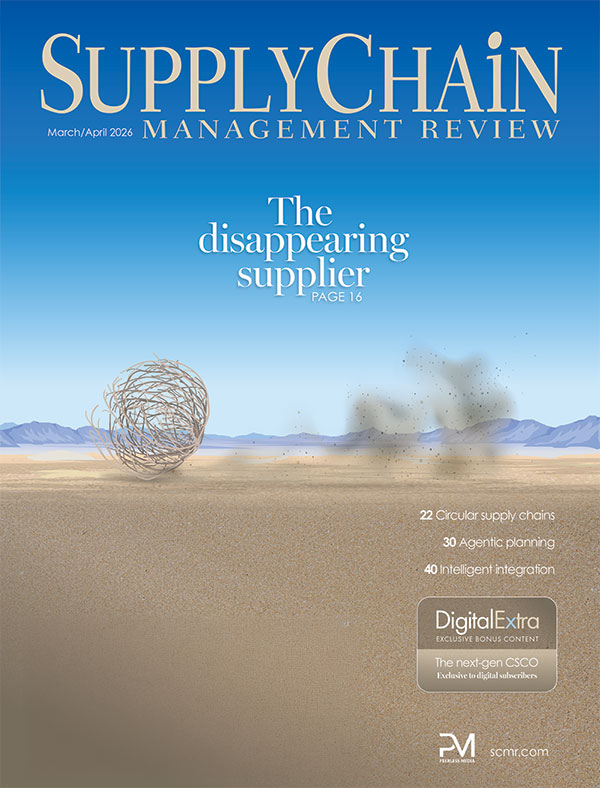
March-April 2026
The March/April 2026 issue of Supply Chain Management Review examines how supply chain leaders are managing supplier risk, circular supply chain design, AI-driven retail planning, CPG network optimization, and shifting LTL market dynamics to improve resilience and performance. Features include frameworks to prevent supplier failure, operationalize circular economy strategies, prevent retail stockouts using AI, and eliminate costly DC transfer patterns, plus insights from the 34th Annual Study of Logistics and Transportation Trends and a digital-exclusive on the evolving CSCO role. Browse this issue archive.Need Help? Contact customer service 1-508-503-1313 More options
A newly released book caught my attention recently. It is titled: Could Should Might Don’t: How We Think About the Future, and written by Nick Foster. Andrew Stark wrote a review of it in the Wall Street Journal on Dec. 31, 2025. As someone interested in forecasting and supply chain planning, the title of the review immediately resonated with me: “A profession of prediction.”
The book, however, talks less about business managers engaged in forecasting & planning, and more about what are termed futurists, such as those that go on speaking tours, as well as some science fiction writers & movie producers postulating future utopian/dystopian societies (e.g., the “Hunger Games” movies). The resulting talks, books and movies are interesting and highly speculative about these futures; yet they are somewhat “far-out” literally and figuratively (e.g., in terms of distant futures and outer space exploration). Today’s most active futurists are focused on the recent uptick in interest in artificial intelligence.
SC
MR
Sorry, but your login has failed. Please recheck your login information and resubmit. If your subscription has expired, renew here.
March-April 2026
The March/April 2026 issue of Supply Chain Management Review examines how supply chain leaders are managing supplier risk, circular supply chain design, AI-driven retail planning, CPG network optimization, and… Browse this issue archive. Access your online digital edition. Download a PDF file of the March-April 2026 issue.A newly released book caught my attention recently. It is titled: Could Should Might Don’t: How We Think About the Future, and written by Nick Foster. Andrew Stark wrote a review of it in the Wall Street Journal on Dec. 31, 2025. As someone interested in forecasting and supply chain planning, the title of the review immediately resonated with me: “A profession of prediction.”
The book, however, talks less about business managers engaged in forecasting & planning, and more about what are termed futurists, such as those that go on speaking tours, as well as some science fiction writers & movie producers postulating future utopian/dystopian societies (e.g., the “Hunger Games” movies). The resulting talks, books and movies are interesting and highly speculative about these futures; yet they are somewhat “far-out” literally and figuratively (e.g., in terms of distant futures and outer space exploration). Today’s most active futurists are focused on the recent uptick in interest in artificial intelligence.
Some futuristic thinking, back in the day
In 1968, the Club of Rome, an organization of intellectuals and business leaders, was founded to address global issues. It conducted computer simulations of the future. It attracted a lot of attention in 1972 with its first report, “The Limits to Growth.”
“The report hypothesized that the growth of production and consumption could not continue indefinitely because of either resource depletion or high levels of pollution,” according to a Wikipedia report on its findings. The report was a best seller, as well as a related book titled The Population Bomb, co-authored by Paul R. Ehrlich and Anne H. Ehrlich. The latter predicted worldwide famines due to overpopulation, as well as other major societal upheavals. It advocated immediate action to limit population growth. Today, we know that through innovation and advances in mass production, mankind’s growing basic needs (e.g., for energy and food) have been and likely will be met for some time. It is forecast that the growing worldwide population will peak in 2084 at just under 10.3 billion from about 8.2 billion today. However, we still struggle to mitigate climate change due to high levels of CO2 pollution.
There is a lot of speculation from futuristics regarding the good, bad, and the ugly futures that might arise from the increasing use of AI. An online WSJ article, titled “Models Will Run the World,” was subtitled “The software revolution has transformed business. What’s next? Processes that constantly improve themselves without need of human intervention” (Aug. 19, 2018). This smacks of a science-fiction viewpoint that robots will fend for themselves and take over the world such as depicted in the 1968 science fiction film “2001: A Space Odyssey.” In it, a computer named HAL is slowly taking over the management of a spaceship in outer space. (A piece of trivia is that the HAL name was chosen because it is an alphabetic sequence shifted by one letter from IBM—the technology powerhouse at that time.)
In my Insights column “AI update: Decisionmaker or decision supporter?” (July/August 2024), I reiterated my earlier optimistic view that: “The promise of AI offers greater decision-making power, but there are some crucial decisions that AI just should not make).
The Could Should Might Don’t book review
Mr. Stark’s review of the book begins with a statement summarizing Mr. Foster’s skeptical view of the futurism industry—of which he has been a part of for many years. That is: “Given the future’s opacity, why should we expect self-appointed futurists—all those jet-setting consultants, risk analysts and TED Talk presenters with their trend lines, and game plans—to know any more about what is going to happen than the rest of us.” Mr. Foster labels four segments of his industry, as follows.
1. Could futurism. Driven by science fiction and claims the future will inevitably entail use of solar-powered cars, delivery drones, and jet-packs. It’s happening whether you like it or not, because it is great stuff.
2. Should futurism. Discuss charts that show paths toward achieving future objectives. Seeing the future as knowable and amenable to our control.
3. Might futurism. Deems the future as an environment of uncertainties. Using risk analysis and game theory, it strategizes possible scenarios under which everything will be all right, and businesses will thrive.
4. Don’t futurism. Originates in dystopian novels and exists “to dispense warnings, highlight issues, and point out consequences.”
After studying each segment’s activities, Mr. Foster concludes that “futurists disagree over how much of the future lends itself to our control and foreknowledge. Many focus too much on the grandiose. Furthermore, since the mundane is where most of us live [especially supply chain managers], futurists have failed to deliver even a low-resolution picture of the world in 10 or 50 years.”
Futurists offer minimal planning support
My takeaway from Mr. Foster’s exposé is that generally, futurists will offer little help to business forecasters and planners who rely on quantitative models to do operational, tactical, and even strategic planning. Most operational and tactical planning processes (such as the sales and operations planning process) usually involve decision-making under certainty or risk (vis-à-vis uncertainty). If any of these processes need futurist input, it would be strategic planning that has a planning horizon up to 15 years out. However, that long-term future is uncertain and unforeseeable.
Thus, a strategic planning process typically relies on scenario planning. As discussed in Insights, “Strategic planning under uncertainty: Long-term muddling-through” (July/August 2021), this approach entails developing multiple realistic future scenarios—often three, and commonly labeled as optimistic, most likely, and pessimistic. Much like the might futurism approach, organizations build strategies for multiple possible futures so they are prepared regardless of how conditions evolve. A decision process then guides which strategy to pursue to support long-term survival and success.
Conclusion
The key to the scenario planning process is developing realistic futures that may come to pass. I originally thought futurists might help model these. However, per Mr. Foster, “they have failed to deliver even a low-resolution picture of the world in 10 or 50 years.” Thus, managers doing strategic planning would be best modeling their own futures because they know their own company’s capabilities, how to compete, and their industry’s trends best.
As I was writing this column my eye caught a huge one-page advertisement in the WSJ by Bain & Company (January 21, 2026). Bain—for those who might not have heard of it –was founded in 1973 and is a management consulting company specializing in business strategy. It was an offshoot of the Boston Consulting Group. The ad had five simple statements.
1. “Prediction looks ahead.”
2. “Conviction moves you forward.”
3. “In a world that changes daily, acting with clarity is more powerful than waiting for certainty. We help leaders find focus, respond now, and adapt as conditions evolve.”
4. “Stop Scenario Planning.”
5. “Start building a macro strategy.”
At first glance I thought that Bain had given up on scenario planning. However, I think I interpret it as saying—do it; however, at some point, you have to commit to developing and deploying a strategy with conviction. It should not be a passive activity because the world is changing too rapidly to stand still.
I have to admit that I may have been perceived as a futurist in some of my MIT Supply Chain 2020 Project-related talks around the world. They were marketed as “a peek into the future.” In 2004, I joined the MIT CTL group to launch a project looking at what excellent supply chains might look like 15 years out. I managed the project launch for its first three years. The project identified scenario planning for use in strategic planning and three scenarios dealing with the level of global free trade that might take place in the future. We also identified six major macro-factors that would shape future supply chains. They were as follows.
1. The aging of developed countries.
2. Oil prices.
3. The power shift toward the east.
4. Trading bloc formation.
5. Globalized green law.
6. Pervasive technologies.
See Insights (May/June 2012), titled “SC2020 Project Update: Uncertainties,” for my latest update on these. After reading about Mr. Foster’s book, I’d say my talks dealt ‘with the mundane’ where most supply chain managers live. I was trying to give them advice on the uncertainties of future global demand-supply chains. This was in contrast to other speakers at supply chain conferences at which I spoke at, who were upbeat about the future. So in conclusion, I’d say I was not a typical futurist. But being honest, I really love listening to those grandiose futurist talks, rather than ones like mine.
SC
MR


More Supply Chain Management
- Managing human and AI teams across the supply chain
- AI won’t fix a broken supply chain foundation
- Stop moving boxes, start moving dollars: The new math of global supply chain velocity
- Consensus won’t cut it: Why assertive advocate CSCOs deliver sustained cost excellence
- Here comes the new supply chain: Is your organization ready?
- More Supply Chain Management
What's Related in Supply Chain Management
 Explore
Topics
Procurement & Sourcing News
- Why companies blame the wrong supplier … and miss the real failure
- NextGen Supply Chain Conference unveils agenda focused on AI, execution and the future of leadership
- From fragmented negotiations to coordinated negotiation performance: an AI-enabled approach
- Supply chain resilience isn’t a data problem; it’s a judgment problem
- Why your supply chain risk management plan will fail
- When component verification becomes operational
- More Procurement & Sourcing
Latest Procurement & Sourcing Resources
About the Author
Larry Lapide, Research Affiliate

Dr. Lapide is a lecturer at the University of Massachusetts’ Boston Campus and is an MIT Research Affiliate. He received the inaugural Lifetime Achievement in Business Forecasting & Planning Award from the Institute of Business Forecasting & Planning. Dr. Lapide can be reached at: [email protected].
Follow SCMR on social media.
@SupplyChainManagementReview on Facebook
@SCMR on Twitter
SCMR on Linkedin
Subscribe

Supply Chain Management Review delivers the best industry content.

Editors’ Picks



