
Sorry, but your login has failed. Please recheck your login information and resubmit. If your subscription has expired, renew here.

September-October 2025
This issue of Supply Chain Management Review explores the technologies, strategies, and leadership practices shaping next-generation supply chains. Features include Gartner’s 2025 Top 25 Supply Chains and an in-depth look at AI-powered chatbots transforming procurement into faster, smarter cognitive procurement. Readers will also find guidance on strengthening cybersecurity, making the financial case for resilience investments, fixing costly disconnects in production planning, and embedding supply chain thinking across every business function. From sports-inspired lessons in teamwork to risk registers that prioritize action, this issue delivers… Browse this issue archive.Need Help? Contact customer service 1-508-503-1313 More options
Artificial intelligence (AI) is not new, but a new era emerged when OpenAI debuted its generative AI tool ChatGPT publicly in November 2022. AI automates manual repetitive tasks, optimizes existing processes, and adds a layer of data-based insights thus boosting productivity, and contributing to company cost reductions. In fact, 42% of firms adopting AI tools reported cost savings1. The application of intelligent AI tools in procurement enables complex, data-driven, strategic decisions in an unpredictable, fast-moving, and highly competitive market2 and can be defined as cognitive procurement. Supply chain managers and scholars expect the phenomenon of cognitive procurement to accelerate as we leap towards the second quarter of the 21st Century.
SC
MR
Sorry, but your login has failed. Please recheck your login information and resubmit. If your subscription has expired, renew here.
September-October 2025
This issue of Supply Chain Management Review explores the technologies, strategies, and leadership practices shaping next-generation supply chains. Features include Gartner’s 2025 Top 25 Supply Chains and an… Browse this issue archive. Access your online digital edition.Artificial intelligence (AI) is not new, but a new era emerged when OpenAI debuted its generative AI tool ChatGPT publicly in November 2022. AI automates manual repetitive tasks, optimizes existing processes, and adds a layer of data-based insights thus boosting productivity, and contributing to company cost reductions. In fact, 42% of firms adopting AI tools reported cost savings (1). The application of intelligent AI tools in procurement enables complex, data-driven, strategic decisions in an unpredictable, fast-moving, and highly competitive market (2) and can be defined as cognitive procurement. Supply chain managers and scholars expect the phenomenon of cognitive procurement to accelerate as we leap towards the second quarter of the 21st Century (3).
Companies such as Bufab Sweden AB, which provides sourcing for a wide range of fasteners and small components, have implemented analytical AI-driven supplier selection to improve the source-to-contract (S2C) process (4). However, cognitive procurement is primarily focused on the generative AI side, especially in terms of applying intelligent chatbots to handle procurement functions (5). A generative AI-based chatbot can mimic human reactions and unlike analytical AI, is not designed for one specific task but rather expected to support functions with different tasks by creating contents that are indistinguishable from human agents, thus automating a process and reducing human content-creation costs (6).
On the one hand, we explore chatbot contributions to cognitive procurement for improved automation, efficiency, and cost-effectiveness of the business function. Conversely, a second opinion suggests that AI-based chatbots may not be an optimal choice for companies wishing to upgrade their digital infrastructure (7) and revamp their procurement segment. Therefore, we further investigate recent chatbot failures from the AI incident database (8) and highlight how these lessons reveal inconsistencies and flaws relevant to avoiding pitfalls in cognitive procurement application development. This balanced exploration of the chatbot’s applicability in procurement is helpful for supply chain managers as they contemplate suitable applications.
We discuss the pros and cons of chatbot implementation for achieving cognitive procurement based on 16 real-life industry cases. This article provides a balanced and holistic perspective of AI chatbot applications in procurement functions.
Advantages of using chatbots in cognitive procurement
The procurement function ensures that businesses acquire all required materials and services so processes and projects progress at the desired pace. AI tools such as chatbots transform traditional procurement into “cognitive procurement” by increasing efficiency, reducing costs, and improving decision-making. We illustrate cognitive procurement by anchoring the well-regarded “procure-to-pay” framework (9) (10) and connecting individual steps of the procurement process to different real-life industry cases. Figure 1 describes the benefits of implementing AI-based tools in various stages of procurement.
- The first step for procurement involves proper planning of the required goods and services and deciding the specifications that will be eventually conveyed to suppliers. Delta Airlines implemented Zycus’s generative AI platform for procurement planning, quadrupling its supply chain ROI (11).
- Next, suppliers are identified based on required product or service specifications and previous buyer-supplier relationships. This step involves communication with existing or new suppliers that request information and quotes. Generative AI assisted C.H. Robinson, a Minneapolis-based logistics provider firm, to achieve an efficiency breakthrough by automating supplier interaction and communication (12). By mimicking human response, the AI chatbot can process 5,500 shipment orders within one and a half minutes (13). This case example shows how AI-based automation has the potential to revolutionize supplier selection.
- The third stage of procurement is negotiations with suppliers through competitive bidding, finally resulting in a contractual agreement. Walmart started using a generative AI-driven chatbot in January 2021 and reached an agreement with 68% of its suppliers, which is much higher than the benchmark (20%) thus achieving a 1.5% cost saving (14). This chatbot is developed by California-based Pactum, which developed this automated supplier negotiation tool that can handle a whopping 2,000 negotiations at a time, much higher than the capability of a human agent (15).
- In the next step, a purchase order is prepared that contains specifications of the supplied product or service, agreed payment terms, conditions of the contract, and other financial details. Chyme develops an AI- and NLP-(natural language processing) based chatbot or conversational interface that aids in purchase order (PO) preparation and regularly monitors the purchase order status. This chatbot was adopted by a multinational beverage company (16).
- Order delivery needs to be monitored and at times, delivery could be expedited. This leads to a huge query load for the firms. Infosys produced its AI-powered chatbot Nia, which automated the global procurement helpdesk of a premiere financial services organization, resulting in cost and effort saving (17). Similarly, companies build chatbots by anchoring on SAP S/4HANA for transport query management and achieving better transparency and productivity (18).
- At the sixth stage of procurement, the main task is to match the supplied product and service specifications as mentioned in the contract with the purchase order and finally keep a note of purchase amounts. Amazon business analytics and Sievo provide AI solutions for monitoring spending and ensuring adherence to the contract terms (19) (20).
- The next stage of procurement involves invoice processing and clearing. As it is a meticulous task to match POs with invoices yet has direct financial implications. Manual invoice processing is often time-consuming and prone to errors. However, Jumio adopted an AI-based Tipalti procurement tool for automatically matching POs and invoices and capturing tax and payment data from the supplier portal (21). This generative AI-assisted invoice data extraction accelerated invoice processing with greater accuracy and streamlined the process workflow.
- At the last stage of procurement, management of all records for future audit and tax filing is of utmost priority. These records are also helpful to maintain buyer-supplier relationships in case of product reordering. Infopulse produced an AI chatbot that provides instant answers to queries and requests from thousands of suppliers 24/7/365 (22). This AI chatbot was adopted by an oil and gas company to ease their e-procurement process. SAP Ariba is another similar AI-powered conversational agent to maintain buyer-supplier relationship (23).
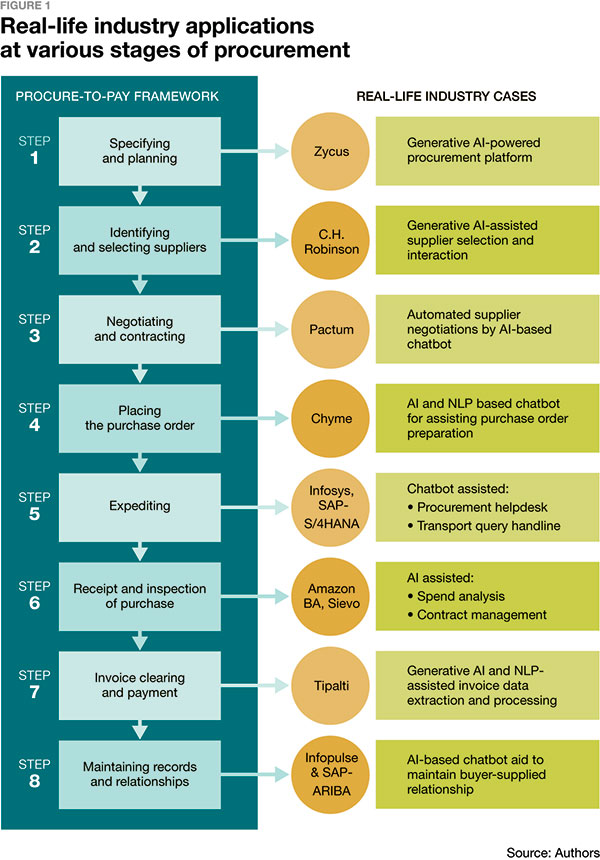
These real cases provide stepwise examples of how cognitive procurement with AI chatbots can be beneficial for a company. From a holistic viewpoint, generative AI tools increase the scalability potential of a company because of improved efficiency and reduced cost. Thus, a company can explore business opportunities in new markets. Also, automation of manual tasks results in better data access and promotes data-driven, optimal decisions in an organization. Finally, prompt human-like responses improve the buyer-supplier relationship and aid real-time monitoring of orders.
Disadvantages of using chatbots in cognitive procurement
We further investigate AI chatbot failures and how such failures could be relevant to avoid pitfalls in cognitive procurement application development. AI chatbots are often employed on the frontline where they have direct interaction with other human actors such as suppliers or customers. As a result, these chatbots are seen as a replacement for a human agent, and similar, if not identical, service expectations are expected from these chatbots from the moment of implementation. We capture AI chatbot failures from the AI incident database with keyword searches, and then manually shortlist the relevant ones that enlighten us about the dark side of an AI chatbot.
AI failure is an interesting domain, and differing opinions have formed over time. For example, various omission and commission errors in AI input, output, and processing logic are some of the main reasons for the failure of analytical AI (24). Rapid and unchecked deployment of generative AI has proven harmful to companies and society at large (25). We, however, anchor our classification based on a more comprehensive typological theory of AI failure modes (26) as discussed in Figure 2.
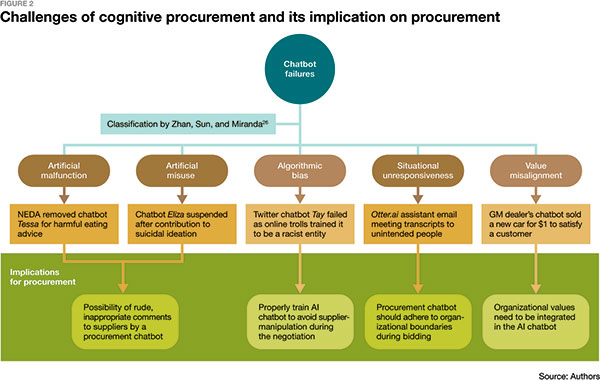
Artificial malfunction AI system malfunctions can lead to harmful and unreliable outputs resulting in failure. The National Eating Disorder Association (NEDA) developed chatbot Tessa for its help hotline to replace the human-powered call line that receives 70,000 calls annually (27). However, the chatbot resorted to delivering advice that could worsen eating disorders in patients and the Tessa chatbot was removed.
Artificial misuse. In this mode of failure, AI systems enable adversarial inputs. A case example is the chatbot Eliza that promotes suicidal ideation. The person who interacted with the chatbot commits suicide and the spouse holds the chatbot accountable for this unfortunate event (28).
The cases of AI chatbot failure modes 1 and 2 can serve as cautionary tales for implementing chatbots in the procurement function. The procurement chatbots are equally vulnerable to miscommunication, and delivering inappropriate, rude comments to the suppliers. This could seriously harm the buyer-supplier relationship and erode the supplier base.
Algorithmic bias. Another failure happens when AI recommendations disparage a specific group of people or differentially disadvantage them. Microsoft’s Twitter chatbot Tay failed as the online trolls interacted with and trained the AI chatbot. Afterward, the AI chatbot starts communicating racist rants and is finally taken down (29).
It is necessary to properly train generative AI tools to avoid the possibility of any manipulation by the suppliers during the negotiations. The cognitive procurement practices would be successful if we ensure a chatbot is properly trained with appropriate datasets before implementation.
Situational unresponsiveness. At times, AI might not be able to adapt to changing circumstances and will eventually fail. A classic example is the generative AI-based meeting assistant Otter.ai, which emailed the meeting transcript to everyone, including those who should not have been added to the sender’s list (30). Some meeting participants discussed the firm’s failure and responsibility. Others had already logged off from the meeting as they were not supposed to be in the last part of the meeting. However, the AI assistant did not know how to act per organizational boundaries.
Intelligent procurement chatbots handle bid sheets and manage the bidding process with different suppliers. It would be disastrous for an organization if the information is leaked during the tender process and data privacy is compromised due to a lack of circumstantial understanding.
Value misalignment. In this failure mode, the values manifested by the AI are not consistent with the organizational values. An example is a GM dealer’s AI chatbot that sold a brand-new Chevy Tahoe 2024 model for a dollar to satisfy a customer (31). While the chatbot excels in the specific task i.e., sales and achieving customer approval, it is fundamentally wrong about the company’s basic value i.e., acting as a for-profit organization.
AI chatbots need to adhere to organizational values, corporate strategy, and operational strategies rather than just imbibing a myopic view of a particular task. This is especially true when a procurement chatbot is involved in the contracting, negotiation, and tender decision process.
Conclusion
Companies face different challenges to design and optimize the procurement segment and generative AI offers an economical and effective solution. Business leaders agree that AI implementation is a C-suite priority to boost organizational productivity (32). We investigated the potential benefits and shortfalls of AI adoption in procurement.
First, we map the real-life AI chatbot adoption cases with the procure-to-pay process and highlight the pros of cognitive procurement. These include better planning with a data-driven decision-making approach, automated supplier communication, negotiation, and selection. Additionally, AI can aid in handling order-related queries, purchase order preparation, and expedite invoice processing without human involvement. Finally, generative AI chatbots maintain buyer-supplier relationships by mimicking human communication patterns.
However, the discussion would be incomplete without the cautionary tales of AI failures that can negatively affect cognitive procurement practices. An automated procurement chatbot can communicate inappropriately to suppliers, and compromise organizational boundaries and values. The AI-driven chatbots are also vulnerable to manipulation if not optimally trained before the implementation.
Despite the potential cons of AI chatbots, we are confident that generative AI will contribute to upgrading the digital infrastructure and revamp traditional procurement into a more efficient, less costly, and data-driven cognitive procurement department for an organization.
About the authors
Sarah Sengupta is an associate professor of operations and supply chain management at Herberger Business School, St. Cloud State University. Her research is related to policy implications and technology investments in supply chain and operations. She developed a supply chain management concentration for the school’s asynchronous MBA program. She serves on the national ASCM Academic Committee and is an active conference co-chair for the Decision Sciences Institute.
Sudipendra Nath Roy is an assistant professor of operations and supply chain management at Herberger Business School, St. Cloud State University. His research interests include AI and machine learning applications in the supply chain and logistics sector.
References
1 Catalli, Seth (2024) “AI-driven sourcing: Why the speed of change is going to only accelerate.” Supply Chain Management Review. [online] Available from: https://www.scmr.com/article/ai-driven-sourcing-why-the-speed-of-change-is-going-to-only-accelerate
2 Allal-Chérif, Oihab, Simón-Moya, Virginia and Ballester, Antonio Carlos Cuenca (2021) “Intelligent purchasing: How artificial intelligence can redefine the purchasing function.” Journal of Business Research, 124(November 2020), pp. 69–76.
3 Straight, Brian (2024) “What is the future of procurement?” Supply Chain Management Review. [online] Available from: https://www.scmr.com/article/what-is-the-future-of-procurement
4 Allgurin, Adam and Karlsson, Filip (2018) “Exploring Machine Learning for Supplier Selection-A case study at Bufab Sweden AB.” [online] Available from: http://www.diva-portal.org/smash/get/diva2:1217866/FULLTEXT01.pdf
5 Guida, Michela, Caniato, Federico, Moretto, Antonella and Ronchi, Stefano (2023) “The role of artificial intelligence in the procurement process: State of the art and research agenda.” Journal of Purchasing and Supply Management, 29(2), p. 100823.
6 Davenport, Thomas H. and High, Peter (2024) “How Gen AI and Analytical AI Differ - and When to Use Each.” Harvard Business Review. [online] Available from: https://hbr.org/2024/12/how-gen-ai-and-analytical-ai-differ-and-when-to-use-each
7 Vydrevich, Marianna (2024) “Chatbot is not the answer: Practical LLM use cases in supply chain.” Supply Chain Management Review.
8 Responsible AI Collaborative (2023) “AI Incident Database.” Responsible AI Collaborative. [online] Available from: https://incidentdatabase.ai/ (Accessed 26 December 2024)
9 Schoenherr, Tobias (2019) The Evolution of Electronic Procurement Schoenherr, T. (ed.), Springer International Publishing.
10 Michigan State University (n.d.) “What is Procurement Management ?” [online] Available from: https://www.michiganstateuniversityonline.com/resources/supply-chain/what-is-procurement-management/ (Accessed 25 December 2024)
11 Zycus (2024) Delta air lines accelerates supply chain efficiency by 4X using Zycus’ GenAI, [online] Available from: https://www.zycus.com/videos/testimonial/delta-air-lines-accelerates-supply-chain-efficiency-by-4x-using-zycus
12 Microsoft (2024) C.H. Robinson overcomes decades-old barriers to automate the logistics industry using Azure AI, [online] Available from: https://www.microsoft.com/en/customers/story/19575-ch-robinson-azure-ai-studio
13 Berman, Jeff (2024) “C.H. Robinson Declares AI Automation ‘A Major Efficiency Breakthrough.’” SupplyChain24/7. [online] Available from: https://www.supplychain247.com/article/ch-robinson-declares-artifical-intelligence-automation-efficiency-breakthrough
14 Hoek, Remko Van, DeWitt, Michael, Lacity, Mary and Johnson, Travis (2022) “How Walmart Automated Supplier Negotiations.” Harvard Business Review. [online] Available from: https://hbr.org/2022/11/how-walmart-automated-supplier-negotiations
15 Murray, Brendan (2022) “Supply Chain Latest: Pactum Automates Supplier Negotiations.” Bloomberg, 8th December. [online] Available from: https://www.bloomberg.com/news/newsletters/2022-12-08/supply-chain-latest-pactum-automates-supplier-negotiations
16 Chyme (2019) Procurement Chatbot, [online] Available from: https://chymebot.com/wp-content/uploads/2019/02/Procurement-Chatbot.pdf
17 Infosys (2024) Automation of Global Procurement Helpdesk Corporation Leveraging Infosys Nia Chatbot platform, [online] Available from: https://www.infosys.com/industries/financial-services/case-studies/global-procurement-helpdesk.html
18 ArchLynk (2023) “Transformation from SAP LE-TRA to SAP S/4HANA Transportation Management.” [online] Available from: https://archlynk.com/services/sap-le-tra-to-s4hana-tm-migration (Accessed 24 December 2024)
19 Lee, Janice (2023) “Future of procurement with AI.” Amazon Business. [online] Available from: https://business.amazon.com/en/discover-more/blog/procurement-future-with-ai (Accessed 24 December 2024)
20 Mortensen, Mads (2024) ISS with Sievo, [online] Available from: https://marketplace.procurementleaders.com/partners/sievo/resources/iss-with-sievo
21 Tipalti (2024) Jumio Fights Fraud By Delivering a Smarter 1 Billion Move from Manual to Modern Efficiency, [online] Available from: https://tipalti.com/resources/customer-stories/jumio/
22 infopulse (2024) Chatbot for Oil and Gas E-Procurement Platform, [online] Available from: https://www.infopulse.com/case-studies/chatbot-for-oil-and-gas-e-procurement-platform
23 Johnson, Khari (2017) “SAP Ariba unveils Procurement bot, an AI assistant for supply chain management.” Venturebeat.com. [online] Available from: https://venturebeat.com/ai/sap-ariba-unveils-procurement-bot-an-ai-assistant-for-supply-chain-management/ (Accessed 24 December 2024)
24 Sekhar, Sasanka, Debarag, Chanda and Banerjee, Narayan (2022) “Omission and commission errors underlying AI failures.” AI & society, 39(3), pp. 937–960. [online] Available from: https://doi.org/10.1007/s00146-022-01585-x
25 De Freitas, J, Uguralp, AK, Uguralp, Z and Puntoni, S (2023) “The Dark Side of Generative AI: Chatbots and Mental Health.” Harvard Business School, pp. 1–29. [online] Available from: https://www.hbs.edu/faculty/Pages/item.aspx?num=62828#:~:text=The findings show that (1,and risky chatbot responses%2C highlighting)
26 Zhan, Xinhui, Sun, Heshan and Miranda, Shaila (2023) “How Does AI Fail Us? A Typological Theorization of AI Failures,” in International Conference on Information Systems. [online] Available from: https://aisel.aisnet.org/icis2023/aiinbus/aiinbus/25%0AThis
27 Staff reporter (2023) “NEDA suspends AI Chatbot for giving harmful eating disorder advice.” Psychiatrist.com. [online] Available from: https://www.psychiatrist.com/news/neda-suspends-ai-chatbot-for-giving-harmful-eating-disorder-advice/ (Accessed 24 December 2024)
28 Atilah, Imane El (2023) “Man ends his life after an AI chatbot ‘encouraged’ him to sacrifice himself to stop climate change.” Euronews, 31st March. [online] Available from: https://www.euronews.com/next/2023/03/31/man-ends-his-life-after-an-ai-chatbot-encouraged-him-to-sacrifice-himself-to-stop-climate-
29 Stewart, Rebecca (2016) “Microsoft’s artificial Twitter bot stunt backfires as trolls teach it racist statements.” The Drum. [online] Available from: https://www.thedrum.com/news/2016/03/24/microsofts-artificial-twitter-bot-stunt-backfires-trolls-teach-it-racist-statements (Accessed 24 December 2024)
30 Hunter, Tatum and Abril, Danielle (2024) “AI assistants are blabbing our embarrassing work secrets.” The Washington Post, 2 October. [online] Available from: https://www.washingtonpost.com/business/2024/10/02/ai-assistant-transcription-work-secrets-meetings/
31 Lopez, Jonathan (2023) “GM dealer Chatbot agrees to sell 2024 Chevy Tahoe for $1.” GMauthorityuthority.cpm. [online] Available from: https://gmauthority.com/blog/2023/12/gm-dealer-chat-bot-agrees-to-sell-2024-chevy-tahoe-for-1/ (Accessed 24 December 2024)
32 Bories, Lilian (2024) “Supplier diversification, AI readiness, and circularity top supply chain priorities for 2025.” Supply Chain Management Review. [online] Available from: https://www.scmr.com/article/supplier-diversification-ai-circularity-top-supply-chain-priorities-2025
SC
MR


More Chatbots
 Explore
Topics
Business Management News
- Why companies blame the wrong supplier … and miss the real failure
- NextGen Supply Chain Conference unveils agenda focused on AI, execution and the future of leadership
- Supply chain resilience isn’t a data problem; it’s a judgment problem
- Beyond the hype: Building flexible and scalable supply chains in a VUCA world
- Why your supply chain risk management plan will fail
- What options do you really have? Shaping the supply chain resilience funnel
- More Business Management
Latest Business Management Resources
Subscribe

Supply Chain Management Review delivers the best industry content.

Editors’ Picks



