
Sorry, but your login has failed. Please recheck your login information and resubmit. If your subscription has expired, renew here.
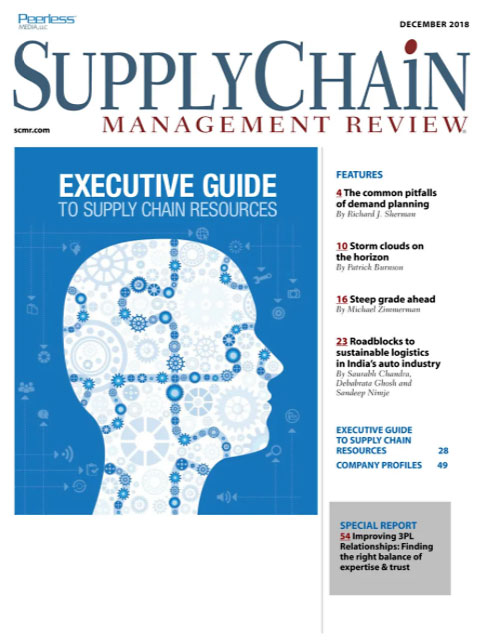
December 2018
It’s December and time once again for our annual Executive Guide to Supply Chain Resources. This is a comprehensive guide to services, products and educational opportunities targeted specifically to supply chain professionals. As with years past, we’re also featuring several articles we trust will offer food for thought in your supply chain in the coming year. Browse this issue archive.Need Help? Contact customer service 1-508-503-1313 More options
Rising volumes. Capacity shortages. Bold price increases. Across all sectors, for all types of shippers. Through most of 2017 and 2018, the story of logistics industry has been inflationary. It simply costs more to move and store things now than in the past. And in general, this trend is likely to continue, according to the Council of Supply Chain Management Professionals’ 2018 State of Logistics Report authored by A.T. Kearney.
Reduced available capacity and high prices have resulted in large part from a strong economy. Most indicators call for the strong economy to continue through 2019 and beyond, despite some recent wobbles and concern that the Fed rate increases will trigger a recession. The capacity crunch has not been helped by uncertainty about big, technology-driven changes coming to most sectors of the industry. While those changes are indeed coming and will be profound, they are not likely to arrive soon enough to make a difference in 2019. Thus, shippers will need smart strategies to address the complex tradeoffs inherent in a tight logistics market.
The industry outlook is clearer than it was a year ago. Back then, uncertainties suggested four different scenarios for how 2018 would play out. This year, all trends point to a single scenario: a steep grade ahead. As demand outpaced supply in every sector of logistics, carriers have been in control. A variety of factors—from high fuel costs to constricted labor markets—will conspire to keep prices high. To contain costs and ensure stability, shippers must become more efficient, in part by leveraging emerging technological tools.

This complete article is available to subscribers only.
Log in now for full access or start your PLUS+ subscription for instant access.
SC
MR
Sorry, but your login has failed. Please recheck your login information and resubmit. If your subscription has expired, renew here.
December 2018
It’s December and time once again for our annual Executive Guide to Supply Chain Resources. This is a comprehensive guide to services, products and educational opportunities targeted specifically to supply chain… Browse this issue archive. Access your online digital edition. Download a PDF file of the December 2018 issue.Rising volumes. Capacity shortages. Bold price increases. Across all sectors, for all types of shippers. Through most of 2017 and 2018, the story of logistics industry has been inflationary. It simply costs more to move and store things now than in the past. And in general, this trend is likely to continue, according to the Council of Supply Chain Management Professionals' 2018 State of Logistics Report authored by A.T. Kearney.
Reduced available capacity and high prices have resulted in large part from a strong economy. Most indicators call for the strong economy to continue through 2019 and beyond, despite some recent wobbles and concern that the Fed rate increases will trigger a recession. The capacity crunch has not been helped by uncertainty about big, technology-driven changes coming to most sectors of the industry. While those changes are indeed coming and will be profound, they are not likely to arrive soon enough to make a difference in 2019. Thus, shippers will need smart strategies to address the complex tradeoffs inherent in a tight logistics market.
The industry outlook is clearer than it was a year ago. Back then, uncertainties suggested four different scenarios for how 2018 would play out. This year, all trends point to a single scenario: a steep grade ahead. As demand outpaced supply in every sector of logistics, carriers have been in control. A variety of factors—from high fuel costs to constricted labor markets—will conspire to keep prices high. To contain costs and ensure stability, shippers must become more efficient, in part by leveraging emerging technological tools.
SC
MR


More Events
- Innovators Netstock, Pickle Robot win NextGen Solution Provider awards
- NextGen Supply Chain Conference unveils agenda focused on AI, execution and the future of leadership
- Wayfair executive to share lessons from building a tech-driven delivery network in NextGen Keynote
- Eli Lilly’s Mar Gimeno to keynote at NextGen Supply Chain Conference 2026
- NextGen extends 2026 award, speaker submission deadlines amid strong industry interest
- Tractor Supply to receive NextGen Supply Chain Visionary Award
- More Events
Latest Podcast
 Explore
Business Management News
- Innovators Netstock, Pickle Robot win NextGen Solution Provider awards
- Bigger trucks versus broken bridges and roads
- From salon to dock door: Repurposing scheduling software for inbound flow
- The biggest barrier to AI in supply chains isn’t technology
- Rebuilding a planning function around the physical world
- Why companies blame the wrong supplier … and miss the real failure
- More Business Management
Latest Business Management Resources
Subscribe

Supply Chain Management Review delivers the best industry content.

Editors’ Picks



