
As we move closer to the end of the year, Drewry reaffirms its view that manufacturers and retailers should expect ocean contract freight rates on most routes to increase – not fall – in 2021, following major market changes since the COVID-19 outbreak.
It is too early in the Q4 bid season to reach exact conclusions about 2021 rate changes. However, industry analysts say the signs are obvious in the spot market for ocean transportation that carriers have gained pricing power and are managing ship capacity to their advantage.
Based on the Drewry Container Freight Rate Insight, a service that tracks and provides average spot container freight rates on 700+ lanes globally and analyses market trends, analysts say they can clearly see that 2020 spot rates have exceeded 2019 spot rates by a large margin since March. The Global Freight Rate Index, a weighted average of all-in spot rates on East-West, North-South and intra-regional international routes, reached $2,540/40ft container in September, a 43% increase from September 2019.
“Some routes and regions stand out as benefiting from lower rates, but the vast majority are seeing rates rise – particularly Transpacific Eastbound -, where the increases are worryingly high for shippers and the rates are much more profitable for ocean carriers,” says Philip Damas, director and head of the supply chain advisors practice London-based Drewry.
The stratospheric increases in transpacific spot rates and the current shortage of capacity in Asia have led regulators in China and in the US to signal that they are watching the competition situation closely. China’s Ministry of Transport met most major carriers on 11 September and asked carriers why there were such large increases in transpacific rates and expressed “hope” that they would bring back ship capacity to the market.
In the U.S. the Federal Maritime Commission said on 16 September that it is “actively monitoring for any potential effect on freight rates and transportation service levels, using a variety of sources and markers, including the exhaustive information that parties to a carrier agreement must file with the agency.”
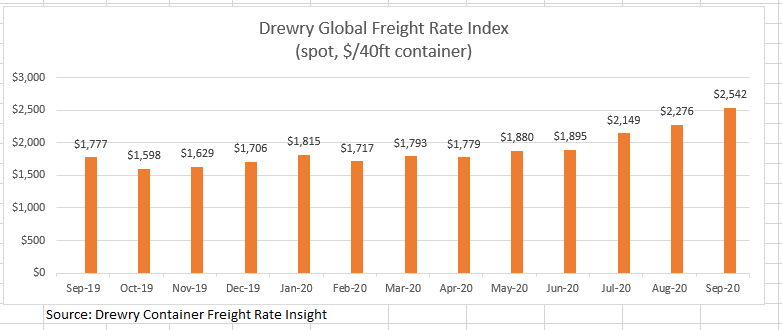
According to Damas, the Transpacific Eastbound route (rates up 180% year-on-year) and the North Europe-to-Asia route (rates up 130% year-on-year) stand out as routes where very high spot rates are likely to pull up contract freight rates in the forthcoming annual tenders.
“In other words, spot rates (now high) and contract rates (now relatively low) will converge – with contract rates on most routes expected to rise in 2021. The current gap between transpacific rates and spot rates is over $2,000/40ft container and intrinsically encourages carriers to minimise their capacity sold under (much lower) contract rates,” says Damas.
Particularly this year, shippers and forwarders should track the development of spot freight rates because they indicate the tightness of the market on some routes, they may be a leading indicator of contract rates, and they could point to future problems of capacity availability if ocean carriers prioritise (higher) spot cargoes vs (lower-rated) less profitable contract cargoes.
“Besides the risk of higher ocean rates, the other question on the agenda in 2021 is: which reliable providers should my company use to secure ship capacity?” Damas concluded.
SC
MR


Latest Supply Chain News
- Schneider Electric’s Jackie Zhu: Why the best leaders build careers across the business
- AI is driving change in supply chain skills and talent
- 4 moves supply chains must make as AI triggers a memory supply shock
- Innovators Netstock, Pickle Robot win NextGen Solution Provider awards
- Bigger trucks versus broken bridges and roads
- More News
Latest Podcast

 Explore
Business Management News
- Innovators Netstock, Pickle Robot win NextGen Solution Provider awards
- Bigger trucks versus broken bridges and roads
- From salon to dock door: Repurposing scheduling software for inbound flow
- The biggest barrier to AI in supply chains isn’t technology
- Rebuilding a planning function around the physical world
- Why companies blame the wrong supplier … and miss the real failure
- More Business Management
Latest Business Management Resources

About the Author
Patrick Burnson, Executive Editor

Patrick is a widely-published writer and editor specializing in international trade, global logistics, and supply chain management. He is based in San Francisco, where he provides a Pacific Rim perspective on industry trends and forecasts. He may be reached at his downtown office: [email protected].
Follow SCMR on social media.
@SupplyChainManagementReview on Facebook
@SCMR on Twitter
SCMR on Linkedin
Subscribe

Supply Chain Management Review delivers the best industry content.

Editors’ Picks



