
Sorry, but your login has failed. Please recheck your login information and resubmit. If your subscription has expired, renew here.
December 2017
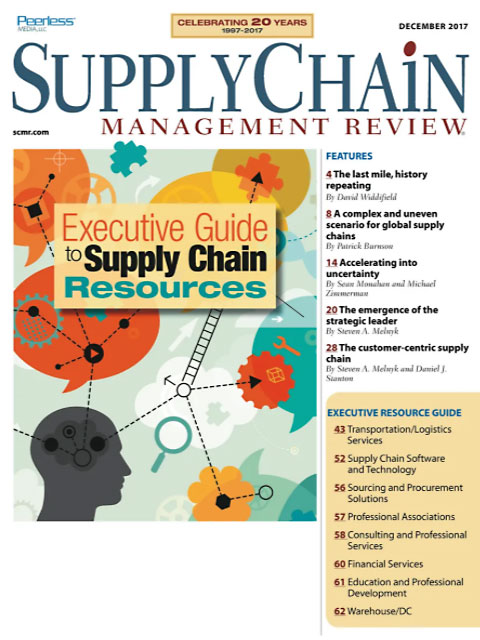
It’s December and time once again for our annual Executive Guide to Supply Chain Resources. This is a comprehensive guide to services, products and educational opportunities targeted specifically to supply chain professionals. As with years past, we’re also featuring several articles we trust will offer food for thought in your supply chain throughout the coming year. Browse this issue archive.Need Help? Contact customer service 1-508-503-1313 More options
As King Solomon noted nothing new is ever really created, just updated to meet the current environment or situation. This is true of last mile logistics delivering products to consumers. When you look beyond the hype of all the new, innovative services and suppliers in the logistics space and view things through the perspective of the past, we find this delivery service capability has been used efficiently and successfully in the past. We only need to look back to the 1940s and the successes America experienced on the battlefields of World War II.
Rise of the importance of final mile logistics
As the U.S. emerged from WWII, military tacticians credited a majority of the U.S. military’s success in the European and Pacific theaters to the U.S. capabilities of mass production enabling the buildup of large inventories of supplies such as ammunition, clothing, food and vehicles, and the ability to combine civilian and military storage and transportation operations to move vast quantities of supplies in an efficient, expeditious manner and to deliver ammunition, materials, personnel or vehicles to the battlefield when, where and in the right configuration needed to support military objectives. Yet, the logistics lessons regarding the importance of the delivery function getting the product to the end user were quickly forgotten as the war concluded.
Shifting from a wartime to peacetime economy unleashed years of pent up consumer demand for goods as disposable incomes rose. The mass production processes that produced war supplies were quickly adapted to the manufacture of consumer goods. However, the processes of efficient distribution methods to deliver goods to the point of consumption were not given as much emphasis. Producers and retailers placed more emphasis on the production of inventory and locating it at central retail locations while minimizing the importance of transportation to satisfy consumers. Consumers were content to acquire their products wherever they were available as long as they were purchased at the “right” price. Even after Bernard J. (Bud) LaLonde, the noted Ohio State University logistics professor, provided research showing the positive impacts efficient delivery methods could have on consumer satisfaction and profitability, manufacturers and retailers continued to rely on mass production and large inventory levels to meet consumer demand.

This complete article is available to subscribers only.
Log in now for full access or start your PLUS+ subscription for instant access.
SC
MR
Sorry, but your login has failed. Please recheck your login information and resubmit. If your subscription has expired, renew here.
December 2017
It’s December and time once again for our annual Executive Guide to Supply Chain Resources. This is a comprehensive guide to services, products and educational opportunities targeted specifically to supply chain… Browse this issue archive. Access your online digital edition. Download a PDF file of the December 2017 issue.As King Solomon noted nothing new is ever really created, just updated to meet the current environment or situation. This is true of last mile logistics delivering products to consumers. When you look beyond the hype of all the new, innovative services and suppliers in the logistics space and view things through the perspective of the past, we find this delivery service capability has been used efficiently and successfully in the past. We only need to look back to the 1940s and the successes America experienced on the battlefields of World War II.
Rise of the importance of final mile logistics
As the U.S. emerged from WWII, military tacticians credited a majority of the U.S. military's success in the European and Pacific theaters to the U.S. capabilities of mass production enabling the buildup of large inventories of supplies such as ammunition, clothing, food and vehicles, and the ability to combine civilian and military storage and transportation operations to move vast quantities of supplies in an efficient, expeditious manner and to deliver ammunition, materials, personnel or vehicles to the battlefield when, where and in the right configuration needed to support military objectives. Yet, the logistics lessons regarding the importance of the delivery function getting the product to the end user were quickly forgotten as the war concluded.
Shifting from a wartime to peacetime economy unleashed years of pent up consumer demand for goods as disposable incomes rose. The mass production processes that produced war supplies were quickly adapted to the manufacture of consumer goods. However, the processes of efficient distribution methods to deliver goods to the point of consumption were not given as much emphasis. Producers and retailers placed more emphasis on the production of inventory and locating it at central retail locations while minimizing the importance of transportation to satisfy consumers. Consumers were content to acquire their products wherever they were available as long as they were purchased at the “right” price. Even after Bernard J. (Bud) LaLonde, the noted Ohio State University logistics professor, provided research showing the positive impacts efficient delivery methods could have on consumer satisfaction and profitability, manufacturers and retailers continued to rely on mass production and large inventory levels to meet consumer demand.
SUBSCRIBERS: Click here to download PDF of the full article.
SC
MR


More 3PL
- NextGen Supply Chain Conference unveils agenda focused on AI, execution and the future of leadership
- Beyond the hype: Building flexible and scalable supply chains in a VUCA world
- AI is reshaping the last meter of delivery
- AI runs on compute; scaling it runs on logistics
- Wayfair executive to share lessons from building a tech-driven delivery network in NextGen Keynote
- DHL Supply Chain bets on data foundations, robotics, and agentic AI to drive growth
- More 3PL
Latest Resources
 Explore
Business Management News
- Why companies blame the wrong supplier … and miss the real failure
- NextGen Supply Chain Conference unveils agenda focused on AI, execution and the future of leadership
- Supply chain resilience isn’t a data problem; it’s a judgment problem
- Beyond the hype: Building flexible and scalable supply chains in a VUCA world
- Why your supply chain risk management plan will fail
- What options do you really have? Shaping the supply chain resilience funnel
- More Business Management
Latest Business Management Resources

Subscribe

Supply Chain Management Review delivers the best industry content.

Editors’ Picks



