
Sorry, but your login has failed. Please recheck your login information and resubmit. If your subscription has expired, renew here.
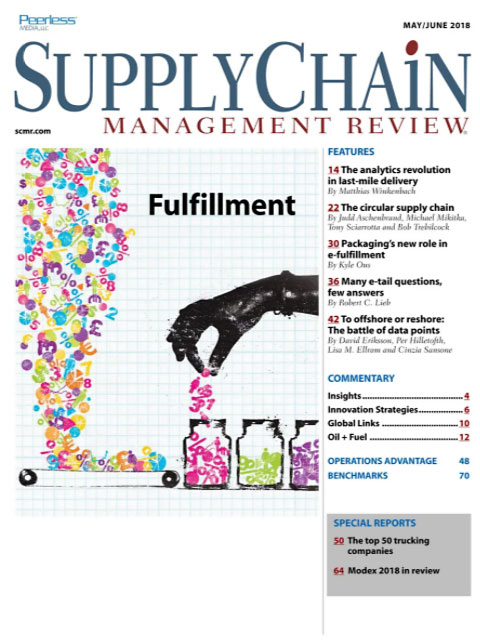
May-June 2018
Last month, I was in Atlanta at the Modex trade show. In one sense, it is a tribute to the automation technologies managing today’s distribution networks. And, I’m not only talking about automated materials handling systems, but also the software and NextGen technologies such as robotics, wearable technologies, including smart glasses and augmented reality solutions and sensors enabling the Internet of Things. In another sense, all of these solutions are coming together to drive fulfillment. With the increase in e-commerce, getting the right product to the right customer at the right time has never been more important. Browse this issue archive.Need Help? Contact customer service 1-508-503-1313 More options
It is said that goldfish have a memory of about four seconds. That’s why they never get bored swimming around in a little bowl, rediscovering the same place over and over again. We may scoff at the repetitiveness of their ways, but are we really any better?
For some time now, offshoring has been one of the most important strategic decisions for manufacturing companies. The practice accelerated along with increased globalization and competition. The intent remains maximizing cost efficiency by shifting home-country production to low-cost countries. This sounds good, but the rewards have not always come to fruition. As a result, many companies are now looking at the possibility of reshoring.
There are numerous reasons to consider the shift, just ask the man in the White House. But the movement goes far beyond President Trump.
The American Manufacturers Association offers its own list of reasons to reshore:
- shorter manufacturing lead times;
- a more skilled workforce;
- rising costs of freight;
- local tax incentives;
- responsiveness to consumer demands; and
- offshore wages are rising.
Additional incentives to reshore are often found within the company and in how it manages the supply chain.
These include:
- growth of transaction costs;
- centralization of firm activities;
- reactive decisions; and
- overestimation of offshored savings originally.

This complete article is available to subscribers only.
Log in now for full access or start your PLUS+ subscription for instant access.
SC
MR
Sorry, but your login has failed. Please recheck your login information and resubmit. If your subscription has expired, renew here.
May-June 2018
Last month, I was in Atlanta at the Modex trade show. In one sense, it is a tribute to the automation technologies managing today’s distribution networks. And, I’m not only talking about automated materials… Browse this issue archive. Access your online digital edition. Download a PDF file of the May-June 2018 issue.It is said that goldfish have a memory of about four seconds. That's why they never get bored swimming around in a little bowl, rediscovering the same place over and over again. We may scoff at the repetitiveness of their ways, but are we really any better?
For some time now, offshoring has been one of the most important strategic decisions for manufacturing companies. The practice accelerated along with increased globalization and competition. The intent remains maximizing cost efficiency by shifting home-country production to low-cost countries. This sounds good, but the rewards have not always come to fruition. As a result, many companies are now looking at the possibility of reshoring.
There are numerous reasons to consider the shift, just ask the man in the White House. But the movement goes far beyond President Trump.
The American Manufacturers Association offers its own list of reasons to reshore:
- shorter manufacturing lead times;
- a more skilled workforce;
- rising costs of freight;
- local tax incentives;
- responsiveness to consumer demands; and
- offshore wages are rising.
Additional incentives to reshore are often found within the company and in how it manages the supply chain.
These include:
- growth of transaction costs;
- centralization of firm activities;
- reactive decisions; and
- overestimation of offshored savings originally.
SC
MR


Latest Supply Chain News
- Innovators Netstock, Pickle Robot win NextGen Solution Provider awards
- Bigger trucks versus broken bridges and roads
- From salon to dock door: Repurposing scheduling software for inbound flow
- The biggest barrier to AI in supply chains isn’t technology
- Rebuilding a planning function around the physical world
- More News
Latest Podcast
 Explore
Procurement & Sourcing News
- Innovators Netstock, Pickle Robot win NextGen Solution Provider awards
- From salon to dock door: Repurposing scheduling software for inbound flow
- The biggest barrier to AI in supply chains isn’t technology
- Rebuilding a planning function around the physical world
- Why companies blame the wrong supplier … and miss the real failure
- NextGen Supply Chain Conference unveils agenda focused on AI, execution and the future of leadership
- More Procurement & Sourcing
Latest Procurement & Sourcing Resources
Subscribe

Supply Chain Management Review delivers the best industry content.

Editors’ Picks



