
Sorry, but your login has failed. Please recheck your login information and resubmit. If your subscription has expired, renew here.
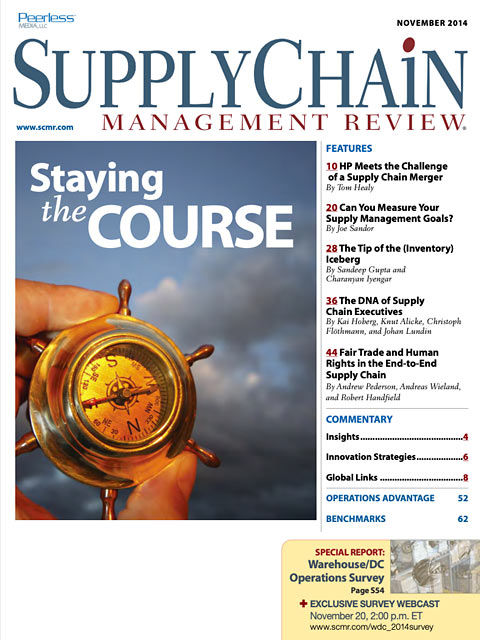
November 2014
Supply chain managers are on the lookout for metrics that will allow them to put a number to their progress - or lack thereof. Welcome to KPI's that allow them to demonstrate the quantifiable value that they deliver. At the same time, Murphy's Law may intervene or they may be called upon to put out fires or come to the rescue and make good on the promises sales and marketing have made to customers - regardless of the cost. So, how do you measure success? I hope this month's issue and online bonus feature help you consider how you measure your progress. Browse this issue archive.Need Help? Contact customer service 1-508-503-1313 More options
The daily life of supply chain managers is full of challenging tasks: negotiating last-minute order changes with sales due to new customer requests; defining working capital requirements with the CFO for the next budget period; or reviewing network structures for new emerging markets with suppliers. This diversity is particularly driven by the cross-functional nature of the job: Supply chain managers interact with many departments and people within and across the firm. In a recent discussion, a plant manager in the machining industry, a passionate athlete, shared his view on the role of supply chain managers. “I am an operations guy,” he said. “I really need tenacity to bring my production forward and achieve my annual cost reduction target; I need a limited set of capabilities, in particular, staying power like a marathon runner. A supply chain manager is a different type of athlete. He needs all these cross-functional skills, should be versatile, and must coordinate well with all departments. I admire people with these skills. In athletic terms, a supply chain manager should be a like a decathlete—the king of the athletes.”
Still, little is known about the backgrounds, careers paths, and success factors of these “decathletes” who intend to make supply chain management the performance engine of the company. In a joint project, our research group from KÜehne Logistics University and McKinsey & Company intensively analyzed the gene pool to shed light on supply chain professionals’ origins and evolution. We studied the career paths and educational backgrounds of thousands of supply chain managers and hundreds of supply chain executives. In addition, we conducted numerous interviews with supply chain executives.
In this article, we provide an overview of our findings. We summarize the educational backgrounds of supply chain professionals, detail the careers that led professionals into a supply chain executive position, and present factors that enable a successful career in supply chain management (SCM).
 |
This complete article is available to subscribers
only. Click on Log In Now at the top of this article for full access. Or, Start your PLUS+ subscription for instant access. |
SC
MR
Sorry, but your login has failed. Please recheck your login information and resubmit. If your subscription has expired, renew here.
November 2014
Supply chain managers are on the lookout for metrics that will allow them to put a number to their progress - or lack thereof. Welcome to KPI's that allow them to demonstrate the quantifiable value that they… Browse this issue archive. Access your online digital edition. Download a PDF file of the November 2014 issue.|
|
Download Article PDF |
The daily life of supply chain managers is full of challenging tasks: negotiating last-minute order changes with sales due to new customer requests; defining working capital requirements with the CFO for the next budget period; or reviewing network structures for new emerging markets with suppliers. This diversity is particularly driven by the cross-functional nature of the job: Supply chain managers interact with many departments and people within and across the firm. In a recent discussion, a plant manager in the machining industry, a passionate athlete, shared his view on the role of supply chain managers. “I am an operations guy,” he said. “I really need tenacity to bring my production forward and achieve my annual cost reduction target; I need a limited set of capabilities, in particular, staying power like a marathon runner. A supply chain manager is a different type of athlete. He needs all these cross-functional skills, should be versatile, and must coordinate well with all departments. I admire people with these skills. In athletic terms, a supply chain manager should be a like a decathlete—the king of the athletes.”
Still, little is known about the backgrounds, careers paths, and success factors of these “decathletes” who intend to make supply chain management the performance engine of the company. In a joint project, our research group from KÜehne Logistics University and McKinsey & Company intensively analyzed the gene pool to shed light on supply chain professionals’ origins and evolution. We studied the career paths and educational backgrounds of thousands of supply chain managers and hundreds of supply chain executives. In addition, we conducted numerous interviews with supply chain executives.
In this article, we provide an overview of our findings. We summarize the educational backgrounds of supply chain professionals, detail the careers that led professionals into a supply chain executive position, and present factors that enable a successful career in supply chain management (SCM).
|
|
SUBSCRIBERS: Click here to download PDF of the full article. |
SC
MR

Latest Supply Chain News
- Supply chain resilience isn’t a data problem; it’s a judgment problem
- Beyond the hype: Building flexible and scalable supply chains in a VUCA world
- Why your supply chain risk management plan will fail
- When component verification becomes operational
- Caught between a rock and a hard place: Mapping your supply chain
- More News
Latest Resources
 Explore
Latest Supply Chain News
- Why your supply chain risk management plan will fail
- When component verification becomes operational
- Caught between a rock and a hard place: Mapping your supply chain
- What options do you really have? Shaping the supply chain resilience funnel
- Nexus suppliers: Hidden anchors of resilience in decentralized supply chains
- Developing the next generation of supply chain leaders: Is higher education serving the needs of the marketplace?
- More latest news
Latest Resources
Subscribe

Supply Chain Management Review delivers the best industry content.

Editors’ Picks



