
Sorry, but your login has failed. Please recheck your login information and resubmit. If your subscription has expired, renew here.
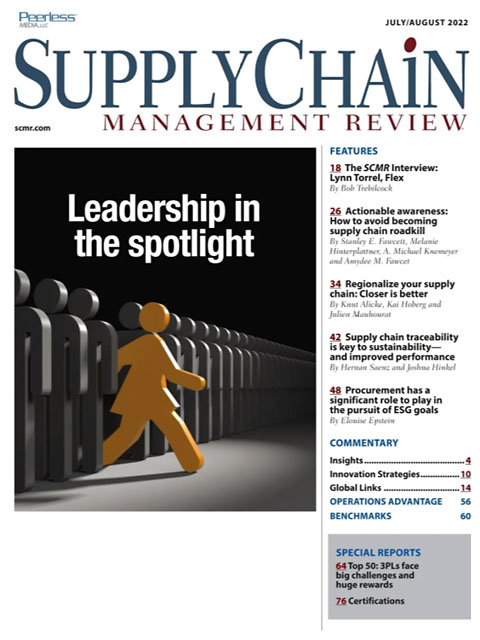
July-August 2022
In late May, I attended the Institute for Supply Management’s first live conference since 2019. The message from Tom Derry, ISM’s CEO, was simple: These are challenging times, but along with the challenges come opportunities for those of us who can step up and lead our organizations into the future. One area where supply chain will be tasked with stepping up to the plate is going to be ESG, the initialism for environmental, social and governance. It was a major theme of the conference, and while all of the reporting requirements are still being debated, there’s little question that supply chain will lead the charge in environmental initiatives… Browse this issue archive.Need Help? Contact customer service 1-508-503-1313 More options
 Download Article PDF
For more than a century, businesses have honed highly efficient, linear supply chains. Raw materials flowed in one direction, were transformed into a product, used and ultimately discarded in a waste heap. That approach now puts a firm’s competitiveness at risk.
To ensure supply in an increasingly volatile business landscape, companies need more resilient networks. Fast-changing consumer preferences and customization require increased flexibility and speed. And investors, consumers and governments expect more sustainable products and processes—with certifications to prove companies’ claims. Winning in the coming decade will require a transparent and circular value chain—one that reduces or reuses materials and remanufactures or recycles products—lowering cost and creating less waste.
It is a profound paradigm shift. And the technology is already available to trace each raw material that goes into a product and follow how a product is used and where it is discarded. In fact, digital traceability enables companies to meet and balance a broader set of business objectives, including efficiency, resilience, responsiveness and sustainability. It allows companies to redefine the boundary of operational excellence and set aspirational new goals.
How does it work? Traceability gives companies the ability to follow products and goods as they move along the value chain and to glean exact information about the provenance of inputs, supplier sourcing practices and conversion processes. With that data in hand, companies can make predictions, run scenarios and dynamically optimize operations. Leadership teams can serve customers better, identify unnecessary resource consumption, respond faster to changes in demand and fulfill orders more efficiently. They are also able to identify strategic value chain opportunities, innovate faster, minimize the impact of internal and external disruptions and certify sustainable processes and products.
SC
MR
Sorry, but your login has failed. Please recheck your login information and resubmit. If your subscription has expired, renew here.
July-August 2022
In late May, I attended the Institute for Supply Management’s first live conference since 2019. The message from Tom Derry, ISM’s CEO, was simple: These are challenging times, but along with the challenges come… Browse this issue archive. Access your online digital edition. Download a PDF file of the July-August 2022 issue.For more than a century, businesses have honed highly efficient, linear supply chains. Raw materials flowed in one direction, were transformed into a product, used and ultimately discarded in a waste heap. That approach now puts a firm’s competitiveness at risk.
To ensure supply in an increasingly volatile business landscape, companies need more resilient networks. Fast-changing consumer preferences and customization require increased flexibility and speed. And investors, consumers and governments expect more sustainable products and processes—with certifications to prove companies’ claims. Winning in the coming decade will require a transparent and circular value chain—one that reduces or reuses materials and remanufactures or recycles products—lowering cost and creating less waste.
It is a profound paradigm shift. And the technology is already available to trace each raw material that goes into a product and follow how a product is used and where it is discarded. In fact, digital traceability enables companies to meet and balance a broader set of business objectives, including efficiency, resilience, responsiveness and sustainability. It allows companies to redefine the boundary of operational excellence and set aspirational new goals.
How does it work? Traceability gives companies the ability to follow products and goods as they move along the value chain and to glean exact information about the provenance of inputs, supplier sourcing practices and conversion processes. With that data in hand, companies can make predictions, run scenarios and dynamically optimize operations. Leadership teams can serve customers better, identify unnecessary resource consumption, respond faster to changes in demand and fulfill orders more efficiently. They are also able to identify strategic value chain opportunities, innovate faster, minimize the impact of internal and external disruptions and certify sustainable processes and products.
SC
MR


More 3PL
- NextGen Supply Chain Conference unveils agenda focused on AI, execution and the future of leadership
- Beyond the hype: Building flexible and scalable supply chains in a VUCA world
- AI is reshaping the last meter of delivery
- AI runs on compute; scaling it runs on logistics
- Wayfair executive to share lessons from building a tech-driven delivery network in NextGen Keynote
- DHL Supply Chain bets on data foundations, robotics, and agentic AI to drive growth
- More 3PL
Latest Resources
 Explore
Topics
Business Management News
- Why companies blame the wrong supplier … and miss the real failure
- NextGen Supply Chain Conference unveils agenda focused on AI, execution and the future of leadership
- Supply chain resilience isn’t a data problem; it’s a judgment problem
- Beyond the hype: Building flexible and scalable supply chains in a VUCA world
- Why your supply chain risk management plan will fail
- What options do you really have? Shaping the supply chain resilience funnel
- More Business Management
Latest Business Management Resources
Subscribe

Supply Chain Management Review delivers the best industry content.

Editors’ Picks



