
The Strait of Hormuz may be opening again slowly, but supply chain leaders should not mistake that for a return to normal.
According to Eric Fullerton, vice president of data insights at project44, the recent disruption serves as another reminder that supply chains are operating in what many leaders now describe as a never-normal environment—one where resilience is less about recovering from disruption and more about adapting to constant change.
Speaking on a recent episode of the Talking Supply Chain podcast, Fullerton said the reopening of the critical trade corridor is only the first step in a much longer recovery process that will include clearing port congestion, repositioning equipment, restoring commercial confidence, and determining which emergency workarounds developed during the crisis become permanent operating practices.
Energy is only part of the story
The Strait of Hormuz is one of the world’s most important trade corridors, handling more than 20% of globally traded oil and natural gas. But Fullerton noted that focusing solely on the energy impact overlooks a much broader supply chain story.
“What is also really significant about this region is that it’s not just oil and natural gases; it’s the petrochemicals, it’s the byproducts,” he said.
Those materials include petrochemical feedstocks used in manufacturing as well as fertilizers critical to global agriculture. Fullerton noted that roughly 40% of global urea exports originate in the Persian Gulf region, making the disruption a food security issue as much as a transportation challenge.
Diverted shipments
Project44 tracked more than 81,000 shipment diversions during the disruption, revealing a response pattern unlike many previous supply chain events. Rather than seeing diversions spike immediately and then decline, rerouting activity continued building for weeks as carriers, shippers, and logistics providers struggled to navigate uncertainty surrounding ceasefires, security risks, and changing operating conditions.
“The actual high for the number of weekly diversions was week four,” Fullerton said. “That is very unique.”
Related Podcast
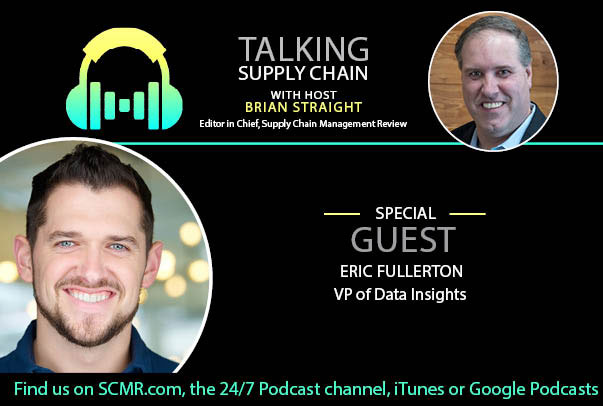
The company’s data showed that even as conditions improved, weekly diversions remained more than 250% above pre-conflict levels.
The disruption also demonstrated how quickly local events can create global consequences. While attention remained focused on the Middle East, some of the most significant operational impacts appeared elsewhere in the network.
India’s Navi Mumbai port, for example, experienced dwell times nearly three times higher than normal as diverted cargo flowed into alternative trade routes. Vessel traffic around the Cape of Good Hope surged as carriers sought alternatives to both the Strait of Hormuz and ongoing disruptions in the Red Sea.
“What we saw with India, I think, was quite surprising,” Fullerton said. “The disruption did not stay in the Middle East and propagated outwards into those Asian port networks.”
Local disruptions mean global impacts
Those secondary impacts highlight the reality that disruptions rarely remain isolated.
Even as vessel traffic begins returning to the Strait, Fullerton believes many of the changes developed during the disruption may persist. Carriers have established new transportation lanes; shippers have developed alternative sourcing strategies; and logistics providers have built new routing playbooks.
Some of those changes may prove more resilient than the operating models they replaced, he said.
That reality raises a broader strategic question for supply chain organizations. Rather than asking how quickly conditions return to normal, leaders may need to determine which new practices should become part of future operations.
The companies that managed the disruption most effectively, according to Fullerton, were not necessarily the ones with the largest logistics teams or resources. They were the organizations that could quickly understand their exposure and make informed decisions before disruptions spread throughout their networks.
“It’s not like they were short on people or effort,” Fullerton said. “They were short on signal.”
Visibility matters, but ...
Organizations with visibility into inventory, supplier networks, transportation lanes, and shipment status were able to identify risks and act quickly. Others found themselves reacting after problems had already propagated through their operations. But Fullerton argued that visibility alone is no longer enough.
“Visibility has been a long journey for many companies and organizations,” he said, but quickly adding that visibility alone was not enough for some companies to respond quickly.
The next stage of supply chain maturity, he said, is connecting that visibility with decision-making and execution. That means not only understanding which inventory is exposed to disruption, but also knowing what actions should be taken, when they should be taken, and whether intervention is even necessary.
It is a lesson that organizations learned after Covid. It was reinforced at the start of the Russia’s invasion of Ukraine. And now it is showing itself again with the Strait of Hormuz.
2026 second-half outlook
Looking ahead, Fullerton expects continued volatility driven by geopolitical tensions, trade policy uncertainty, weather disruptions, and changing transportation patterns. He described the near-term outlook as “cautious stabilization with ongoing volatility.”
For supply chain leaders, the most important question may not be what happened during the latest disruption, but whether they are prepared for the next one.
If a major event occurs tomorrow, can the organization immediately identify its exposure?
“What I would say is, okay team, next time a disruption like this happens at this scale—and there will be a next one—I want to know what our risk exposure is to in-transit inventory instantly,” Fullerton said.
That capability, he argued, is becoming the foundation of modern supply chain resilience.
SC
MR

More Risk Mitigation
- Strait of Hormuz reopens, but supply chains face a long road to recovery
- The hidden supply chain risk no dashboard shows
- From orbit to operations: Winning the race for the earliest disruption signal
- Supply chain’s new normal isn’t stability, it’s change
- The hidden cost of damaged pallets in warehouses (and how to prevent them)
- More Risk Mitigation
What's Related in Risk Mitigation
 Explore
Topics
Procurement & Sourcing News
- Coordinating AI-enabled supply chain operations
- The hidden supply chain risk no dashboard shows
- AI is reshaping the last meter of delivery
- Last-mile delivery success begins before the driver arrives
- Elucidating import container flows: A simulation study of Port of New York/New Jersey
- Wayfair executive to share lessons from building a tech-driven delivery network in NextGen Keynote
- More Procurement & Sourcing
Latest Procurement & Sourcing Resources
About the Author
Brian Straight, SCMR Editor in Chief

Brian Straight is the Editor in Chief of Supply Chain Management Review. He has covered trucking, logistics and the broader supply chain for more than 15 years. He lives in Connecticut with his wife and two children. He can be reached at [email protected], @TruckingTalk, on LinkedIn, or by phone at 774-440-3870.
Follow SCMR on social media.
@SupplyChainManagementReview on Facebook
@SCMR on Twitter
SCMR on Linkedin
Subscribe

Supply Chain Management Review delivers the best industry content.

Editors’ Picks



