
Every company believes it is unique. Its operation is unique. Its challenges are unique. And as a result, when it comes to installing warehouse automation, it needs a unique solution.
But are more tailored solutions the best approach to every challenge? Probably not. In some cases, the more tailored the solution, the more expensive it may be turn out to be in the long term, eliminating the exact reason to install automation in the first place—to streamline operations and reduce costs.
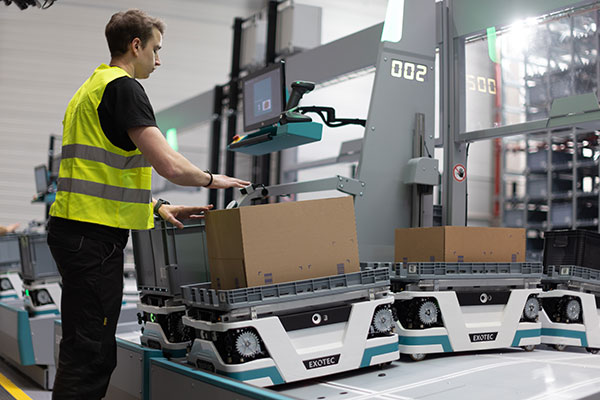
Romain Moulin, CEO and co-founder of Exotec, told Supply Chain Management Review that the assumption that a customized automation solution is the best approach can hamstring organizations for years to come.
That level of customization seems like the ideal approach, but in practice, it often undermines cost, reliability, and scalability, he said.
“We are in an industry which has been used to really offering a bespoke solution—designing a machine and software around the customer’s needs,” Moulin said. “Which is very good for suiting the customer needs, but which is very bad for time, cost and reliability.”
The hidden cost of custom automation
During his on-stage presentation, Moulin compared bespoke warehouse automation to first-of-a-kind megaprojects that are complex systems that inevitably exceed budgets and timelines.
Inside the four walls of a facility, the risk shows up in three ways:
- Performance uncertainty. Individual modules may be engineered precisely, but predicting overall warehouse performance becomes difficult.
- Operational fragility. Highly customized software depends on specific individuals who may no longer be available when problems arise.
- Slow ramp-up. Complex systems take longer to stabilize, delaying ROI.
“The more assumptions you make, the less resilient your warehouse is” Moulin said.
If every warehouse in a distribution network is uniquely engineered, balancing throughput or shifting inventory becomes nearly impossible, he argued.
Standardized doesn’t mean one-size-fits-all
But Moulin is not advocating for cookie-cutter solutions. In fact, he pushes back when the idea of building a one-size-fits-all solution is brought up. Instead, he advocates for a Lego-block type approach. Lego is known for creating standard blocks and letting kids’ imaginations go wildly with the designs. That is the approach that Exotec is taking.
“All of our solution are different for all the customers, but they are made of the same building blocks,” he said. “It’s really the Lego … which is reassembled differently”
In essence, the hardware modules, the software layers, and the robotic elements are standardized. Their configuration is not.
“You should not say you have one solution for your customer … but you listen to your customer and you reassemble your bricks together [to meet their needs],” Moulin said.
Composability enables replication and replication is what drives speed and cost control, he added.
Designing for uncertainty, not forecasts
Moulin also warned against over-designing around forecasts. Warehouses are typically built on detailed projections: B2B vs. B2C mix, order profiles, lines per order, or cartonization assumptions. But those ratios can change. Moulin offered the example of a cross-channel warehouse that shifted from 80% B2B and 20% B2C to the inverse within three years.
If the organization had installed a static automation solution based on the original mix, the cost savings achieved in those first three years may evaporate as it retools for the new product mix.
“If your warehouse cannot cope with that, you are really in danger,” Moulin said.
Rather than hard-coding assumptions into workflows, he advocates designing systems that rely on optimization algorithms rather than preconceptions.
“We won’t program the solution to the problem,” he explained. “We will use mathematics to find the best solution at any given moment.”
Replication as strategy
In his presentation, Moulin described how this philosophy scaled across a major sports retailer’s network. Rather than launching sequential four-year bespoke projects, the company defined a template warehouse with variable robot fleets and inventory sizing. The result: faster deployment and reduced inventory levels.
From a strategic standpoint, replication also reduces integration risk, he argues. Moulin says projects are evaluated by how much custom software labor is quoted.
“It tells me exactly the risk associated with that project,” he said.
The smaller the bespoke layer, the lower the ramp-up risk and the easier upgrades become Moulin noted.
Starting with the problem, not the solution
The right approach to automation in Moulin’s view is similar that being advocated for the adoption of artificial intelligence. Don’t start with a solution and try to find the problem, start with the problem and find the right solutions.
“Tell us about your logistics and we’ll work together to find what the right approach,” he said.
Customers often come with the idea that then need to install ‘X’ solution, but that isn’t always the right approach. The right solution is the one that solves the pain point and is scalable and flexible as needs change.
That may be a customized solution, or it may be a new configuration of existing solutions. Moulin doesn’t argue against customization, but rather for finding the right solution that can adapt with your business as you grow.
SC
MR

More Warehouse Automation
- Beyond the hype: Building flexible and scalable supply chains in a VUCA world
- DHL Supply Chain bets on data foundations, robotics, and agentic AI to drive growth
- How industrial real estate decisions are shaping supply chain performance
- Your supply chain automation should trade like a hedge fund
- Why trust, flexibility, and execution now matter more than speed
- More Warehouse Automation
What's Related in Warehouse Automation
 Explore
Topics
Software & Technology News
- NextGen Supply Chain Conference unveils agenda focused on AI, execution and the future of leadership
- From fragmented negotiations to coordinated negotiation performance: an AI-enabled approach
- Beyond the hype: Building flexible and scalable supply chains in a VUCA world
- Managing human and AI teams across the supply chain
- The AI-empowered supply chain leader
- Technology isn’t strategy
- More Software & Technology
Latest Software & Technology Resources

About the Author
Brian Straight, SCMR Editor in Chief

Brian Straight is the Editor in Chief of Supply Chain Management Review. He has covered trucking, logistics and the broader supply chain for more than 15 years. He lives in Connecticut with his wife and two children. He can be reached at [email protected], @TruckingTalk, on LinkedIn, or by phone at 774-440-3870.
Follow SCMR on social media.
@SupplyChainManagementReview on Facebook
@SCMR on Twitter
SCMR on Linkedin
Subscribe

Supply Chain Management Review delivers the best industry content.

Editors’ Picks



