
Sorry, but your login has failed. Please recheck your login information and resubmit. If your subscription has expired, renew here.
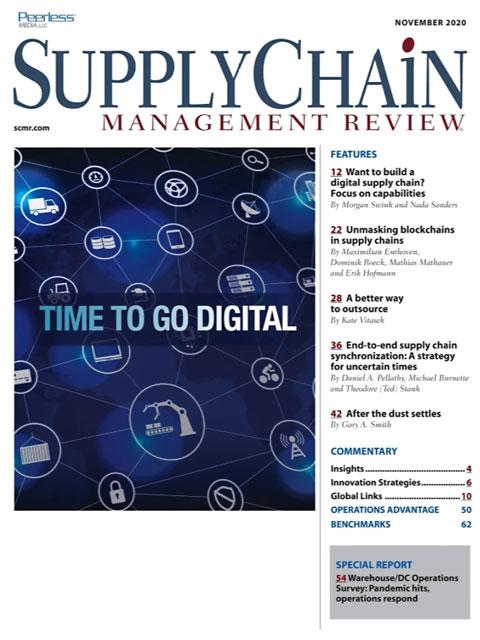
November 2020
Supply chains have been in the spotlight like never before over the last eight months. That hasn’t always been a good thing. The perception, reinforced by shortages of products essential to our daily lives, is that supply chains were not up to the task and failed. The reality, as argued by MIT’s Yossi Sheffi in his new book, “The New (Ab)Normal: Reshaping Business and Supply Chain Strategy Beyond COVID-19,” is that supply chains performed as designed—they did what we expected them to do. Browse this issue archive.Need Help? Contact customer service 1-508-503-1313 More options
COVID-19 has swelled the e-commerce tidal wave that was submerging traditional retailing before the virus struck. During the pandemic, stay-at-home consumers switched to online buying in droves, and the 2020 roll call of bricks-and-mortar bankruptcies reads like a “Who’s Who” of retailing.
However, there is another side to this dramatic story. The pandemic has also unleashed a wave of innovation that is giving more impetus to the changes that are reshaping the retail business and its supporting supply chains.
As I describe in my new book, “The New (Ab)Normal: Reshaping Business and Supply Chain Strategy Beyond COVID-19,” the crisis is compressing innovation adoption cycles as retailers scramble to stay afloat in an ever-changing landscape. These efforts offer vital clues to the shape of retailing in a post-pandemic world.
Navigating new paths
During May and June 2020, the MIT Center for Transportation & Logistics conducted a survey of grocery shopping habits in the United States. The survey, part of a “Covid-19 Generational and Lifestyle Study,” elicited 1,320 responses. The survey focused on buying behavior, distinguishing between store shopping and various online modes such as home delivery, curbside pickup and locker pickup. Home delivery’s share of shopping increased from 13% to 31% of all buying trips. Of those individuals who shifted from in-store shopping to home delivery—the largest group to shift modes—31% stated they were likely to continue with home delivery.
SC
MR
Sorry, but your login has failed. Please recheck your login information and resubmit. If your subscription has expired, renew here.
November 2020
Supply chains have been in the spotlight like never before over the last eight months. That hasn’t always been a good thing. The perception, reinforced by shortages of products essential to our daily lives, is that… Browse this issue archive. Access your online digital edition. Download a PDF file of the November 2020 issue.COVID-19 has swelled the e-commerce tidal wave that was submerging traditional retailing before the virus struck. During the pandemic, stay-at-home consumers switched to online buying in droves, and the 2020 roll call of bricks-and-mortar bankruptcies reads like a “Who’s Who” of retailing.
However, there is another side to this dramatic story. The pandemic has also unleashed a wave of innovation that is giving more impetus to the changes that are reshaping the retail business and its supporting supply chains.
As I describe in my new book, “The New (Ab)Normal: Reshaping Business and Supply Chain Strategy Beyond COVID-19,” the crisis is compressing innovation adoption cycles as retailers scramble to stay afloat in an ever-changing landscape. These efforts offer vital clues to the shape of retailing in a post-pandemic world.
Navigating new paths
During May and June 2020, the MIT Center for Transportation & Logistics conducted a survey of grocery shopping habits in the United States. The survey, part of a “Covid-19 Generational and Lifestyle Study,” elicited 1,320 responses. The survey focused on buying behavior, distinguishing between store shopping and various online modes such as home delivery, curbside pickup and locker pickup. Home delivery’s share of shopping increased from 13% to 31% of all buying trips. Of those individuals who shifted from in-store shopping to home delivery—the largest group to shift modes—31% stated they were likely to continue with home delivery.
 SUBSCRIBERS: Click here to download PDF of the full article.
SC
MR

Latest Supply Chain News
- Supply chain resilience isn’t a data problem; it’s a judgment problem
- Beyond the hype: Building flexible and scalable supply chains in a VUCA world
- Why your supply chain risk management plan will fail
- When component verification becomes operational
- Caught between a rock and a hard place: Mapping your supply chain
- More News
Latest Resources
 Explore
Business Management News
- Why companies blame the wrong supplier … and miss the real failure
- NextGen Supply Chain Conference unveils agenda focused on AI, execution and the future of leadership
- Supply chain resilience isn’t a data problem; it’s a judgment problem
- Beyond the hype: Building flexible and scalable supply chains in a VUCA world
- Why your supply chain risk management plan will fail
- What options do you really have? Shaping the supply chain resilience funnel
- More Business Management
Latest Business Management Resources

Subscribe

Supply Chain Management Review delivers the best industry content.

Editors’ Picks



