
Pickup defects, which we define at late pickups from a vendor or shipper site, represent a very costly challenge in transportation cost management. Pickup defects often cascade to late departures from shipper or vendor sites and late arrivals at downstream sites, and can lead to customer promise misses.
They impact vendor experience and additional volume from suppliers. Pickup delays can also cause labor and volume availability mismatches at downstream sites, inventory placement issues and also slow down inbound transportation speed. U.S. logistics costs reached $2.58 trillion in 2024 (about 8% of GDP) and transportation costs reached $937 billion (CSCMP State of Logistics report, 2025). Even a small percentage improvement in pickup defects can reduce overall transportation cost for the industry by manifold.
This article introduces a new framework called PRI (Predictive Reliability Index) that leveraged machine learning to predict carrier-level risk in future pickup defects. By analyzing more than 147 input factors that affect pickup defects across 150,000-plus records in various logistics network, the model attempts to enable proactive actions to prevent pickup defects from occurring. While 100% defect mitigation is not possible from the model’s output yet, pilot results showed a 35% reduction in pickup defects among high-risk carriers. With an accuracy rate of 85%, the model is projected to deliver cost savings of $40M-plus at full-scale implementation. Until PRI, most networks across logistics companies focused on on-time delivery used only reactive means to resolve issues and take actions to prevent defects.
This paper outlines the problem landscape, the analytical methodology, and recommendations for supply chain practitioners considering similar predictive approaches.
Why reactive carrier management does not work
Carrier performance in most logistics networks is reactive in nature. Drivers arrive late to their destination, the defect is identified either through escalations from the field or operations teams, or through periodic data analysis. Corrective actions are identified and implemented, but by that time, using a recovery load might be too late to protect a customer promise. Also, if a load arrives late to its destination, the operations teams might already be using available labor capacity to process loads that were not a priority. So, even when the load arrives, the operations team might not be able to process the load immediately, leading to further delays. These issues can also create inventory placement issues or yard utilization risks if the load is dwelling in the yard. In the pilot study, we estimated that every unit that dwelled for an hour in the yard cost between 29 cents to 45 cents. That’s why proactively preventing defects is the most cost-effective solution.
There has been some research in the industry supporting this—in a 2023 analysis performed by CSCMP, the researchers found that one of the top three causes of inventory placement and availability issues in retail and manufacturing supply chains was inbound transportation delay. Also, research published in the Journal of Business Logistics has suggested that carrier performance and on-time arrival are predictable based on historical data.
Why do big logistics and retail companies continue to be reactive in that case? The primary reason is the unavailability of a singular source of data to perform a holistic evaluation of these defects. Different teams within a company track different metrics, and they usually take ownership of their part of the problem only. This leads to different teams creating different root cause analyses for the same defect. For example, pickup defects can be related to vendor sites not providing on-time check-in to the drivers, the scheduling team creating an incorrect schedule, the carrier team dispatching a driver late or a driver arriving late due to weather or other issues. Each team only addresses its part of the problem. Also, each team’s manager relies on dashboards specifically built for their team to reactively find solutions.
We analyzed a large, very complex inbound network for the study. The analysis found that 1.35% of carriers were responsible for a large percentage of the pickup defects, based on data from over 1,600-plus carriers. Without a machine learning model, it was difficult to identify these high-risk carriers since new carriers are frequently onboarded and many carriers experience pickup defects for the first time each week. This finding is consistent with what current academic research in supply chain literature points to.
Development of the PRI framework
Development of the PRI framework involved the integration of data from two core operational sources: load performance records and shipment summary data. The dataset covered U.S. domestic truckload operations across thousands of active carrier-lane combinations.
The machine learning model—built using Python with SQL-based data extraction—was designed to accomplish four tasks: identify the factors most predictive of pickup defects; quantify the direction and magnitude of each factor's contribution; generate a composite risk score for each carrier; and flag carriers requiring immediate intervention.
For developing the PRI framework, extensive research was conducted to identify the types of data required for performing the holistic analysis. Data related to vendor pickup, weather, load scheduling, carrier historical performance, load characteristics, equipment used, operational site characteristics, and a variety of other input parameters was collected. A total of 147 input parameters were initially used for prediction. A machine learning model was built, and the first step was to improve the model’s accuracy in predicting defects using a real-life dataset. The model was trained on a portion of the data to predict outcomes from the remaining set of data. The model’s accuracy was initially close to 53%. After discussing with domain experts and eliminating non-essential predictors, the model’s accuracy continued to improve. At the end, around 20 input factors were identified to be the most important in predicting the output—in this case, pickup defects. Once these factors were identified and the model was retrained, the model’s accuracy reached almost 85%.
Key predictive factors
The model identified the following as the most significant predictors of pickup defects, ranked by contribution:
|
Risk Factor |
Contribution to Defect Prediction |
|
Carrier-specific historical performance |
~20% |
|
Regional trend |
~20% |
|
Hour of arrival |
~12% |
|
Scheduling |
~9% |
|
Haul distance |
~7% |
|
Lane-specific performance |
~6% |
|
Contract type |
High discriminating power |
|
Type of driver deployment |
Significant modifier |
Some of the findings from the model that supply chain professionals may find interesting are:
- Pickup time at the supplier site mattered a lot. Night shift pickups showed a higher rate of delays compared to day shift pickups. Especially, pickups after midnight showed a very high rate of defects. While it is not possible to only schedule pickups during day shifts, this pointed toward an opportunity to schedule specific loads during day shifts.
- Specific geographic regions showed higher pickup defect rates compared to others. This suggests that lane-level and origin-specific interventions might be effective in preventing a significant percentage of defects.
- During the study, a number of different driver type deployments were studied, and some of them showed higher defect rates. For critical lanes and customer-sensitive shipments, it is possible to use the low-risk driver type to prevent defects.
- Contract types matter significantly. Contracted carriers with long-term contracts are less likely to be late to pick up a load compared to short-term contracted carriers.
Risk score distribution and model performance
For the purpose of this study, the PRI was developed to generate scores ranging from 0 to 100. Scores below 25 indicate low risk; 25-60 indicate medium risk; above 60 represent high-risk carriers requiring immediate engagement. In the pilot study, the average carrier score was approximately 24.3, indicating that the majority of the carriers performed well. Carriers exceeding a score of 60 were 3.5 times more likely to experience pickup defects compared to the network average. For supply chain professionals who want to adopt this model, the risk tolerance will depend on the specific use case of this model and also on the cost of the defects that will be analyzed.
The scatter plots were developed for a sample of the carriers representing the overall population using Python pandas and seaborn libraries (Figure 1). The top chart shows the relationship between PRI score and pickup defect rate. It shows that high-risk carriers generate a disproportionate number of defects. The bottom two charts show slight inverse relationships between PRI score and cost savings, and PRI score and model detection accuracy.
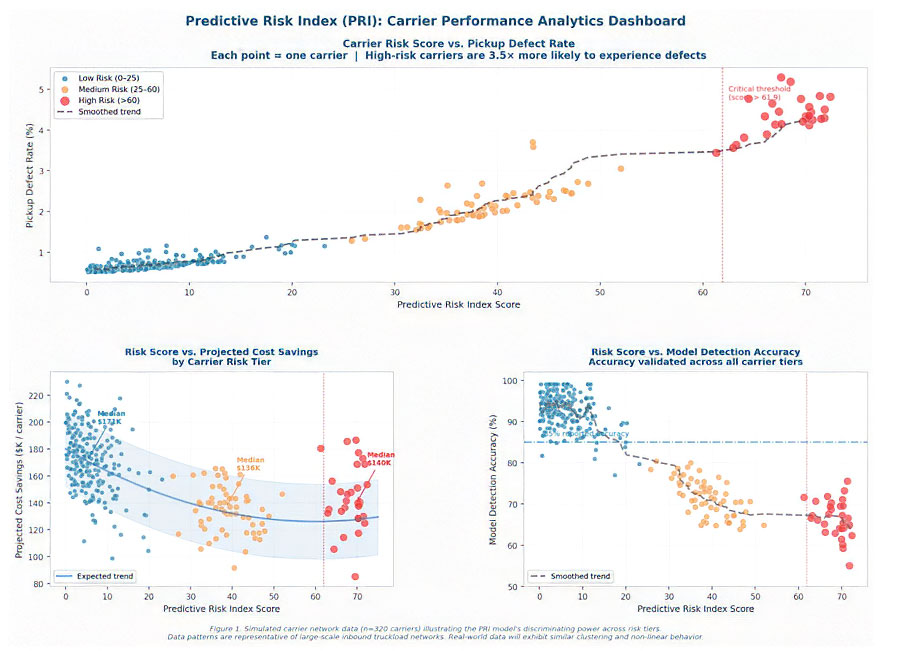
Figure 1. Carrier Risk Score vs. Pickup Defect Rate, Projected Cost Savings, and Model Detection Accuracy across 320 carriers. Color indicates risk tier. Dashed lines show smoothed non-linear trends. Red dotted line marks the critical threshold (score > 61.9). Note: Specific data points have been anonymized and figures are illustrative of observed patterns.
Two interesting features of the data can be identified here. First, the trend is non-linear and defect rates are relatively low at low PRI scores. Defect rates rise sharply above 40, and cluster at and above 61.9. This means that prioritizing high-risk carriers for targeted actions will result in preventing a high number of defects. Second, the model's accuracy is highest for low-risk carriers and truly high-risk carriers. The middle band is where the model's accuracy is not as high, and may require human intervention to further investigate specific issues related to the carrier pool.
The PRI framework – How does it work?
The PRI model operates as a real-time risk score projection tool. The risk scores for carriers are updated with the latest data almost in real-time as they execute and complete loads. During the pilot study, the model was not automated and the risk scores were manually updated. However, the long-term vision is to have the model automatically ingest new data and learn from that data, so the model’s accuracy improves and the output data is also more actionable in preventing future defects. The PRI model already helps managers to take proactive actions. A more accurate model will enable greater impact from the actions.
Core system components (long-term vision)
- Data integration layer: In this layer, the model will extract data from a variety of load performance and shipment-specific sources and will consolidate them into a singular analytical dataset.
- Machine learning scoring engine: In this layer, the trained ML model weighs the input parameters and generates carrier-specific risk scores.
- Risk stratification dashboard: This layer is a visual interface that segments carriers by risk tiers, highlighting contributing factors and tracking score trends over time.
- Intervention workflow: This feature allows the model interface to send automated alerts to defect owners when a specific threshold is exceeded.
The model enables assessment of risk related to pickup defects and supports proactive intervention to prevent defects. This also allows labor planning teams and operations teams to adjust their plans according to the risk of late shipments.
Demonstrated results
|
Metric |
Result |
|
Reduction in pickup defects (high-risk carriers) |
30% |
|
Model accuracy in predicting high-risk carriers |
85% |
|
Relative defect likelihood for flagged carriers vs. average |
3.5x higher |
|
Improvement in on-time performance (pilot) |
15% |
|
Projected annual cost savings (full network) |
>$40M |
Industry context: Where this fits
While the PRI framework is consistent with the broader industry trend of enabling proactive measures through AI and automation, the application of machine learning in pickup defects is not well researched. Regardless, some similar research efforts are worth mentioning:
- FourKites, project44, and some similar visibility platforms have proved that real-time and predictive ETA capabilities reduce defects, but these tools generally focus on in-transit events. They don’t mitigate pickup risks.
- Academic research on freight market dynamics has highlighted that carrier behavior is heavily dependent on contract type and capacity conditions. The PRI model identifies both as significant factors in predicting pickup defects.
- The 2024 State of Logistics Report (Council of Supply Chain Management Professionals) stated that transportation cost and service reliability are top operational concerns for shippers. The PRI model attempts to solve these two issues through predictive risk management.
The distinguishing feature of the PRI approach is its integration of multiple datasets from different sources across the supply chain and logistics network, which other models fail to achieve—and therefore lack the true predictive nature required for proactive defect prevention. Most existing tools only optimize for one or two factors responsible for on-time performance defects; the PRI approach synthesizes multiple factors to produce a more realistic and accurate risk picture.
Recommendations for supply chain practitioners
An important clarification to note is that the PRI approach is just one use case of how it can be applied to carrier performance management. In theory, the same approach should be applicable to multiple defect types. Based on learnings from the pilot study, a list of recommendations has been compiled for supply chain executives considering a predictive risk approach.
1. Start with defect concentration analysis
Before building a predictive model, analyze how defects are distributed across the carrier base. If a small percentage of carriers account for a disproportionate share of defects, a risk index approach might be what you need. If defects are not concentrated, the problem may be systemic and carrier performance may not be the primary root cause.
2. Prioritize data integration into the model
The PRI model works because it gathers data from a variety of signals across the supply chain. The more accurate input data that the model receives, the more accurate its output will be. Ensuring that the data exists, and if not, measuring data points and making them available to the model is a pre-requisite of the PRI approach.
3. Use risk scores to change the process and mindset
The value of creating risk index scores is the targeted actions that the scores enable. The specific factors that the model identifies make it easier to address concerns and take preventive actions. The team and company will have to trust the model's output once its accuracy is established, and be willing to take proactive actions.
4. Design for real-time update and automation
The PRI model was not fully automated during the pilot study, but supply chain practitioners should target building a fully automated version of the model requiring no manual intervention. Planning, designing and validating a fully automated model early is essential for scaling the system across a full supply chain network.
5. Expand gradually and validate rigorously
The initial model should focus on a small subset of the network. Once the model’s outputs are validated using real data and accuracy is improved, gradually expand it into testing at a larger scope. Expanding too quickly may reduce stakeholder confidence and complicate model refinement.
Conclusion
Managing risk in supply chain has been mostly reactive, but it is slowly transforming toward a more proactive risk management approach. Today, we have the tools, data and processes to identify risks before they become expensive, chronic and unmanageable.
The Predictive Reliability Index framework described in this article demonstrates that proactively managing pickup defects is possible and a low-hanging fruit in some cases to reduce transportation cost.
The model’s accuracy and the ability to reduce defect rates and improve on-time performance provide a compelling case for investment.
More broadly, the PRI approach underscores the mindset that with available data, we should be able to predict every defect in the supply chain network. Fixing a defect proactively not only reduces cost, but also improves team morale. This is the mindset that keeps supply chain practitioners relevant and will keep their business competitive in tomorrow’s increasingly complex supply chain network.
About the author
Debanshu Sharma is a senior supply chain and transportation analytics professional with expertise in predictive modeling, transportation network design, inventory placement, carrier performance management, and large-scale freight network optimization. He regularly publishes in well-known trade publications and serves as a reviewer for peer-reviewed supply chain journals.
Disclaimer: The views expressed in this article are the author's own and do not represent the views of any employer, past or present. All operational data referenced in this article has been anonymized to protect confidentiality. Quantitative figures—including model performance metrics, defect reduction rates, and projected savings—are scenario-based estimates derived from operational analysis and are presented for illustrative purposes only. They should not be interpreted as formally audited or externally validated results.
SC
MR

More Risk Management
- Supply chain resilience isn’t a data problem; it’s a judgment problem
- Why your supply chain risk management plan will fail
- Lead time economics: What semiconductor supply chains reveal about strategic planning
- Chokepoints need the ‘Theory of Constraints’
- The hidden supply chain risk no dashboard shows
- More Risk Management
What's Related in Risk Management
 Explore
Topics
Procurement & Sourcing News
- When component verification becomes operational
- Caught between a rock and a hard place: Mapping your supply chain
- What options do you really have? Shaping the supply chain resilience funnel
- Nexus suppliers: Hidden anchors of resilience in decentralized supply chains
- Lead time economics: What semiconductor supply chains reveal about strategic planning
- Risk sharing is the new advantage in capital project delivery
- More Procurement & Sourcing
Latest Procurement & Sourcing Resources
Subscribe

Supply Chain Management Review delivers the best industry content.

Editors’ Picks



