
Sorry, but your login has failed. Please recheck your login information and resubmit. If your subscription has expired, renew here.
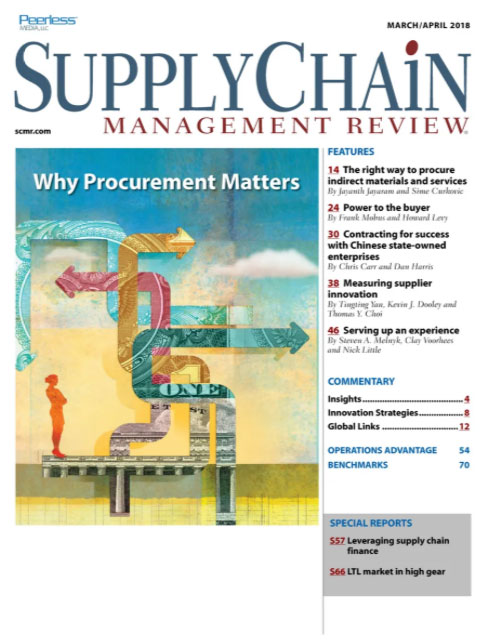
March-April 2018
"Inflation creeps into U.S. Supply Chain.” So said the headline on a Wall Street Journal article I read this morning before writing this column. The Journal went on to write that U.S. companies are grappling with rising material and ingredient costs on top of pressure from higher wages—a potential double whammy— and noted that companies like Whirlpool and Ford have already issued warnings to the market. Browse this issue archive.Need Help? Contact customer service 1-508-503-1313 More options
In a business climate where optimizing cash flow, lengthening payment terms and preserving financial assets have become strategic imperatives for most companies, supply chain, or supplier, finance is gaining in popularity across the global supply chain. Through a “reverse factoring” process, this financing option finds suppliers “selling” their invoices to a bank or other entity at a discount, and then paying those invoices later while suppliers get paid earlier.
Rather than relying on the individual supplier’s credit, the middleman (usually a bank) deals directly with the buyer. A large, global manufacturer, for example, can use supply chain finance to pay its suppliers later, thus boosting its own working capital while holding onto its cash for a longer period of time.
In a best-case scenario, both supplier and buyer improve their own working capital while the middleman receives a fee for its services. And because the risk is transferred to one buyer (versus a group of buyers, as in the case of factoring), it tends to be a less expensive and less risky proposition. Through it all, the end game is to give suppliers access to beneficial financing options as a result of the buyer’s good credit rating.

This complete article is available to subscribers only.
Log in now for full access or start your PLUS+ subscription for instant access.
SC
MR
Sorry, but your login has failed. Please recheck your login information and resubmit. If your subscription has expired, renew here.
March-April 2018
"Inflation creeps into U.S. Supply Chain.” So said the headline on a Wall Street Journal article I read this morning before writing this column. The Journal went on to write that U.S. companies are grappling… Browse this issue archive. Access your online digital edition. Download a PDF file of the March-April 2018 issue.In a business climate where optimizing cash flow, lengthening payment terms and preserving financial assets have become strategic imperatives for most companies, supply chain, or supplier, finance is gaining in popularity across the global supply chain. Through a “reverse factoring” process, this financing option finds suppliers “selling” their invoices to a bank or other entity at a discount, and then paying those invoices later while suppliers get paid earlier.
Rather than relying on the individual supplier's credit, the middleman (usually a bank) deals directly with the buyer. A large, global manufacturer, for example, can use supply chain finance to pay its suppliers later, thus boosting its own working capital while holding onto its cash for a longer period of time.
In a best-case scenario, both supplier and buyer improve their own working capital while the middleman receives a fee for its services. And because the risk is transferred to one buyer (versus a group of buyers, as in the case of factoring), it tends to be a less expensive and less risky proposition. Through it all, the end game is to give suppliers access to beneficial financing options as a result of the buyer's good credit rating.
SC
MR


More Finance
- NextGen Supply Chain Conference unveils agenda focused on AI, execution and the future of leadership
- Wayfair executive to share lessons from building a tech-driven delivery network in NextGen Keynote
- Finance as a transformation catalyst: A How-To guide for supply chain finance leaders
- AI won’t fix a broken supply chain foundation
- Eli Lilly’s Mar Gimeno to keynote at NextGen Supply Chain Conference 2026
- NextGen extends 2026 award, speaker submission deadlines amid strong industry interest
- More Finance
Latest Resources
 Explore
Business Management News
- Why companies blame the wrong supplier … and miss the real failure
- NextGen Supply Chain Conference unveils agenda focused on AI, execution and the future of leadership
- Supply chain resilience isn’t a data problem; it’s a judgment problem
- Beyond the hype: Building flexible and scalable supply chains in a VUCA world
- Why your supply chain risk management plan will fail
- What options do you really have? Shaping the supply chain resilience funnel
- More Business Management
Latest Business Management Resources
About the Author
Bridget McCrea, Contributing Editor

Bridget McCrea is a Contributing Editor for Logistics Management based in Clearwater, Fla. She has covered the transportation and supply chain space since 1996 and has covered all aspects of the industry for Logistics Management and Supply Chain Management Review. She can be reached at [email protected], or on Twitter @BridgetMcCrea
Follow SCMR on social media.
@SupplyChainManagementReview on Facebook
@SCMR on Twitter
SCMR on Linkedin
Subscribe

Supply Chain Management Review delivers the best industry content.

Editors’ Picks



