
Sorry, but your login has failed. Please recheck your login information and resubmit. If your subscription has expired, renew here.
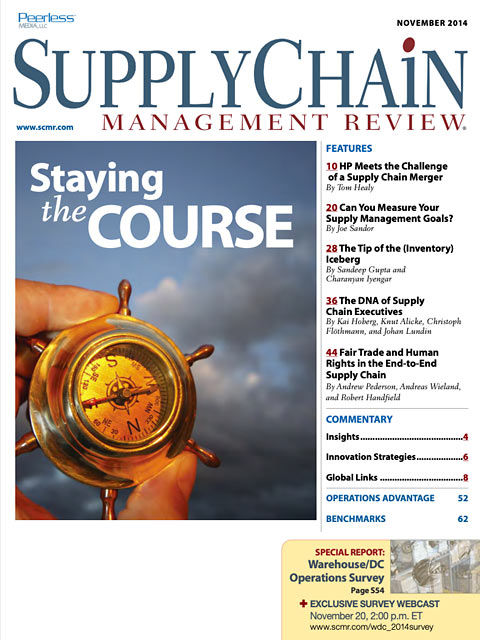
November 2014
Supply chain managers are on the lookout for metrics that will allow them to put a number to their progress - or lack thereof. Welcome to KPI's that allow them to demonstrate the quantifiable value that they deliver. At the same time, Murphy's Law may intervene or they may be called upon to put out fires or come to the rescue and make good on the promises sales and marketing have made to customers - regardless of the cost. So, how do you measure success? I hope this month's issue and online bonus feature help you consider how you measure your progress. Browse this issue archive.Need Help? Contact customer service 1-508-503-1313 More options
I have been researching, speaking, and writing about Sales and Operations Planning (S&OP) for over 15 years and in that time I have seen the industry increasingly embrace the process. I have also noted an unsettling trend: The process has been subjected to too much hype and now appears to be positioned as too complicated, unwieldy, and costly to implement. Often times consultants and technology providers push too much technology and overly complicated processes. While indeed an important process, S&OP is simple.
The process merely involves conducting a set of periodic cross-functional meetings to develop consensus-based, aligned (i.e., matched) tactical supply and demand plans. Getting a working process started is tantamount to successful implementation, as this provides a firm foundation upon which to build the use of sophisticated methods often needing more technology—such as advanced planning and scheduling, the use of Big Data (e.g., upstream/downstream signals), and risk management techniques.
Ten “Foundational” Success Factors
Exhibit 1 depicts a list of 10 “foundational” S&OP process success factors. The factors deal with meetings and the support needed to conduct them. None deal with technology per se because technology enables businesses processes—and as a process—S&OP may not need much as long as it ultimately leads to consensus, accountability, and commitment to supply-demand plans. The factors are described below.
 |
This complete article is available to subscribers
only. Click on Log In Now at the top of this article for full access. Or, Start your PLUS+ subscription for instant access. |
SC
MR
Sorry, but your login has failed. Please recheck your login information and resubmit. If your subscription has expired, renew here.
November 2014
Supply chain managers are on the lookout for metrics that will allow them to put a number to their progress - or lack thereof. Welcome to KPI's that allow them to demonstrate the quantifiable value that they… Browse this issue archive. Access your online digital edition. Download a PDF file of the November 2014 issue. |
Download Article PDF |
I have been researching, speaking, and writing about Sales and Operations Planning (S&OP) for over 15 years and in that time I have seen the industry increasingly embrace the process. I have also noted an unsettling trend: The process has been subjected to too much hype and now appears to be positioned as too complicated, unwieldy, and costly to implement. Often times consultants and technology providers push too much technology and overly complicated processes. While indeed an important process, S&OP is simple.
The process merely involves conducting a set of periodic cross-functional meetings to develop consensus-based, aligned (i.e., matched) tactical supply and demand plans. Getting a working process started is tantamount to successful implementation, as this provides a firm foundation upon which to build the use of sophisticated methods often needing more technology—such as advanced planning and scheduling, the use of Big Data (e.g., upstream/downstream signals), and risk management techniques.
Ten “Foundational” Success Factors
Exhibit 1 depicts a list of 10 “foundational” S&OP process success factors. The factors deal with meetings and the support needed to conduct them. None deal with technology per se because technology enables businesses processes—and as a process—S&OP may not need much as long as it ultimately leads to consensus, accountability, and commitment to supply-demand plans. The factors are described below.
|
SUBSCRIBERS: Click here to download PDF of the full article. |
SC
MR

Latest Supply Chain News
- From salon to dock door: Repurposing scheduling software for inbound flow
- The biggest barrier to AI in supply chains isn’t technology
- Rebuilding a planning function around the physical world
- Why companies blame the wrong supplier … and miss the real failure
- NextGen Supply Chain Conference unveils agenda focused on AI, execution and the future of leadership
- More News
Latest Podcast
 Explore
Latest Supply Chain News
- Why companies blame the wrong supplier … and miss the real failure
- NextGen Supply Chain Conference unveils agenda focused on AI, execution and the future of leadership
- From fragmented negotiations to coordinated negotiation performance: an AI-enabled approach
- Supply chain resilience isn’t a data problem; it’s a judgment problem
- Beyond the hype: Building flexible and scalable supply chains in a VUCA world
- Why your supply chain risk management plan will fail
- More latest news
Latest Resources
Subscribe

Supply Chain Management Review delivers the best industry content.

Editors’ Picks



