
Sorry, but your login has failed. Please recheck your login information and resubmit. If your subscription has expired, renew here.
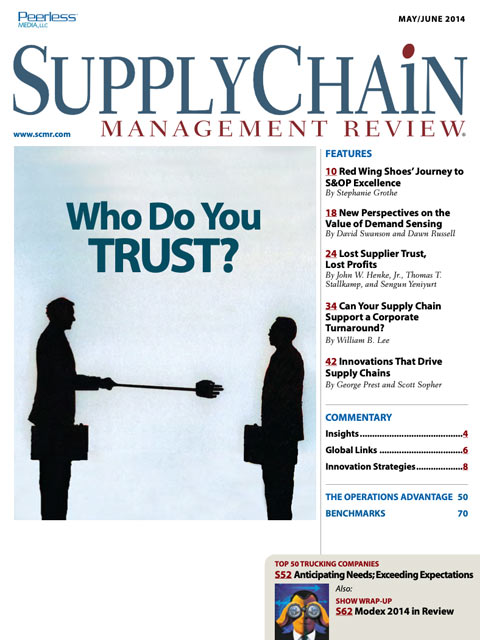
May-June 2014
Getting the most from Sales and Operations Planning is a combination of people, processes, and technology. The Red Wing Shoe Company details the steps it took to improve S&OP processes, slash its S&OP planning efforts by 50 percent, and align manufacturing with sales—all while growing its business. Browse this issue archive.Need Help? Contact customer service 1-508-503-1313 More options
Who owns your Sales and Operations Planning process? Is it the supply chain? Is it sales and marketing? Is it manufacturing? Is it your executive team?
In 2008, those were questions that we struggled to answer at the Red Wing Shoe Company as we started our journey towards S&OP success. After speaking to consultants and to other companies like ours at conferences, we knew we were certainly not alone. Gartner, for instance, has reported that about 70 percent of global organizations are only in Stage 1 or Stage 2 of the four stage S&OP Maturity Model. Most organizations acknowledge the need for a step-change improvement to their S&OP process.
At the start of our journey, the S&OP process took six weeks to prepare. It was reactive, manual, and primarily a backward looking
exercise; much of our planning was based on historical data that we updated by backing out our most recent sales figures from the total projection for the year. The remainder at the bottom of the column became the figure we expected to sell for the rest of the year. There was little collaboration with our suppliers or manufacturing team to understand their capacities and constraints compared to our forecasts. We relied on voluminous and complex spreadsheets and updating them was a manual, labor-intensive process that was prone to error. More importantly, nobody in the organization really owned the process or the results.
 |
This complete article is available to subscribers
only. Click on Log In Now at the top of this article for full access. Or, Start your PLUS+ subscription for instant access. |
Not ready to subscribe, but need this article?
Buy the complete article now. Only $20.00. Instant PDF Download.
Access the complete issue of Supply Chain Management Review magazine featuring
this article including every word, chart and table exactly as it appeared in the magazine.
SC
MR
Sorry, but your login has failed. Please recheck your login information and resubmit. If your subscription has expired, renew here.
May-June 2014
Getting the most from Sales and Operations Planning is a combination of people, processes, and technology. The Red Wing Shoe Company details the steps it took to improve S&OP processes, slash its S&OP planning… Browse this issue archive. Access your online digital edition. Download a PDF file of the May-June 2014 issue.|
|
Download Article PDF |
Who owns your Sales and Operations Planning process? Is it the supply chain? Is it sales and marketing? Is it manufacturing? Is it your executive team?
In 2008, those were questions that we struggled to answer at the Red Wing Shoe Company as we started our journey towards S&OP success. After speaking to consultants and to other companies like ours at conferences, we knew we were certainly not alone. Gartner, for instance, has reported that about 70 percent of global organizations are only in Stage 1 or Stage 2 of the four stage S&OP Maturity Model. Most organizations acknowledge the need for a step-change improvement to their S&OP process.
At the start of our journey, the S&OP process took six weeks to prepare. It was reactive, manual, and primarily a backward looking
exercise; much of our planning was based on historical data that we updated by backing out our most recent sales figures from the total projection for the year. The remainder at the bottom of the column became the figure we expected to sell for the rest of the year. There was little collaboration with our suppliers or manufacturing team to understand their capacities and constraints compared to our forecasts. We relied on voluminous and complex spreadsheets and updating them was a manual, labor-intensive process that was prone to error. More importantly, nobody in the organization really owned the process or the results.
|
|
SUBSCRIBERS: Click here to download PDF of the full article. |
SC
MR

Latest Supply Chain News
- Innovators Netstock, Pickle Robot win NextGen Solution Provider awards
- Bigger trucks versus broken bridges and roads
- From salon to dock door: Repurposing scheduling software for inbound flow
- The biggest barrier to AI in supply chains isn’t technology
- Rebuilding a planning function around the physical world
- More News
Latest Podcast
 Explore
Topics
Latest Supply Chain News
- Innovators Netstock, Pickle Robot win NextGen Solution Provider awards
- Bigger trucks versus broken bridges and roads
- From salon to dock door: Repurposing scheduling software for inbound flow
- The biggest barrier to AI in supply chains isn’t technology
- Rebuilding a planning function around the physical world
- Why companies blame the wrong supplier … and miss the real failure
- More latest news
Latest Resources
Subscribe

Supply Chain Management Review delivers the best industry content.

Editors’ Picks



