
Sorry, but your login has failed. Please recheck your login information and resubmit. If your subscription has expired, renew here.
March-April 2026
The March/April 2026 issue of Supply Chain Management Review examines how supply chain leaders are managing supplier risk, circular supply chain design, AI-driven retail planning, CPG network optimization, and shifting LTL market dynamics to improve resilience and performance. Features include frameworks to prevent supplier failure, operationalize circular economy strategies, prevent retail stockouts using AI, and eliminate costly DC transfer patterns, plus insights from the 34th Annual Study of Logistics and Transportation Trends and a digital-exclusive on the evolving CSCO role. Browse this issue archive.Need Help? Contact customer service 1-508-503-1313 More options
Once confined to logistics and cost control, the chief supply chain officer (CSCO) now often operates as the enterprise’s strategic integrator—linking operations, finance, technology, and marketing around shared purpose and synchronized execution. In today’s volatile global environment, the CSCO’s nexus role has become a central organizing principle of resilient, growth-oriented leadership. This article introduces the concept of Nexus Leadership, showing how supply chain maturity and behavioral agility together empower CSCOs to orchestrate enterprise performance across the C-suite.
In the post-pandemic decade, global enterprises operate in an era defined by pervasive volatility. Supply disruptions, geopolitical realignments, AI-driven automation, and corporate responsibility imperatives have collapsed the traditional boundaries between functions. Strategy is no longer formulated in the boardroom and executed on the factory floor—it now unfolds dynamically across an interdependent ecosystem of data, capital, and customers.
Leadership coherence has become as critical as innovation.
SC
MR
Sorry, but your login has failed. Please recheck your login information and resubmit. If your subscription has expired, renew here.
March-April 2026
The March/April 2026 issue of Supply Chain Management Review examines how supply chain leaders are managing supplier risk, circular supply chain design, AI-driven retail planning, CPG network optimization, and… Browse this issue archive. Access your online digital edition. Download a PDF file of the March-April 2026 issue.Once confined to logistics and cost control, the chief supply chain officer (CSCO) now often operates as the enterprise’s strategic integrator—linking operations, finance, technology, and marketing around shared purpose and synchronized execution. In today’s volatile global environment, the CSCO’s nexus role has become a central organizing principle of resilient, growth-oriented leadership. This article introduces the concept of Nexus Leadership, showing how supply chain maturity and behavioral agility together empower CSCOs to orchestrate enterprise performance across the C-suite.
In the post-pandemic decade, global enterprises operate in an era defined by pervasive volatility. Supply disruptions, geopolitical realignments, AI-driven automation, and corporate responsibility imperatives have collapsed the traditional boundaries between functions. Strategy is no longer formulated in the boardroom and executed on the factory floor—it now unfolds dynamically across an interdependent ecosystem of data, capital, and customers.
Leadership coherence has become as critical as innovation. The competitive frontier is not just speed or efficiency, but the ability to synchronize operations, finance, technology, and marketing around a shared purpose. This is where the chief supply chain officer emerges as the pivotal integrator—the executive who translates complexity into coordination and turbulence into trust.
The transition from operations to orchestration marks a profound redefinition of leadership. What began as a focus on cost and logistics has evolved into a cross-functional command center that connects sensing, strategy, and execution across the C-suite. The CSCO’s evolving mandate now defines how enterprises achieve resilience and growth in equal measure.
1. The CSCO as the enterprise integrator
Supply chains have moved decisively from the backroom to the boardroom. In a world defined by geopolitical fragmentation, digital acceleration, and volatile trade flows, cross-functional synchronization has become the new frontier of competitive advantage. The ability to align multiple functions around a unified operating rhythm now determines whether a company can respond to disruption with coherence or collapse into incoherence. Yet many organizations still operate within legacy silos—where financial prudence, customer insight, and technological innovation remain disconnected. This structural fragmentation weakens enterprise agility and exposes the limits of traditional management models.
Amid these pressures, the CSCO has emerged as the enterprise’s logical integrator. The CSCO sits at the intersection of capital, operational capability, and customer value delivery—translating market signals into actionable strategy and synchronized execution. Unlike the historical view of supply chain leaders as efficiency managers, today’s CSCO operates as a systems architect who connects sensing, analysis, and delivery into one intelligent flow.
In doing so, the CSCO bridges the gap between strategic vision and operational reality, transforming uncertainty into opportunity and friction into synergy. As classic resilience models emphasize risk mitigation rather than orchestration (Chopra & Sodhi, 2014; Sheffi, 2020), today’s enterprises must integrate financial discipline, digital intelligence, and market insight into a unified strategic rhythm.
This integrative leadership is not confined to operations. The CSCO’s reach extends across the entire C-suite: aligning financial discipline with adaptive execution through the CFO, linking digital infrastructure and visibility with the CTO, and harmonizing customer promise and value delivery with the CMO. Each function brings vital strengths, but it is the CSCO that ensures they operate in concert. The modern supply chain thus becomes the central nervous system of the enterprise—where data, decisions, and actions move fluidly through an orchestrated ecosystem rather than a rigid hierarchy.
In essence, the CSCO embodies a new kind of executive intelligence—one that combines enterprise visibility, analytics, and operational agility. By synthesizing information across the enterprise and beyond, the CSCO fosters shared understanding, trust, and decisive action among peers. This integrator role defines the next phase of leadership maturity: from functional command to cross-functional orchestration. As turbulence becomes the norm, the organizations that thrive will be those whose CSCOs can transform the supply chain from a cost center into a strategic conductor of enterprise resilience and growth.
2. Strategic contexts shaping the CSCO’s nexus role
For decades, the CSCO was perceived mainly as a functional executor—tasked with cost efficiency, delivery reliability, and operational control. That paradigm no longer fits. Today’s volatile global environment demands a new kind of leadership: a nexus role that connects operations, finance, marketing, and technology into a unified system of decision and execution. Operational excellence remains necessary but no longer sufficient. Sustainable success now depends on the CSCO’s ability to orchestrate strategic alignment, analytic insight, and enterprise-wide responsiveness across the C-suite.
Recent research highlights how digital transformation and ESG governance must converge to sustain long-term value creation (Alkaraan et al., 2025; Mendonça et al., 2025). This reinforces the idea that the CSCO’s nexus role extends beyond operational control toward embedding sustainability, transparency, and technological intelligence as interconnected leadership imperatives. The shift arises from a convergence of powerful external forces that have redrawn the boundaries of management. These patterns of global realignment reflect broader industrial dynamics in which structural capability and policy coordination determine long-term competitiveness (Hong, Park, Hwang, & Sepehr, 2024)
Global trade fragmentation, persistent market shocks, accelerating digital complexity, heightened ESG scrutiny, and rapidly evolving customer behavior all intersect to challenge traditional hierarchies. Each of these forces demands synchronization across multiple domains—financial risk, digital infrastructure, and customer experience. The CSCO, uniquely situated at the crossroads of supply visibility, capital flow, and fulfillment capability, has become the natural integrator who ensures coherence amid turbulence.
Table 1 summarizes five contextual forces reshaping enterprise leadership. Each factor demonstrates that the CSCO is ideally positioned to enable the integration of financial stability, market responsiveness, and technological enablement into one synchronized system. This nexus role transforms external turbulence into coordinated agility, ensuring that strategic coherence becomes a lasting source of competitive advantage.
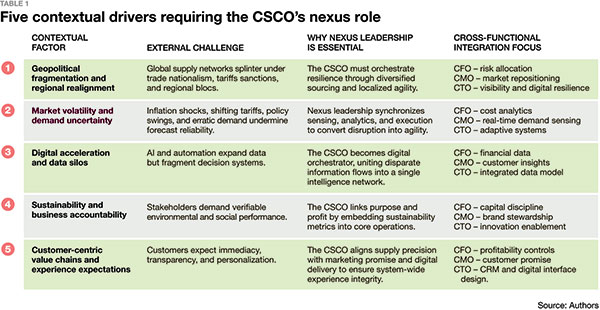
Taken together, these forces—geopolitical disruptions, volatile markets, digital fragmentation, ESG imperatives, and escalating customer expectations—underscore why the CSCO has become indispensable to enterprise leadership. Organizations that continue to view the CSCO as a cost controller rather than a strategic orchestrator risk losing not only efficiency but strategic coherence itself—the ability to adapt, compete, and grow in a turbulent global landscape.
3. Nexus leadership: Balancing agility and discipline
Today’s organizations must be strategically ambidextrous—flexible enough to adapt, yet grounded enough to stay coherent. Nexus leadership depends on blending two complementary capabilities: dynamic agility and structural discipline. Dynamic agility refers to the Sensing–Searching–Synergizing (SSS) behaviors that allow leaders to detect shifts, explore adaptive pathways, and align cross-functional responses in real time. Structural discipline, represented by the Strategic Structural Core (SSC), embeds process, governance, and scalable execution across the enterprise. Agility without structure leads to chaos, while structure without agility results in rigidity. The CSCO’s art lies in synchronizing both, transforming organizational maturity into mastery and reaction into orchestration. This duality echoes a recurring theme in supply chain leadership—balancing exploration and control to achieve both resilience and performance—a topic long recognized in practitioner and scholarly dialogues (Sheffi, 2020; Chopra & Sodhi, 2014)
This nexus role becomes visible in how CSCOs collaborate across domains. With the CFO, they strengthen financial resilience by linking supply chain metrics to working-capital efficiency and enterprise value creation. Unilever’s finance supply chain councils, for example, convert forecast accuracy into cash-flow improvement. With the CMO, they uphold the customer promise by aligning promotions, inventory, and fulfillment so that marketing commitments remain operationally feasible; one leading consumer-electronics company achieved over 90% service levels during seasonal peaks through such synchronized planning. And with the CTO, CSCOs drive digital enablement by co-leading analytics, AI, and digital twin initiatives that turn data into foresight—exemplified by Siemens’ digital thread, which connects design, procurement, and production in near-real time. Together, these collaborations reveal the CSCO as the orchestrator of enterprise rhythm, ensuring that agility and structure move in harmony.
These partnerships define what we call the Triad of Strategic Synergy—finance, market, and technology—anchored by the CSCO’s nexus role, an active orchestrator rather than a symbolic participant. Serving as the connective core of the modern C-suite, the CSCO links these functions through continuous feedback and decision flow.
Figure 1 visualizes this integrative perspective. It depicts the model of CSCO Nexus Leadership, connecting the dynamic agility of the SSS framework. The SSS framework represents how leaders detect shifts, explore adaptive pathways, and align cross-functional action. At the intersection stands the CSCO as the collaboration nexus, translating dynamic sensing into structural execution—transforming maturity into resilience and synergy across the C-suite. The bidirectional arrows emphasize constant exchange—turning functional alignment into strategic integration and enterprise agility. This visualization highlights how the CSCO’s leadership extends beyond coordination to continuous orchestration of insight, strategy, and performance across the organization.
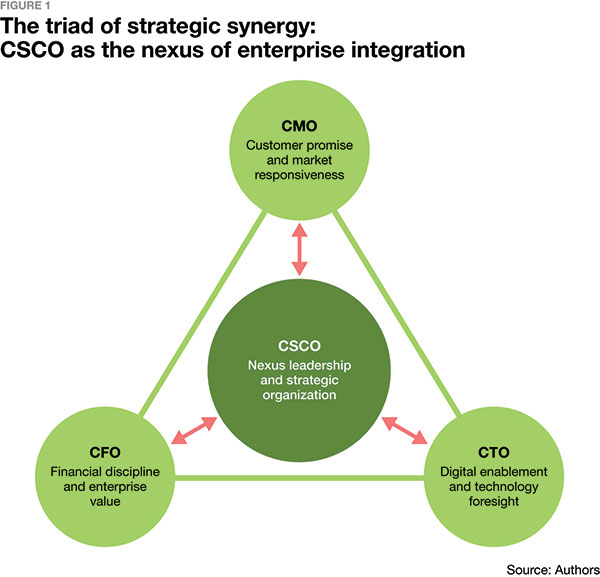
The outer triangle among the CFO, CMO, and CTO represents routine collaboration that keeps core functions aligned in daily operations. In contrast, the central connections radiating from the CSCO signify dynamic leadership—energizing and synchronizing the triad to sustain agility, resilience, and innovation. Positioned as the organization’s fulcrum, the CSCO harmonizes customer direction (CMO), technological enablement (CTO), and financial discipline (CFO). This geometry captures the essence of the CSCO as the enterprise integrator who translates strategy into coordinated performance.
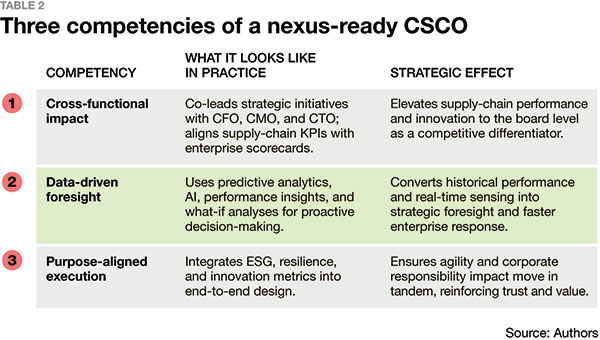
Three diagnostic competencies reveal when a CSCO has fully evolved from operator to orchestrator. Cross-functional credibility emerges when the CSCO co-chairs strategic sessions with finance, marketing, and technology leaders. Data-driven foresight is shown through predictive analytics and scenario modeling that shape corporate strategy rather than merely support operations. Finally, purpose-aligned execution incorporates ESG and innovation goals into supply chain design, aligning performance with principles. When these competencies converge, the CSCO becomes the central integrator of value, speed, and trust across the organization.
As shown in Table 2, three defining competencies—cross-functional credibility, data-driven foresight, and purpose-aligned execution—characterize a “nexus-ready” CSCO. Such a leader is no longer a cost controller but a strategic orchestrator. This evolution marks a profound shift in leadership logic: the CSCO is no longer silo-focused on logistics coordination or cost optimization but represents the organization’s integrative intelligence. Acting as both translator and orchestrator, the CSCO converts uncertainty into coordinated action, aligning sensing, decision, and execution into a cohesive system. The true leadership value lies in harmonizing strategic intent with operational reality, transforming the supply chain into the connective tissue of enterprise agility and coherence.
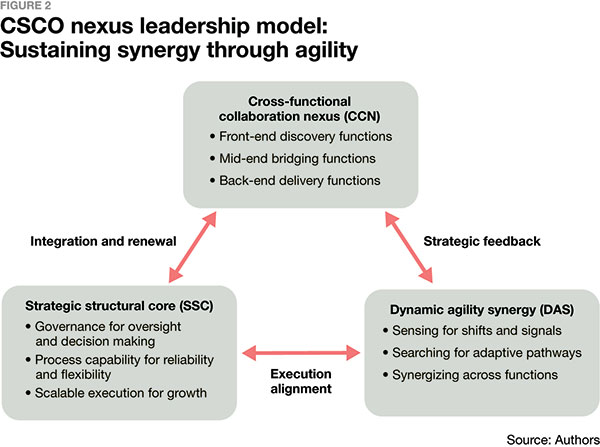
While the Triad of Strategic Synergy illustrates how the CSCO connects core enterprise functions around a shared purpose, Figure 2 expands this idea into a full enterprise system of leadership flow. The CSCO Nexus Leadership Model shows how synergy is sustained through continuous feedback among Dynamic Agility Synergy (DAS) through Sensing–Searching–Synergizing and the enterprise’s structural core via the Cross-functional Collaboration Nexus (CCN). Rather than emphasizing process maturity, this model underscores leadership rhythm—the ongoing cycle of feedback, alignment, and renewal that transforms cross-functional collaboration into enduring organizational agility. It reveals how the CSCO orchestrates strategic alignment across three reinforcing loops: strategic feedback, execution alignment, and integration & renewal. At the center of this system lies the CCN, where sensing and learning become coordinated action across finance, technology, and market-facing teams. The Strategic Structural Core (SSC) ensures that this agility remains grounded in governance discipline, process capability, and scalable execution, enabling the CSCO to translate speed into sustained enterprise stability.
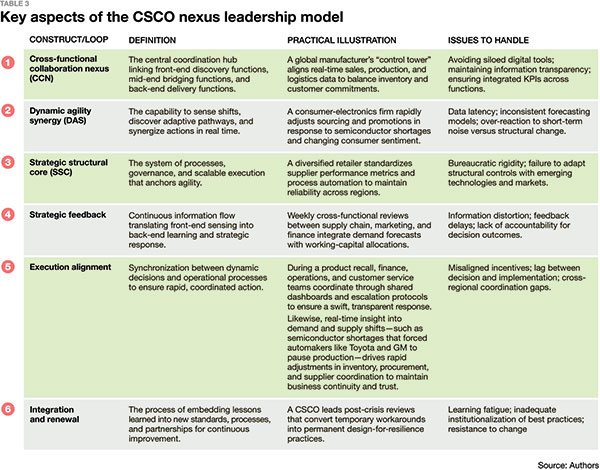
Table 2 defines the CSCO Nexus Leadership Model for practitioners. Each aspect—such as Cross-functional Collaboration Nexus, Dynamic Agility Synergy, and Strategic Feedback—shows how the CSCO converts strategy into coordinated execution. The table provides plain-language meanings, real-world illustrations, and the key issues leaders must manage to sustain performance. Together, these aspects depict how sensing, decision, and delivery are continuously linked through feedback, alignment, and renewal. Rather than a static framework, the model functions as a living system for cross-functional orchestration and enterprise learning.
Understanding these leadership aspects establishes the groundwork for identifying the personal capabilities that make them work. The next section, “The Nexus Leader,” examines the evolving skillset of high-impact CSCOs—those who combine strategic vision with operational empathy through storytelling, cross-functional fluency, and digital-ecosystem awareness. These competencies turn the CSCO from a process manager into a true system integrator, capable of aligning insight, technology, and enterprise purpose.
The frameworks presented so far establish the systemic foundation of Nexus Leadership, yet structure alone does not produce orchestration. Effective integration depends on the leader’s human capability to sustain rhythm, interpretation, and trust across functions. The ability to convert insight into influence—and frameworks into collaboration—rests on the CSCO’s personal competencies. These capabilities translate the architecture of Nexus Leadership into daily executive behavior, ensuring that sensing, alignment, and renewal occur not only through systems but through the leader’s mindset and interpersonal fluency.
4. The Nexus Leader
The most effective CSCOs are redefining executive leadership through a blend of strategic vision and operational empathy. They act not as process overseers but as system integrators—linking operations, finance, marketing, and technology into one synchronized enterprise rhythm. Three emerging competencies distinguish these nexus leaders from traditional operators.
Cross-functional fluency allows the CSCO to “speak” operations, finance, marketing, and technology simultaneously, translating metrics into meaning and strategy into alignment. Digital-ecosystem awareness equips leaders to navigate AI, cloud, and data-trust architectures, connecting operational performance with innovation velocity. Strategic storytelling enables the CSCO to frame supply chain initiatives as enterprise narratives that inspire action at the board level. Microsoft’s CSCO, for instance, positioned sustainability dashboards as part of a corporate story of responsible growth—elevating operational transparency into shareholder value.
When the CSCO consistently demonstrates these competencies, collaboration turns into measurable performance. Organizations with CSCOs that effectively demonstrate nexus leadership experience faster decision cycles, higher trust among functions, and sustained value creation. These outcomes confirm when the CSCO’s role extends beyond efficiency—and ultimately achieves enterprise coherence and competitiveness.
5. Conclusion
The transformation of the chief supply chain officer from operator to orchestrator represents one of the most profound shifts in modern enterprise leadership. As volatility, digital acceleration, and stakeholder expectations converge, the CSCO’s nexus role has become the foundation of organizational coherence—defining how strategy is translated into execution, how collaboration becomes capability, and how resilience becomes renewal. This article reframes supply chain management as the strategic language of integration, showing that the CSCO is not merely reacting to disruption but shaping the enterprise’s adaptive rhythm through agility, structure, and shared purpose. Organizations that recognize and empower this role will not only withstand turbulence but transform it into insight and momentum. Ultimately, the message is clear: the future of enterprise leadership will move at the speed of its supply chain—and the CSCO stands at its very center, turning orchestration into advantage.
References
Fawcett SE, Stevens M, Fawcett AM, Knemeyer AM, Brockhaus S. (2020). Are we there yet? Supply chain managers trying to get a seat at the C table ask: What do we need to know to increase supply chain influence? Supply Chain Management Review. 2020;24(7):10-17
Fuchs, J., Sandell, S., & Shanker, V. (2023). It’s time to define your company’s principles. Harvard Business Review, 101(6), 122–131.
Hong, P. C., Park, Y. S., Hwang, D. W., & Sepehr, M. J. (2024). A growth theory perspective on the competitive landscape of shipbuilding: A comparative study of Japan, Korea, and China. Maritime Economics & Logistics, 26(3), 462–489.
Mendonça, J. A., Seelent, J. F. C., Steiner, A. A., & Benitez, G. B. (2025). The dark side of digital transformation on supply chain’s ESG practices. Supply Chain Management: An International Journal.
Nikookar, E., Stevenson, M., & Varsei, M. (2024). Building an antifragile supply chain: A capability blueprint for resilience and post-disruption growth. Journal of Supply Chain Management, 60(1), 13-31.
Reinhart, D., Hong, P., Miller, S (2025). Strategic Synergy to Bridge the C-suite Divide. ISM World. pp. 32-37.
Sheffi, Y. (2020). The new (ab) normal: Reshaping business and supply chain strategy beyond Covid-19. Mit Ctl Media.
About the authors
Paul Hong, Ph.D., CMA, Distinguished University Professor and chair of Information Systems & Supply Chain Management, University of Toledo.
Doug Reinart is chief product officer, GoDigital Media Group, Los Angeles.
Steve Miller is chief procurement officer, Integrity LLC, Dallas–Fort Worth.
SC
MR


More Supply Chain Orchestration
 Explore
Topics
Business Management News
- Why companies blame the wrong supplier … and miss the real failure
- NextGen Supply Chain Conference unveils agenda focused on AI, execution and the future of leadership
- Supply chain resilience isn’t a data problem; it’s a judgment problem
- Beyond the hype: Building flexible and scalable supply chains in a VUCA world
- Why your supply chain risk management plan will fail
- What options do you really have? Shaping the supply chain resilience funnel
- More Business Management
Latest Business Management Resources
Subscribe

Supply Chain Management Review delivers the best industry content.

Editors’ Picks



