
Sorry, but your login has failed. Please recheck your login information and resubmit. If your subscription has expired, renew here.
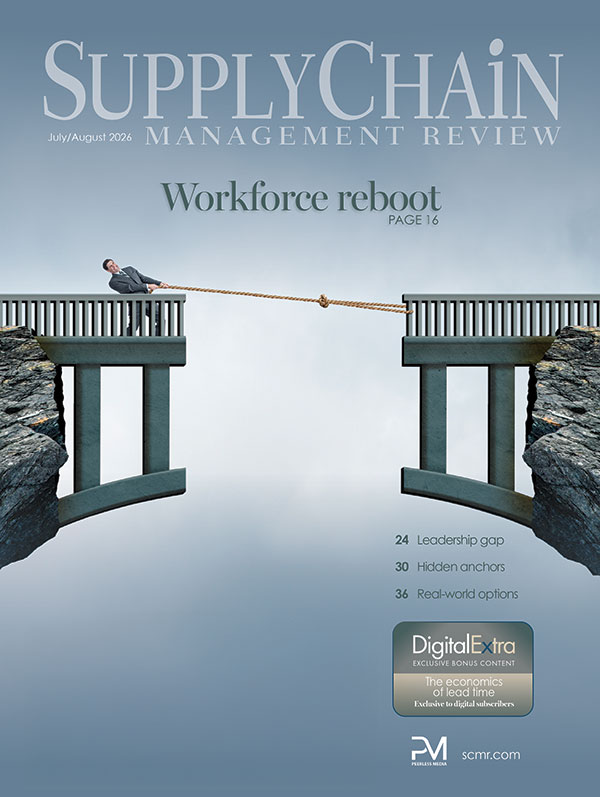
July-August 2026
The July issue of Supply Chain Management Review explores how organizations are preparing for the future through workforce development, AI adoption, leadership education, and supply chain resilience. Features examine closing the skills gap, building AI-enabled teams, strengthening supplier networks, and developing practical strategies for navigating disruption in an increasingly complex global marketplace. Browse this issue archive.Need Help? Contact customer service 1-508-503-1313 More options
Supply chain professionals carry a lot on their shoulders, and the job keeps getting bigger. For years, the focus was mostly on functional expertise: procurement, logistics, inventory, transportation, planning, and day-to-day management. All of that still counts, but it’s no longer the whole job by any stretch. The global pandemic changed the rules when it pushed supply chains into a spotlight so bright that the average consumer now understands their inner workings and what happens when they get disrupted.
SC
MR
Sorry, but your login has failed. Please recheck your login information and resubmit. If your subscription has expired, renew here.
Supply chain professionals carry a lot on their shoulders, and the job keeps getting bigger. For years, the focus was mostly on functional expertise: procurement, logistics, inventory, transportation, planning, and day-to-day management. All of that still counts, but it’s no longer the whole job by any stretch. The global pandemic changed the rules when it pushed supply chains into a spotlight so bright that the average consumer now understands their inner workings and what happens when they get disrupted.
But that was just the beginning. Artificial intelligence, machine learning, automation, data analytics, geopolitical risk, cybersecurity, labor challenges, and shifting customer expectations have also raised the bar. Suddenly, supply chain professionals had to be part data scientist, part statistician and part business strategist, all while maintaining a big-picture view of their global or domestic networks.
It’s a big ask, and one that executive education providers are well aware of and working to address. “The profession has really evolved,” says Abe Eshkenazi, CEO at ASCM. “Historically, the focus was on the fundamentals: planning, sourcing, manufacturing and execution. Today, risk, AI, analytics and geopolitical uncertainty are all core to the supply chain profession.”
Those requirements looked a lot different just five to 10 years ago. And while supply chain professionals still need the fundamentals, they now also have to think strategically, collaborate across the business, and make decisions that can affect customers, costs, service levels, and daily operations. “We need to prepare them not only to execute,” Eshkenazi says, “but also to lead.”
Still satisfied, still learning
Supply chain professionals may be carrying a heavier load, but most of them still enjoy the work they’re doing. According to Peerless Research Group’s 2026 Salary and Compensation Study, 76% of logistics and supply chain professionals say the number of functions they perform has increased over the last two to three years. Even with that added responsibility, 93% are either very satisfied or somewhat satisfied with their careers.
As the ground continues to shift under them, these individuals are using certifications, job-related training, conferences, seminars and workshops to sharpen existing skills and learn new ones. For example, the survey found that 31% of respondents had completed a professional certification; 70% cited job-related training, and 47% pointed to industry conferences, seminars, or workshops.
That continuing education pays off in more ways than one. In its most recent Supply Chain Salary and Career Report, ASCM says supply chain professionals with at least one credential earn a median salary 8% higher than those without certifications. That figure rises to 14% for those with two or more credentials. The organization also says APICS certifications contribute to a 20% median salary increase compared to professionals who don’t hold
those designations.
Eshkenazi says those salary gains usually come when the learning translates into measurable contributions. “Certification on its own can be a great door opener, but it’s the contribution you make to the organization that enables your career,” he says. “You don’t get
the salary lift because you get the certification. You get it because you increase profitability, improve execution, and contribute to the organization’s results.”
On becoming financial analysts
Certification providers are updating their programs around the skills companies say they need now. For example, the Institute for Supply Management (ISM) is in the middle of a full refresh of its CPSM certification, according to Jim Fleming, manager, product development and innovation. He says digital transformation and risk management remain high on the list, but another area is also getting more attention: financial analysis.
So just when you thought supply chain managers couldn’t possibly fit another hat on their heads, they’re also being asked to better understand how their decisions affect organizational financial statements. “You can look at profit and loss statements and balance sheets,” Fleming says, “and then use the data that goes into these financial reports to understand just how effective your supply chain is.”
That’s a shift from the days when supply chain teams focused mainly on cost reduction. Today, CEOs and CFOs expect them to show how their decisions affect the business, from return on investment and working capital to inventory turns and quarterly results. “We’re seeing a lot of the executives coming in and saying, ‘We need our employees to learn more in these areas,’” Fleming says, “and we need them to be able to look beyond just cost savings.”
As he surveys the executive education and certification environment, Fleming says two other themes keep coming up: digital transformation and risk management. AI gets a lot of the attention right now, but it’s only one part of a larger technology shift that’s changing how supply chain professionals work, he explains. Risk management also remains a constant concern.
“Risk management continues to be front and center because every time you turn around, the news is blaming supply chain for whatever the problem is,” Fleming says. “It seems like every day there’s a new risk to address.”
The biggest bang for your buck
Continuing education works best when it fits the need. An individual may want to fill a specific knowledge gap, prepare for the next role or build deeper expertise in a certain supply chain function. A company may need something broader, especially if it wants to raise the skill level of an entire team or give employees a common base of knowledge.
Either way, the ROI question should focus on what people need to know now, how they can prepare for what’s coming next and which program gets them there without wasting time or money in the process. Mark Baxa, president and CEO at CSCMP, says the answer depends on what the learner or company wants to get out of the experience. Some people want to better understand the role they’re already in. Others want to prepare for the next one, become the person in the room who can solve bigger problems or build more expertise across the full supply chain.
Companies usually approach the question from a wider angle. For instance, they may want to build a stronger base of knowledge across the broader team, not just send one person through a lengthy certification program.
Instead of guessing at where to start, Baxa says both individuals and companies can use assessments to identify knowledge gaps across the supply chain. “You don’t have to just say, ‘Well maybe I’ll just start with planning’ or ‘I’ll start with procurement,’” he says. “Instead, a quick assessment will point you in the direction of where you need to go.”
That direction can help students understand their jobs and the functions that feed into them. Someone may have the core skills for their current role, for example, but still need a better understanding of what happens upstream or downstream in planning, procurement, logistics, or another area of the supply chain.
Baxa also sees companies putting more emphasis on shorter courses that can reach more people faster. Longer certification programs still have their place, he notes, but some organizations want to raise the overall skill level of a team by function. “When you look at improving the overall competency of an organization,” he says, “more of them are investing in the shorter courses that give more instantaneous results and upskill their broader workforces.”
Where to start
Supply chain professionals exploring certification and other programs should start with where they want to go next. A specialized program can make sense for someone who wants deeper expertise in contracts, planning, procurement or another specific area. Professionals who want to move into bigger roles should ask whether the program helps them understand more of the total supply chain and how it affects the business.
“If your career aspiration is to grow and take on more, then you really do have to make a choice around how much of the total supply chain am I learning about,” Fleming says.
Time also matters, especially for professionals who are already carrying full workloads. Fleming says ISM has been building more digital options that let people study at their own pace, in bite-sized chunks or with instructor support. From an ROI standpoint, he adds, “the best program will always be the one that teaches the right skills in a format the learner can actually finish and apply.”
Eshkenazi concurs and says individuals and companies alike should look for programs that address modern supply chain challenges, reflect current practices, carry global recognition, and teach students how to apply what they learn. That last point matters, especially for professionals who expect education to translate into higher pay. “You don’t get that bump because you get the certification,” he says. “You get it because you increase profitability, improve execution and contribute to the organization’s results. That’s what we’re really trying to impress.”
SC
MR


More Supply Chain Education
What's Related in Supply Chain Education
 Explore
Topics
Business Management News
- Innovators Netstock, Pickle Robot win NextGen Solution Provider awards
- Bigger trucks versus broken bridges and roads
- From salon to dock door: Repurposing scheduling software for inbound flow
- The biggest barrier to AI in supply chains isn’t technology
- Rebuilding a planning function around the physical world
- Why companies blame the wrong supplier … and miss the real failure
- More Business Management
Latest Business Management Resources
About the Author
Bridget McCrea, Contributing Editor

Bridget McCrea is a Contributing Editor for Logistics Management based in Clearwater, Fla. She has covered the transportation and supply chain space since 1996 and has covered all aspects of the industry for Logistics Management and Supply Chain Management Review. She can be reached at [email protected], or on Twitter @BridgetMcCrea
Follow SCMR on social media.
@SupplyChainManagementReview on Facebook
@SCMR on Twitter
SCMR on Linkedin
Subscribe

Supply Chain Management Review delivers the best industry content.

Editors’ Picks



