
By Alex Carroll and Troy Egar
Editor’s Note: The SCM capstone Drop Trailer Forecasting in Volatile Networks was authored by Alex Carroll and Troy Egar. The project was supervised by Dr. Elenna Dugundji ([email protected]) and Dr. Thomas Koch ([email protected]). For more information, contact the thesis supervisors.
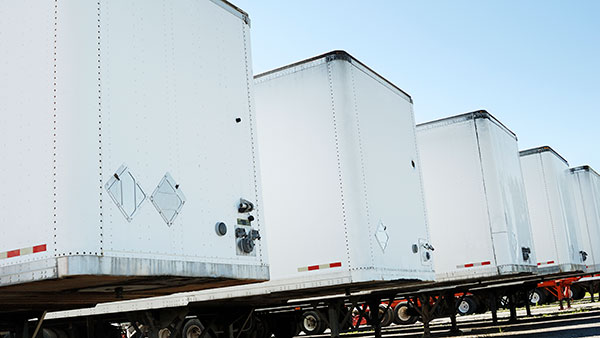
This paper examines the critical role of demand forecasting in optimizing drop trailer management within volatile networks, focusing specifically on a large pallet manufacturer's supply chain. Drop trailer programs, a key element of transportation for retailers, manufacturers, and their carrier partners, involve a carrier arriving at a shipper’s location with an empty trailer, which is then loaded with goods for transport. These programs have become integral for ensuring the timely and efficient movement of goods in complex networks. The research emphasizes the importance of accurate forecasting to inform subsequent optimization models, particularly in a supply chain that faces significant challenges related to unpredictability and complexity.
The primary goal of the study is to improve the efficiency of the sponsor company’s supply chain by predicting future trailer requirements with greater accuracy. Such predictions are essential for developing effective inventory control and optimization models that can manage trailer assets more efficiently. This research highlights the difficulties of traditional forecasting methods, which often fail to account for the dynamic nature of complex supply chain environments like the one faced by the sponsor company. In response, the study introduces advanced forecasting techniques, such as Gradient Boosted Trees (GBT), which offer improved performance compared to conventional approaches, particularly in adapting to fluctuating demand patterns.
The demand forecast generated through these techniques is a vital input for developing optimization models. These models aim to ensure that trailers are allocated and managed effectively, ultimately leading to reduced costs and better service levels within the supply chain. By leveraging machine learning techniques, the study demonstrates how advanced forecasting methods can address the challenges of demand volatility, improve resource allocation, and enhance overall supply chain performance. Moreover, the incorporation of these techniques enables more precise and timely responses to demand fluctuations, ensuring that trailer management is always aligned with operational needs.
Furthermore, the research underscores the growing importance of sophisticated forecasting tools in modern supply chain management. It provides valuable insights into how these techniques can be applied in real-world settings, offering a pathway to more robust optimization models for drop trailer management. The use of machine learning in this context not only improves the accuracy of demand forecasts but also equips companies with better tools for managing their trailer assets under unpredictable conditions. These advancements are particularly critical in industries where demand is volatile and where efficient use of assets is crucial for maintaining competitive advantage, especially in a fast-moving marketplace.
The paper also contributes to the broader field of supply chain management by showcasing how modern forecasting techniques can be applied to specific operational challenges, like drop trailer management. By improving the accuracy of demand predictions, companies can better align their resources with actual needs, minimizing inefficiencies such as underutilized trailers or shortages that impact service levels. The findings suggest that using machine learning for demand forecasting can significantly enhance decision-making and lead to more responsive, cost-effective supply chains. This research demonstrates the potential for companies to unlock new efficiencies and improve decision-making frameworks, enhancing their ability to navigate supply chain complexities.
In conclusion, this study highlights the importance of accurate demand forecasting in optimizing drop trailer management within volatile supply chain networks. Through the use of advanced forecasting methods like Gradient Boosted Trees, companies can improve resource allocation, reduce costs, and enhance service levels. As supply chain networks continue to become more complex and dynamic, the application of machine learning and other sophisticated techniques will be increasingly crucial for maintaining operational efficiency and competitiveness.
Every year, approximately 80 students in the MIT Center for Transportation & Logistics’s (MIT CTL) Master of Supply Chain Management (SCM) program complete approximately 45 one-year capstone projects.
These students are early-career business professionals from multiple countries, with two to 10 years of experience in the industry. Most of the research projects are chosen, sponsored by, and carried out in collaboration with multinational corporations. Joint teams that include MIT SCM students and MIT CTL faculty work on real-world problems. In this series, they summarize a selection of the latest SCM research.
SC
MR

More Fleet Management
What's Related in Fleet Management

 Explore
Topics
Business Management News
- Why companies blame the wrong supplier … and miss the real failure
- NextGen Supply Chain Conference unveils agenda focused on AI, execution and the future of leadership
- Supply chain resilience isn’t a data problem; it’s a judgment problem
- Beyond the hype: Building flexible and scalable supply chains in a VUCA world
- Why your supply chain risk management plan will fail
- What options do you really have? Shaping the supply chain resilience funnel
- More Business Management
Latest Business Management Resources
About the Author
Massachusetts Institute of Technology

Launched in 1973, the MIT Center for Transportation & Logistics is a dynamic solutions-oriented environment where students, faculty, and industry leaders pool their knowledge and experience to advance supply chain education and research. Through the Global Supply Chain and Logistics Excellence (SCALE) Network, it possess an international network of six centers of excellence, more than 80 researchers and faculty members from multiple disciplines, over 150 corporate partnerships, more than 170 students annually, and approximately 1,000 alumni worldwide. It creates supply chain innovation and drives it into practice through the pillars of research, outreach and education.
Follow SCMR on social media.
@SupplyChainManagementReview on Facebook
@SCMR on Twitter
SCMR on Linkedin
Subscribe

Supply Chain Management Review delivers the best industry content.

Editors’ Picks



